Light Fountain
By
SRI SWAMI CHIDANANDA
A DIVINE LIFE SOCIETY PUBLICATION
Fifth Edition: 1991
(3,000 copies)
World Wide Web (WWW) Edition : 1999
WWW site: https://www.dlshq.org/
This WWW reprint is for free distribution
© The Divine Life Trust Society
ISBN 81-7052-080-0
Published By
THE DIVINE LIFE SOCIETY
P.O. Shivanandanagar–249 192
Distt. Tehri-Garhwal, Uttar Pradesh,
Himalayas, India.
CONTENTS
- Publishers’ Note
- Preface
- The Author
- Introduction
- Days Of The Acorn
- The Apostle Of Prayer
- Being And Doing
- Secret Of The Intense Activity
- Lessons On Life
- Real Renunciation: The Fiery Flame
- The Rugged Path
- The Problem Of The Aspirants In Society
- Ever-Alert Vigilance And Vichara
- Precept And Practical Living
- Asceticism And Common-Sense
- What The World Finds
- The World As He Beholds It
- His Destined Role
- “The Only Worship I Know”
- The Medium Of Today
- Echo From The West
- Ecce Homo!
- This I Bequeath
- Pointers On The Pathway
- Light-Fountain
- Epilogue
PUBLISHERS’ NOTE
In this little volume an attempt has been made to present to the public an impartial study of Swamiji’s personality from a consideration of some of the salient incidents of his interesting life–past and present as well. Unlike the two or three books of a biographical nature issued on earlier occasions, the present work mainly aims at bringing out the philosophy underlying and the practical lessons embodied in many of his ordinary activities. Therefore it is in the nature of a development of and a finishing touch to the previous works, rather than a mere narration of his career. Written somewhat in an analytical vein, very many helpful and guiding hints have been brought out: they are certain to be of immense practical value to every class of reader. Herein lies its distinctive worth. It also brings to light some beautiful traits of Sri Swamiji, known little hitherto, as a many-sided model of the Ideal Man.
—THE DIVINE LIFE SOCIETY.
PREFACE
Blessings come slowly but when do they come they shower upon you in plenty. They have done so in my case. On top of all, I have had the crowning good fortune of being chosen by Him to engage in a work that is certain to prove of service to not a few. Considering it a rare privilege to write about one who is a leading light both to India and to the world of today, I am launching forth this work with pleasure. The purpose of the book, the introduction makes amply clear. Even if a fraction of it is fulfilled, I shall be thrice blessed indeed.
SWAMI CHIDANANDA.
THE AUTHOR
Sridhar Rao, as Swami Chidananda was known before taking Sannyasa, was born to Srinivasa Rao and Sarojini on 24th September, 1916, the second of five children and the eldest son. Srinivasa Rao was a prosperous Zamindar owning several villages, extensive lands and palatial buildings in South India. Sarojini was an ideal Indian mother, noted for her saintliness.
At the age of eight his life was influenced by one Anantayya, a friend of his grandfather, who used to relate to him stories from the epics, Ramayana and Mahabharata. Doing Tapas, becoming a Rishi, and having a vision of the Lord became ideals which he cherished.
His uncle, Krishna Rao, shielded him against the evil influences of the materialistic world around him and sowed in him the seeds of the Nivritti life which he joyously nurtured until, as later events proved, it blossomed into sainthood.
His elementary education began at Mangalore. In 1932 he joined the Muthiah Chetty School in Madras where he distinguished himself as a brilliant student. His cheerful personality, exemplary conduct and extraordinary traits earned for him a distinct place in the hearts of all teachers and students with whom he came into contact.
In 1936, he was admitted to Loyola College, whose portals admit only the most brilliant among students. In 1938 he emerged with the degree of Bachelor of Arts. This period of studentship at a predominantly Christian College was significant. The glorious ideal of Lord Jesus, the Apostles and the other Christian saints had found in his heart a synthesis with all that is best and noble in the Hindu culture. To him study of the Bible was no mere routine; it was the living of God; just as living and real as the words of the Vedas, the Upanishads, and the Bhagavad Gita. His innate breadth of vision enabled him to see Jesus in Krishna, not Jesus instead of Krishna. He was as much an adorer of Jesus Christ as he was of Lord Vishnu.
The family was noted for its high code of conduct and this was infused into his life. Charity and service were the glorious ingrained virtues of the members of the family. These virtues found an embodiment in Sridhar Rao. He discovered ways and means of manifesting them. None who sought his help was sent away without it. He gave freely to the needy.
Service to the lepers became his ideal. He would build them huts on the vast lawns of his home and look after them as though they were deities. Later, after he joined the Ashram, this early trait found complete and free expression where even the best among men would seldom venture into this great realm of divine love, based upon the supreme wisdom that All is one. Patients from the neighbourhood, suffering from the worst kinds of diseases came to him. To Chidanandaji the patient was none other than Lord Narayana Himself. He served Him with a tender love and compassion. The very movement of his hand portrayed him as worshipping the living Lord Narayana. Nothing would keep him from bringing comfort to the suffering inmates of the Ashram, no matter the urgency of other engagements at the time.
Service, especially of the sick, often brought out the fact that he had no idea of his own separate existence as an individual. It seemed as if his body clung loosely to a soul which he fully awakened to the realisation that It dwelt in all.
Nor was all this service confined to human beings. Birds and animals claimed his attention as much as, if not more than, human beings. He understood their language of suffering. His service of a sick dog evoked the admiration of Gurudev. He would raise his finger in grim admonition when he saw anyone practising cruelty to dumb animals in his presence.
His deep and abiding interest in the welfare of lepers had earned for him the confidence and admiration of the Government authorities when he was elected to the Leper Welfare Association, constituted by the State–at first Vice-Chairman and later Chairman of the Muni-ki-Reti Notified Area Committee.
Quite early in life, he although born in a wealthy family, shunned the pleasures of the world to devote himself to seclusion and contemplation. In the matter of study it was the spiritual books which appealed to him more than college books. Even while he was at the College, lesson-books had to take second place to spiritual books. The works of Sri Ramakrishna, Swami Vivekananda and Gurudev took precedence over all others. He shared his knowledge with others so much so that he virtually became the Guru of the household and the neighbourhood to whom he would talk of honesty, love, purity, service and devotion to God. He would exhort them to perform Japa of Sri Rama. While still in his twenties he began initiating youngsters into this great Rama Taraka Mantra. He was an ardent admirer of Sri Ramakrishna and Swami Vivekananda. He visited the ‘Math’ at Madras regularly and participated in the service there. Swami Vivekananda’s call for renunciation resounded within his pure heart. He ever thirsted for the Darshan of saints and Sadhus visiting the metropolis.
In June 1936, he disappeared from home and after a vigorous search by his parents, he was found in the secluded Ashram of a holy sage some miles from the sacred mountain shrine of Tirupati. He returned home after some persuasion. This temporary separation was but a preparation for the final parting from the world of attachments to family, friends and possessions. While at home his heart dwelt in the silent forests of spiritual thoughts, beating in tune with the eternal Pranava-Nada of the Jnana Ganga within himself. The seven years at home following his return from Tirupati were marked by seclusion, service, intense study of spiritual literature, self-restraint, control of senses, simplicity in food and dress, abandonment of all comforts and practice of austerities which would augment his inner spiritual power.
The final decision came in 1943. He was already in correspondence with Sri Swami Sivananda of Rishikesh. He obtained Swamiji’s permission to join the Ashram.
On arrival at the Ashram, he naturally took charge of the dispensary. He became the man with the healing hand. The growing reputation of his divine healing hand attracted a rush of patients to the Sivananda Charitable Dispensary.
Very soon after joining the Ashram, he gave ample evidence of the brightness of his intellect. He delivered lectures, wrote articles for the magazines and gave spiritual instructions to the visitors. When the Yoga-Vedanta Forest University (now known as the Yoga-Vedanta Forest Academy) was established in 1948, Gurudev paid him a fitting tribute by appointing him Vice-Chancellor and Professor of Raja Yoga. During the first year he inspired the students with his brilliant exposition of Maharshi Patanjali’s Yoga Sutras.
It was also in the first year of his stay at the Ashram that he wrote his magnum opus–“Light-Fountain”, an immortal biography of Sivananda of which Gurudev once remarked: “Sivananda will pass away, but ‘Light-Fountain’ will live.”
In spite of his multifarious activities and intense Sadhana, he founded under the guidance of Gurudev, the Yoga Museum in 1947, in which the entire philosophy of Vedanta and all the processes of Yoga Sadhana are depicted in the form of pictures and illustrations.
Towards the end of 1948, Gurudev nominated him as General Secretary of the Divine Life Society. The great responsibility of the organisation of the Society then fell on his shoulders. From that moment he spiritualised all its activities by his presence, counsel and wise leadership. He exhorted all to raise their consciousness to the level of the Divine.
On Guru Purnima day, 10th July 1949, he was initiated into the holy order of Sannyasa by His Holiness Swami Sivanandaji Maharaj, as Swami Chidananda, a name which connotes, “One who is in the highest consciousness and bliss.”
Apart from his distinction as an able organiser of Divine Life Society Branches in several parts of India, his contribution to the success of the epochal All-India Tour of Gurudev in 1950 is memorable. Together they attracted to the Divine Life movement great political and social leaders in India, high-ranking Government officials and rulers of Indian States.
In November 1959 Swami Chidananda embarked on an extensive tour of America, being sent by Gurudev as his personal representative to radiate the message of Divine Life in the New World. He was hailed by the Americans as the Yogi of India very well fitted to interpret Indian Yoga to the occidental mind. He also toured several countries in South America and preached in Montevideo and Buenos Aires etc. From America he made a quick tour of Europe, returning to the Ashram in March 1962.
In April 1962 he set out on a pilgrimage to South India where he visited temples and other holy places and delivered soul-stirring lectures. He returned from the South in early July 1963, about ten days before the Mahasamadhi of Sri Gurudev, a fact which he described as nothing short of a miracle.
In August 1963 he was elected as President of the Divine Life Society. After the election, he strove hard to hold aloft the banner of Tyaga (renunciation), Seva (dedicated service), Prem (love of humanity) and Adhyatmikata (Spiritual idealism) not only within the set-up of the widespread Organisation of the Society, but in the hearts of countless seekers throughout the world, who were all too eager to seek his advice, help and guidance. He has endeared himself to one and all by his exemplary life of a towering Sannyasin, a spiritual magnet and working hard in all directions, for a resuscitation of the glorious Ideals of Divine Life in the world. His carefully guarded personality of an intrinsically good and loving nature of spontaneous servicefulness had brought immense solace in the lives of hundreds and thousands. In addition to his regular tours in this country far and near, the Swamiji toured Malaysia and Hong Kong and scattered broadcast the seeds of true culture, spirituality and the spirit of self-effacement in all actions, thus planting the art of divine living in the minds of thousands of people, which has evoked a deep sense of gratefulness to him in all quarters.
INTRODUCTION
I
“Lives of great men all remind us
We can make our lives sublime.”
–Longfellow.
The life and actions of a great man–an illumined soul–are ever a permanent fount of inspiration and refreshment to the struggling wayfarer on the hard and weary road of life. The day-to-day activities and talks of such saints and seers form as it were so many instructive and eminently helpful pages of a guide and ready-reference book to bewildered travellers. When the frail raft of life, adrift on the dark ocean of earthly existence, is heaved about on the surging swell of mighty Maya and is tossed by the violent winds of passions and the pairs, the living records of a great life, nobly and intensely lived, act as the benign beams from a brilliant beacon-light brightening the benighted mariner’s way and bringing strength and solace to the solitary sailor on the stormy seas of Samsar…..The conduct of an ideal life faithfully recorded is therefore of the utmost importance to struggling humanity. It is a valuable asset in its fight against the forces of darkness and evil, and is of inestimable help in the perpetual endeavour to solve the numerous painful problems that perplex it on the path of progress towards perfection. In its power to awaken and inspire, in the practical example that it puts before the aspiring one, in its ability to evoke that which is noble, sublime and divine in man and influence him to emulate such an ideal, in these lie the worth and value of such a narration. Such indeed is the purpose of this chronicle, dear reader, and to that degree of the eagerness and receptivity with which you approach it, will inspiration, guidance and strength be thine.
But is there indeed such a pressing need and demand for light and guidance? Comes the query. Ah! Reader, do but open thy eyes and cast a glance on humanity around thee. Therein lies the answer to the query. Everywhere you see mankind in a feverish quest after happiness, rushing after fleeting phenomena and trying to grasp the transitory trifles that go to make up this sense-world. The being does not know what constitutes real happiness or wherein it lies. Neither is he certain how to set about to acquire it. It is all a feverish groping in the darkness, a groping made even more confusing by a hundred conflicting theories, cults, philosophies and ideals that have obscured the mental horizon of the present-day world. Each asserts its infallibility and warns the already-tormented traveller to beware of the other paths. So everywhere there is the cry for guidance, direction and light. Whither lies the way to joy and what direction to follow is the question on every lip. At this juncture comes to mind the sound counsel of the ancient sage Vyasa on Ekadasi Tattva:
Srutir-vibhinna smritayopi bhinnah
Tatha muneenam matayopi bhinnah
Dharmasya tattvam nihitam guhayam
Mahajano yena gatah sa panthah.
“The Srutis are conflicting, the Smritis too differ. Even so, the opinions of sages too vary. The inner truth of what is Dharma is concealed as it were in a cavern. The path to follow is therefore that path which the saints have traversed, i.e., the way to live is even as the great ones lived their life.”
Sound counsel is this, for confused mankind to abide by. And here mark, with these great ones, to whichever age, clime and clan they belong, the basic qualities of head and heart, the sublime impulses that animated their lives, you will find to be everywhere similar.
And to enable you, dear reader, to get to know how one such ideal life has been and is being lived, how it reacted to certain circumstances, what sublime considerations motivated many of its apparently insignificant actions, what noble impulses lay hid behind certain acts that outwardly seemed sometimes ungenteel, nay even crude, these enlightening fragments are presented here as and when they became known to the humble narrator.
They reveal aspects of a life fully, nobly and energetically lived; a life whose chief joy consists in giving itself away ceaselessly to others, to the world at large, day and night, physically, mentally, intellectually and spiritually in every conceivable form and way it can think about. Not being satisfied with this perpetual self-sacrificing, it ever tries to devise fresher and newer ways and means each day, by which to be of some service to every creature on earth, to reach and relieve even the least one on earth. For herein indeed is the secret of all happiness, all joy, in wearing away oneself in selfless and loving service. Life is for joyous sacrifice, not to rust in repose and lethargy.
And behind this reckless extravagance of life, there is withal a deep and silent undercurrent of ever awake spiritual awareness that continuously feels the presence of a universal power and love and knows that it is that power, that love, which flows into and works through him. This fills his life with a child-like artless humility that cannot be understood easily by an onlooker. A unique spontaneity, a complete absence of all artifice or guile, and a complete disinterestedness, freedom from attachment, all have originated from this inner awareness. Such is the life, the living light from which a humble attempt has been made to absorb a few rays and refract them through the prism of the writer’s plainly unworthy and all too inadequate understanding, so that perchance some one may find his path brightened, and his heart lightened and enabled to march straight and vigorously on the highway of life. To chase out darkness and dispel doubts everyone will find this of greatest positive help.
The personality I have had the great good fortune and privilege to move with is, as it were the flower in full bloom, whose budding and growth can be traced far back to his early years at a time when he toiled as a doctor in a hospital in the F.M.S. Those were the days of silent shaping and growth, when for nearly a decade, he strove intensely for the alleviation of human suffering. The fiery and abundant energy of the choicest years of his youth (a period when most of us would like to enjoy for ourselves the best of life’s gaieties) he ungrudgingly and freely utilised in working for the welfare of his fellow-beings around him. He has always been reluctant to make any mention of his early activities and even now is apt to be reticent in divulging his silent acts of everyday service and love. It was by tactful persuasion and opportune enquiry that we could draw him out of his self-imposed reticence and make him tell us something about his life now and then. Finally it was by touching upon a soft spot in his nature that many factors were brought to light. It happened this way. As seekers on the spiritual path we were now and again faced with various problems that agitated and troubled us greatly. Also a great many aspirants were constantly writing numerous letters to Swamiji putting before him their difficulties and desiring help and guidance. Emboldened by this state of affairs we importuned him greatly to tell us how he dealt with similar conditions when he was striving in his early days, what the secret of his success was, wherein lay the source of that bubbling energy and joy, what now animated him every moment of his life and were manifest in every act of his life which would be of help to us and the world at large, by their inspiring example. We pressed home the point that such information would be of immense help and guidance to one and all by the ideal of conduct thus represented by the principle that motivated them and the moral they revealed. We would be the losers, we told him, if information of such practical utility were withheld out of personal disinclination. For the benefit of others he must speak. We urged. And thus we got him to lift part of the veil that covered the intense activity of his life.
II
The holy sage and saint Sri Swami Sivanandaji of Rishikesh, Himalayas, became widely well-known throughout the modern spiritual world. During the past fifty years of this 20th century, he is regarded as one of the world teachers of our times and a great spiritual Master who brought about spiritual awakening into the hearts of millions of people in numerous countries of the world. He became familiar to countless grateful seekers all over the world as a benign Teacher, a great Sadguru and a gracious and compassionate saint who brought spiritual light and guidance as well as solace, comfort and peace into the hearts of innumerable people in different walks of life. His gracious and radiant personality shining with radiance of Goodness, Selflessness and Universal Love attracted earnest aspirants and devotees from all parts of the modern world even as the full-blown lotus flower attracts bees from all the ten directions to his beautiful spiritual abode on the bank of the sacred river Ganga near holy Rishikesh. His entire life was totally consecrated to a continuous spiritual ministry that kept Him engaged day and night in teaching, instructing, training, inspiring, guiding, encouraging, consoling, helping and transforming seekers, spiritual aspirants, Sadhakas and people of all sorts, men and women, young as well as old including students, teachers, professional people and even politicians. Engaged in this ceaseless spiritual work, Swami Sivanandaji shed His mortal coil on the 14th of July, 1963 and merged in the Divine.
This holy saint of modern India was the Light of the East and a Light for the whole world. His country recognises Him as one among the foremost spiritual leaders born in this land of sages, saints, holy men and monks. His life-long services for the revival of the Vedic Religion and the effective propagation of the spiritual science of Yoga and Vedanta have been unparalleled and outstanding in this present century. His name is known in countless homes and has become a byword for spiritual world and ideal conduct and selfless service. Swami Sivanandaji preached selfless service to mankind, devotion to and worship of God, practice of meditation and attainment of Divine wisdom and liberation through the Realisation of Self. He enjoined upon all the principles of TRUTH, CHASTITY and NON-INJURY. Such a life of Truth, Purity and Love and of Service, Devotion, Meditation and Realisation, Swamiji termed as Divine Life. He broadcast His message of Divine Life through His Institution, the Divine Life Society, which he founded in I936. He came to be hailed as the prophet of Divine Life.
In this little book, “LIGHT-FOUNTAIN”, an attempt is made to take a close look into the daily life of this great spiritual luminary as well as to have a glimpse into the background of His early years in distant Malaysia when as a doctor he strove tirelessly to serve, relieve and treat the suffering and sick in the Far East. This book comprises a study of His noble personality with a humble aim to learn about the secrets of His self-development, inner unfoldment and spiritual perfection through the pattern of Divine living, He adopted for Himself. Thus it would become a source of light to us all who also wish to live an ideal life and tread the path that leads to Divine Perfection. This book was written in the year 1943-44 while the spiritual hero and worshipful subject of this study was gloriously alive and full of vibrant and dynamic spiritual service of one and all. Hence, the difference in the present tense is found throughout the book.
May Gurudev’s Grace be upon all seekers and spiritual aspirants who study this book with faith, devotion and with receptivity and reverence. May all aspirants reach the highest spiritual Realisation and attain Supreme spiritual blessedness and Divine Bliss.
OM NAMO BHAGAVATE SIVANANDAYA.
Swami Chidananda
CHAPTER ONE
Days Of The Acorn
Far back, during those days of medical practice at Malaya, the young Dr. Kuppuswamy was the biblical Samaritan carried to the degree of perfection. He effaced himself. His energy, his talents and his body, he did not consider as belonging to him. He belonged to any creature that was in distress and in need of him. He would not spare himself. It happened once that a humble woman of the low caste–a pariah (untouchable)–was about to be of child. She had none to call her own and to be of help. This young doctor, a Brahmin of a most celebrated family was at once by her side, all tenderness and sympathy, more solicitous than if she were his own sister. He looked to her comforts, eased her as best as he could and, as the necessity arose, kept vigil that night, stretching himself down on the earth and passing the night thus outside the door of her lowly dwelling. Only when the task on hand was concluded did he return home and think of himself. It is this inherent thirst to befriend all, to relieve pain, to lessen sorrow, to console and comfort, that animates his life. A genuine disinterestedness and depth of sympathy form leading traits in this personality. It is this rare virtue that constitutes the central secret of the happiness that fills his life. Man forgets his ‘self’ in an all-absorbing love and sympathy for others!
Readers who are acquainted with the life of that saintly man, Dr. Rangachari of Madras, will recall how this sympathy and love formed the key-note of his beautiful life. More than as a famed surgeon of almost international repute, he is enshrined in the grateful hearts of thousands as the man of compassion, who was ever ready to lovingly minister even unto the most lowly. Instances have been when, forgetting all engagements, he had stopped on the wayside and alighted from his car; to be by the side and attend to some destitute low-caste woman who was in labour. Not infrequently, after treating and tending some penurious patients in his nursing home for several days, he refused the small fee they hesitatingly tried to offer him. Instead, he would force them to accept double the amount from him for their diet, etc., and send them away silencing ail their remonstrances.
Even so, Swamiji, while at Malaya, would keep poor patients in his house, nurse them back to health and send them after giving them some gift out of his own pocket. Without the least aversion he would tenderly support untouchable patients on his lap, clean their beds and even dirt cheerfully, in case they were too weak to move.
But one point we may note here with profit. Though having the softest of hearts, brimming with an almost motherly tenderness, gentle to a degree, yet these essentially feminine traits did not at all make him effeminate and timid or weak-willed. On the other hand, with all the woman’s sympathy, concern, desire to comfort that had in it something of the passionate and inspired urge of a Florence Nightingale, Swamiji was a purposeful and enterprising man. He lived a manly life, very active and vigorous. He was the soul and centre of all popular functions and social gatherings which he animated with his cheerful and ready activity. If there was any trouble at the hospital, any discontentment among the employees–a threat of strike–it was the young doctor who had to be on the spot to set it right at once. Even a perfect stranger to the town happening to come to the young doctor’s notice, immediately had all his problems solved. Whatever he wanted, was arranged by the eager host even before he expressed them, right up to the moment of his departure when the doctor would personally give him a send-off.
He also took a keen interest in sports, followed important tournaments, wrote articles to papers, like the ‘Malay Times’, etc. He was the author of several instructive tracts on medicine, hygiene, etc. He was editing a medical journal too.
If only the youth of today are fired with this genuine zeal to serve and to relieve suffering, sorrow will vanish from their lives and the earth will become a blessed place filled with joy.
Years later, when Swamiji, no longer a fashionable doctor but a monk given to intense asceticism and Sadhana, was in seclusion at Rishikesh, the self-same flame continued to burn steadily within him with the same warmth of compassion and desire to serve, with which his heart was aglow in the earlier days. To him, turning away from worldly pursuits on a higher quest did not mean the suppression of the sublime sentiments and the extinction of the elevating emotions that were his inherent nature. Rather they became the more intensified and refined by the touch of a higher unselfishness and wider consciousness.
We have here an incident that reveals some striking aspects of this strange personality. Even after renunciation he made it a practice to help the pilgrims to Badri with medicines. The road was very bad and the journey difficult and attended with several risks. Therefore he used to distribute packets containing seven or eight medicines to the pilgrims he came into contact with.
It happened on an occasion that a Badri Yatri came to see him one evening. After a short talk when he was taking his departure Swamiji gave him the wonted packet with the directions for using the medicines. The Yatri left for Lakshman Jhula, the next halt. Anyone would have retired and slept restfully that night pleased with his work, for as the good old saying goes, “Something attempted, something done has earned a night’s repose.” Not so Swamiji. After the visitor has left, it occurred to Swamiji that he should have given a certain special medicine that would be particularly helpful to the pilgrim. The thought filled his mind that he had not done the utmost, the best that he could have done. So, very early the next morning, even before dawn, he took the medicine and started at a steady uphill-run to catch up with the traveller. When he reached the next halt, he found that the pilgrim was an even earlier riser and had already proceeded on his way. Nothing daunted, Swamiji at once commenced running higher up to Garud Chutty only to be informed that his quarry had passed higher up. Undismayed, the pursuer pressed on to Phul Chutty and not finding him even there ran further up, caught up with, the pilgrim near the 5th mile and there gave him the precious medicine. By this time it was past nine o’clock and the monk had to race back to his Kutir to be in time for the daily alms at the Annakshetra.
Let us pause and reflect for a moment what this one incident reveals to us. We see that it was all done silently and unostentatiously, none else being the wiser for it save the two concerned. All for the sake of a person whom Swamiji had never seen before nor perhaps afterwards. He would not be satisfied by doing a little but must give his very best. The urge in him has always been to do the maximum good. A task undertaken must be pursued to its logical conclusion and done perfectly. Such was the genuine aspiration in him to serve, that to the winds went all considerations of personal comfort and even daily spiritual routine. Overcoming physical laziness (the greatest bar and pitfall to the selfless worker) to have run nearly 6 miles distance, gives an idea of the absolute, almost breath-taking sincerity and wholeheartedness that burns throughout the whole act. Ordinarily, a person after going up a little distance and failing to catch up with the pilgrim would have returned succumbing to a sense of moral satisfaction of having done his duty. The whole incident bespeaks the high mettle that made up his personality.
At another time, an old lady rashly undertook the difficult ascent to the shrine Nilakanth Mahadev, about 7 miles from Swargashram. The strain proved too much for her and on her return both her legs got swollen. Without hesitation Swamiji went to her aid and set about shampooing her legs until relief was obtained.
On several occasions, he gave up even his Sadhana and Tapas to be by the side of a sick man until the latter was nursed back to health. When a junior monk, the Swami Atmananda, lay dangerously ill at Rishikesh, Swamiji left Swargashram at once and came over to Rishikesh (where he put up for nearly three weeks) and nursed him successfully through a critical period.
The grateful monk recently wrote, “He whom I have the honour to call Gurudev, stayed during my severe sickness, in some neighbouring Dharmashala at Rishikesh for about twenty days to personally attend to me. He saved me when my life was in danger during that illness.” A European Sadhu, a disciple of Shree Meher Baba, used to tell Swamiji that whenever the latter approached his sick-bed he felt healing vibrations and obtained relief at once. Indeed, genuine and disinterested love cannot but make itself felt as a positive force emanating from the fortunate possessor. A similar love it was that irresistibly drew the hearts of those that approached the Lord Jesus Christ and the Lord Buddha and in our own times, the patriot saint Gandhiji–the Mahatmaji of the adoring masses.
The modern boy-scout is urged to do at least one good turn every day. Swamiji’s persistent insistence to everyone he meets, is to fill the entire day from dawn to dusk with good turns. At all places, in every situation, throughout the waking hours, ‘service’ is to be the motto.
A robust positivism characterises Swamiji’s attitude towards this factor of being useful and doing good. “Ever be on the lookout for an opportunity to serve. Never let by even a stray chance of being of some service. You must be like a watch-dog, alert and keen to grasp at once any possibility that presents itself, of being useful. Sharply watch and see what help you can do to those about you”. Thus run some of his favourite admonitions to eager workers. Nay, he went a step further. You must create opportunities to do something for others. Do not keep quiet waiting for a chance but create means of making yourself useful and helpful, whichever way you are particularly suited by temperament, talents and natural disposition.
No one is to neglect his or her natural talent. If a person is endowed with fine physique and is of an energetic disposition, let him learn some Asanas and exercises and spread physical culture among students and youths. Let him do active and intense social service. A doctor should treat the poor gratis. He must treat his patients with gentleness and kindliness. Let him also be scrupulously honest in all his dealings with his patients. A lawyer should refuse to argue false cases and avoid taking recourse to untruth on any account. This will constitute the greatest service to the cause of ‘justice’ in his capacity as lawyer. In the educational field let the teacher or professor throw himself heart and soul in elevating and moulding the character of the students entrusted to his care. A trader, by being honest in all his transactions, renders his service to society. Even a menial servant should faithfully do his routine duties, looking upon his master with loyalty and reverence. Thus, to suit every case, each in his particular sphere could live up to this ideal of being helpful and serviceable.
As with Browning, Swamiji too firmly believes that “All service ranks the same with God.” There is no act of service ever so trifling that one would be justified in passing it by. For it is not what we do that matters, but with what attitude it is done that counts. Let every act be a beautiful blossom reverentially laid at the feet of the Divine, manifest as Humanity, i.e., Virat. And I have found that with Swamiji this ‘worship by service’ is not so much poetry but it is the very fact of his being.
Coming across old Sadhus, long-standing residents of Rishikesh and its environs, I would sometimes obtain glimpses of Swamiji’s Swargashram days in the course of my talks with them. From what I could gather in this way, I saw that Swamiji’s method of service had one valuable feature which is worth noting and emulating. That is the quality of motivelessness and absence of ostentation. They would relate how Swamiji would wait for the time when they were away from their cell, either at toilet or bath, then enter it, sweep and clean the floor, wash the pot and refill it with fresh water and come away silently. At other times, if a recluse happened to be ailing, Swamiji would himself go to the Kshetra and get Bhiksha on behalf of the sick person and procuring a little extra milk would place it in his room and come away.
This silent and humble service was not that of a devout youngster to his elders (for one must remember that at the time Swamiji was nearing his fortieth year–a time when a person usually becomes invested with a sense of dignity and subtle egotism peculiar to middle age). This was possible because Swamiji has, throughout his life, unconsciously retained the essential simplicity of the child.
When a certain monk belonging to the well-known Ramakrishna Order, Swami Tanmayananda by name, was once laid up with a severe attack of pox, Swamiji attended upon him for two or three weeks incessantly doing all the work of nursing, feeding, cleaning and fetching pots full of water from the river. Years later when recently I chanced upon the monk Sri Tanmayananda, now grown old and infirm, he feelingly related to me this incident and said, “He saved me from certain death that time. None could have possibly served me in such a way as he did. If you see him please take a note from me.” And I wrote on a piece of soiled paper his message of informal greetings to Swamiji, familiar in the way of long-standing friends and gratefully reminiscent of the old days.
The test of genuineness of the selfless server is the whole-heartedness of the urge in him. He must have no vestige of any sort of mental reservation in his action. Else it will at once be felt by sensitive natures and they will shrink from accepting the proffered hand. There was at that time (about 1926) a young anchorite practising austerities at Swargashram. He belonged to a very highly-placed family of the Southern Provinces, almost a prince in a small way. So complete was his renunciation, so severe the standard of self-denial, that he had set up for himself and so extremely sensitive his disposition that he not only never accepted any sort of gift from any one but also scrupulously avoided even borrowing anything. He persistently declined Swamiji’s offers of little things of simple everyday necessity and would not allow of his attempts at small services even. But gradually the absolute selflessness and the genuineness of the desire to help, of Swamiji so overcame him that, he ended by accepting whatever Swamiji brought to him. The onslaught of this disinterested love made Bhaskarananda (for that was the name of the youthful ascetic) relax the stern austerity for which his name had become a byword amongst the hermit community of the place.
But not unfrequently the situation was of a different kind. Hearing of his efficiency as a man of medicine and his loving nature numerous people would invade his cell for help and treatment at all odd hours of the day. So much so, that at times he felt forced to flee the locality and hide himself either among the huge rocks by the waters’ edge or in some dilapidated Kutir further inside the jungle. Thus he would snatch a quiet hour or two for deep meditation.
At times urgent summons would come from some distressed person; then leaving aside everything Swamiji would run (at times even at midnight) to relieve him. Once an amusing incident occurred which proved a trial to his patience. A fastidious Sadhu at midnight invaded his Kutir, even climbing the protective fencing surrounding it, to hammer on the door insistently. It was to remove some grit that had entered his eye. Though sorely tried, Swamiji maintained his equanimity, carefully attended to his night-raider and sent him back satisfied. Calls to treat scorpion-bite would come at all unexpected moments because the creatures abound in the locality even to this day. Not once did he allow his temper to be ruffled even under the most annoying circumstances. Such then is to be the true spirit of the selfless server. Let him aim to be cheerful and keep alive a genuine enthusiasm, not allowing disgust to creep in even unnoticed–an ideal to be kept in mind, be it by the student, the boy-scout, an occasional volunteer or the member of some service league, in private or public capacity.
Once or twice these interesting remarks have escaped him… “On rare occasions you must even be aggressive in your service. Sometimes helpless persons in need of aid will foolishly refuse aid. In such cases do them the required service in spite of their hesitation.” He would laughingly cite two occasions when he employed such aggressive methods, once forcibly carrying about the monk Jnanananda in the hospital at Lucknow where he was undergoing treatment; unable to walk the daily round from the ward to the dressing-room and back again, the monk was at the same time unwilling to ride on Swamiji’s obliging shoulders. But the latter took the matter into his own hands and carried the protesting but grateful monk on his back daily.
The second incident was how he turned a deaf ear to the remonstrations of the venerable lady, the pious and devoted Rani of Singhai and himself lifted her up from the ferry-boat on to the steamer as they were proceeding in a party on pilgrimage to Ganga-sagar. The water was rough and the boat heaving alarmingly, and the frightened ‘dear old lady’ (she was about seventy then) was in a quandary. She was at the same time full with the instinctive feminine reluctance to accept Swamiji’s aid. But the latter did not waste time to argue. In a trice the protesting Rani found herself gently and reverentially lifted up and safely deposited on board the steamer, good-naturedly riled by her own daughters laughing merrily at Swamiji’s effective tactics. “But”, (I remember his adding quietly) “at all times be uniformly decent, delicate and courteous. Always have consideration for others’ feelings. Never be rough in the name of ‘service’.”
CHAPTER TWO
The Apostle Of Prayer
To such of us that are so placed in life as to be denied the opportunity and scope for doing actual active service most of the time, there is another, a little known aspect of Swamiji’s life, which has a wealth of significance and inspiration. That is his practice of a continuous, silent prayer, the hidden habit of ‘constantly willing good’ to all. Those who are unable to engage in sustained service let them pray for everyone, at all times, everywhere and on all occasions. Let them commence to earnestly wish the happiness and good of all creatures. To fill the heart with sincere motiveless love for all will, by itself, mysteriously help those in need of aid and relief. This will itself constitute a sublime service. Service is ‘Love’ in expression and the cherishing of such a broad love in oneself, coupled with a strong positive desire for Universal weal, becomes an effective and higher sort of service. By generating a current of helpful and healing vibration, it will contribute to common welfare in a subtle but none-the-less powerful way.
Swamiji puts this into practice everyday, even now. I have observed that there is no exception to the prayer that he says. If he sees a sick person he at once breathes a prayer to him. Happening to read the obituary report of some person he will at once pray for his peace. For the war to end soon as also for the relief of the starving multitudes in Bengal, he regularly offers daily prayers. Seeing a lame dog, a prayer will rise up in his heart. Perhaps an ant is accidentally trodden underfoot in his presence, at that very moment a feeling heart would melt in hidden prayer all unnoticed by those about him. Even hearing from another that someone else is ill makes Swamiji pray for the stranger’s recovery and health. Perhaps some little disagreement resulted in a momentary angry word or two between a couple of his own students; then too Swamiji’s only reaction would be to silently forego his next meal and pray for the erring worker. Thus firmly has this habit of prayer become grounded in his nature that it has come to be an inseparable part of Swamiji’s very existence.
There is something so peculiarly and essentially Christian about this trait in him that the ordinary non-Christian will fail to understand him. One may find it somewhat difficult to appreciate the significance of this habit which savours so much of the Occident. The devout Christian on the other hand will find it to be quite in sympathy with his firm beliefs. Swamiji himself is very emphatic in his convictions about the efficacy of prayer that is really earnest and genuine. He once said in reply to a query, “Yes. Prayer has tremendous influence. It can work anything provided you are sincere. It is at once heard and responded to. Do it in the daily struggle of life and realise for yourself its high efficacy. Pray in any way you like. Become as simple as a child. Have no cunningness or crookedness. Then you will get everything.”
That he has proved this to himself in his very life, I have no doubt. I had the fortunate privilege to freely go through the voluminous mail that he daily receives, practically from throughout the length and breadth of the land. Without the least exaggeration I can state that people keep writing to him from the whole of India. I found that everyday there are numerous letters begging Swamiji to pray for some person or other. Sometimes it is a prayer for recovery from illness. At another it is for the long life of a new-born or the prosperity and happiness of a newly-wed couple. One will write for prayer to succeed in some critical endeavour. Then grateful acknowledgements of the mysterious efficacy of Swamiji’s prayers come as unsought-for testimonials. Call this a result of subjective faith, law of psycho-therapeutics or what you will. The bare truth is that it is a matter of fact. Quite recently the mail brought with it three urgent telegrams on three consecutive days, all requesting for the prayers of Swamiji on behalf of a chronic sufferer, one Gopal M. from distant Feroke in Malabar. This and numerous similar instances make one pause before venturing to entertain any doubt or scepticism as to whether Swamiji’s firm opinion on the subject of prayer is based upon personal experiment and experience or not. The intellectual and the rationalist is bound to smile indulgently at this somewhat eccentric anachronism of such a kind of perpetual piecemeal praying, for anything and everything, in an enlightened age as this. But one would do well to ask himself how it is that Sri Gandhiji, universally acknowledged as one of the greatest thinkers of our times, happens at the same time to be a staunch and confirmed votary and a most ardent advocate of prayer? Were the practice of prayer an obsolete antiquity, then Gandhiji’s critical intellect (whose pre-eminence none questions) would have ere now rejected it unhesitatingly. Those who regard prayer as something queer and puerile are those who have never bestowed a thought as to what prayer is and how it works. Prayer for others is, in a way, the intense willing of good. Now this constant habit of unselfishly desiring good to all evokes a stream of pure ‘love’ in the praying heart. Pure unselfish ‘love’ is in essence really God Himself. Love is the very essence of divinity. Thus in prayer a wave of divinity is set up in the etheric field in which the Universe has its being. And wherever there is need of it, this wave reaches and acts with its benign force. When one reminds oneself that right at this very moment some insignificant individual (let us call X) sitting at a table in a dingy office in one corner of the world, is able by jabbing away at a knob with a staccato rattle, to register a message and set things moving thousands of miles away in some other corner, then it becomes easy to accept that there can be a positive efficacy and power in prayer. The mental and supra-mental powers in man are rapidly being recognised as most potent factors in the shaping of human affairs.
Swamiji is so filled with this conviction that any observer, who is curious enough to note, will find that he has tagged up prayer as an invariable item in every sort of occasion and function imaginable. I could see that whatever is done, either by himself or by others under his guidance, always started with and ended with a prayer. If a room was being constructed then the workers were made to gather round a tiny lamp, sing the Lord’s Name, chant a prayer and then commence the work. A consignment of marble image arrives and immediately a prayer is arranged. Should a dinner be given to a party of Sadhus, then too, a prayer is an invariable item of the function. While packets and leaflets are done up or magazines wrapped for mailing, Swamiji would tell the workers “Pray and praise the Lord while your hands are doing the work. Do not carry on loose talk.” And at the Ashram itself, he and his little band of workers, assemble in the prayer hall on the hillside and there the Lord’s Name is chanted in unison and then a prayer for Universal Peace is solemnly uttered in the stillness of twilight.
CHAPTER THREE
Being And Doing
To the casual observer, however, externally there is very little in Swamiji’s day-to-day activities to suggest a man of prayer. Indeed the exact opposite impression. If ever a person is thoroughly removed from the dreamy mystic type, it is Swamiji. For I have seldom witnessed a busier or a more intensely active life. For an ascetic, who had shut himself up in seclusion for more than half a decade and has stuck to the selfsame spot for well nigh a quarter of a century, he is of an incredibly dynamic type. I have to admit that, when I was new to him, until I got accustomed to his surprisingly ceaseless activity, I was for sometime left helpless and gaping. Recently they celebrated his 57th birthday (and six months have already passed) and yet to this day, try as I may, I cannot get over the feeling that he is not one hour older than sixteen. And rest assured, I am not a bit sentimental about this, but from what I see with mine own eyes, I am literally forced to accept this paradoxical fact. There is about him an air of such juvenile vivacity that completely belies his years. Oftentimes it happens that some idea suddenly strikes him or some new scheme unexpectedly appeals to him. It sets him at once all abubbling with an exquisite boyish enthusiasm. His cheeks are set aglow with a childlike excitement and expectancy and the lively sparkle in the clear eyes reflects the keen zest with which he applies himself to anything that once catches his fertile imagination. With him there are no half measures; there is nothing of indecision, much less of hesitation. He is as thorough in his actions as he is earnest and deep in his inward life of prayer and almost constant holy recollection.
From the solemnity and silence of his room by the waters’ edge, a room sounding only with the whispers and murmurs of the sacred river softly flowing past in all her majestic serenity, he will step out in the morning at about ten. The moment he steps out of his room, he is a different man altogether. He becomes a veritable live-wire. With a brisk gait, he will walk up to the Society premises and his appearance is at once a signal to set the little community of his student-workers hum with activity. It is impossible to be dull or slovenly in his presence. His dealing with certain aspirants who used to go about their work in a dreamy and abstract fashion, was rather amusing. One such aspirant had acquired a sort of deceptive indolence imagining it to be a way of expressing inner spiritual tranquillity. It happened that Swamiji was conversing with some visitors on the broad verandah skirting the hall of common worship on the hillside. The youth in question came ambling up the pathway in leisurely stateliness which immediately caught Swamiji’s eye. “Come on here, young man” he called out, and then, “What is the matter with all of you? Are you being underfed? Is there nothing in the kitchen? Or is it that you don’t get time to eat? Your hair is not grey yet. Why then this deportment of a half-starved being? Where is your energy, your youth? Why can’t you step about with a bound and a jump? Let me see you sprint. Now take a run round the hall. Come on.”
A sheepish expression that the youth assumed so tickled Swamiji that he suddenly turned round to me and said with a serious nod, “Look here, I want to send this X (naming the youth) to a military camp. It is only a military training which will infuse pep into these entranced hermits. I think man is born lazy. It seems that a life of renunciation is synonymous with physical quiescence and inactivity. Where they obtain such ideas the Lord alone knows. You have to learn lessons from the busy man of the city and the young medical students. How agile, efficient and full of enthusiasm is the young medico! How briskly from block to block, from ward to ward, along verandahs and through corridors, does the medico step about in his daily work in the hospital! Why can’t we take his example? A world-renouncer should, on the other hand, be the most dynamic of workers because he has the advantage of wholly being free from the multifarious vexing activities and distractions that beset a man in the worldly life. Be energetic from tomorrow. Let me see you run and not walk. Let me see you everywhere at once. Sloth does not constitute sainthood. If it were so, then every chair, table, pillar and wall would have to be canonised. Shake yourself up, my young man, and turn out into a versatile worker”.
This drew forth a hurried and embarrassed “Yes Sir, I will, I will,” from the confused youth as he hastily retreated from the spot. The next instant Swamiji naively addressed the visitors saying, “What do you say to this, am I right in having said so? Or am I being a bore in sermonising? Don’t you really think that everyone ought to be active and energetic?”
And sure enough, from the next day, not only the particular aspirant but also one or two other amblers were observed to step on it with added zest and vigour.
In this connection I cannot help digressing to mention a peculiar phenomenon that has caught my attention. It is this. Whatever Swamiji asks or advises a person to do, sooner or later the person begins to follow in spite of himself. He may be a most heedless and negligent sort. He might forget Swamiji’s suggestion. He may just make light of the instruction, or fail to pay any attention to it, due to preoccupation. But he will invariably end up by following it. Now, what is the explanation of this? The reader doubtless knows that there are thousands of irate fathers, despairing mothers, helpless school-masters and professors, furious employers and bitterly complaining public leaders, all utterly dismayed and distracted at their failure to make others listen to their ceaseless admonitions, obey their words and follow their lead. They are at a loss as to how to make those about them pay any heed to their counsel. But here is one, surrounded by a band of workers (who have by the very nature of their lives, no ultimate connection with one another, and who have freedom from all bonds as their aim) who utters a few sentences of advice and instruction and never racks his brains about ways and means of enforcing them; and yet within a short time beholds them being diligently put into practice. Wherein lies the secret of this? What lesson of practical utility could be drawn out of this? I am forced to conclude that it lies in the deep difference that exists between the mere saying of certain things and actually being and doing them oneself. People are not generally moved to action by the words of a person but, on the other hand, almost unconsciously begin to copy and follow him when they observe him actually living his precepts. If one actually lives the exhortations that he utters, then, even the most recalcitrant and the proudest will bend before him. For, example verily is yet the highest known method of evoking emulation. For instance, what a vast gulf there is between one who professes and preaches selfless service and another who, according to his native disposition, ceaselessly serves all beings with equal vision? Trying to review the serious problem of advice and obedience in this light will doubtless help the vexed parents, preachers, teachers and leaders a great deal.
It is this law that is also at the back of the admirable attainments of the modern miracle of a man, Sri Gandhiji, in the field of politics and social morality. To millions, his is a name to conjure by and he is a power to be reckoned with. This phenomenal achievement is attributable to the utter sincerity of his life and the exact correspondence of his life to the beliefs he holds. To do even the lowliest act as the highest worship is one of the dominant notes of his life. One is told how when his son Sri Devadas Gandhi was married to the daughter of the reputed C.R., the very first thing Gandhiji had them do, immediately after the ceremony, was to take up broom and pail in hand and clean some spots in the locality. This was the wedding present of the groom’s father to the new couple! The ‘Old Man of Sewagram’ has successfully striven to make himself the living embodiment of the ideals that he seeks to propagate.
This very phenomenon it is that shines through the varied activities of the dynamic saint of ‘Ananda Kutir’. It dawned on me that to Swamiji ethical and spiritual truths were not so many sentences on the pages of the sacred books, but were to become facts of one’s life, a life of being and doing. Let one but strive to become the incarnate expression of the advice and admonitions that he wants to be heard and followed, then, as sure as day follows night, will the world follow his lead. To be like the Brahmin in the fable and to expect obedience will only prove futile. It is related that a Brahmin of Karnatak, a reader of scriptures by profession, was on one occasion presented with a basket of vegetables by an appreciative member of the daily audience. There were among others, a few fresh and juicy brinjals in the vegetables presented. The Pundit on reaching home that day handed them to his timid wife and asked her to prepare a nice curry of the brinjals. Now it had so happened that the day previous, the Pundit had discoursed on some texts dealing with the qualities of various things and had explained that brinjals were to be eschewed from one’s menu as they (brinjals) were classed among articles that tended to rouse the dire nature or Tamas in man. His wife who had been present during the exposition had heard this and now she recalled the passages and made bold to mention the injunction to the Pundit. Instantly, he turned round on her and exclaimed, “Hush woman, do you seek to teach me ‘Dharma’? Listen, the vegetable that was forbidden is the ‘brinjal in the book,’ not the ‘vegetables in the basket’. Make haste thou and cook this brinjal in the basket.”
Referring to this type of people, the saint Sri Ramakrishna used, in his own inimitably quaint way, to say, “Mere erudition and knowledge of scriptures is of no avail. If a scholar is also endowed with dispassion and discrimination then I feel nervous while visiting him. But if he is a mere Pundit without Vairagya then I look upon him as a mere dog or a goat.”
It is the fact that, to the best of his ability, Swamiji constantly endeavours to embody in life whatever he speaks and writes, that makes it impossible for one to pass over his words lightly. The practical counsels that come from Swamiji have a vital, though quiet, authority behind them. They carry with them an incontestable assurance and reliability such as that behind a serum that comes out of the Pasteur Institute or a formula given out by ‘May and Bakers’.
CHAPTER FOUR
Secret Of The Intense Activity
When he urges one and all to keep themselves ever active in service and doing of altruistic works, it is just what he is himself actually doing. There is not one idle moment in Swamiji’s life. He does not know what ‘ennui’ is, just as Napoleon did not know what ‘impossible’ meant. At times he would say that “24 hours are all too little for a day. They are not enough. Every moment is precious. Even a single minute should not be wasted. Keeping the body and mind fully engaged is the best panacea for all physical and mental ills. Unregulated living and idleness are prolific parents of every known evil. Therefore, like Benjamin Franklin, Samuel Smiles and others, Swamiji sticks to a time-table of activities for the day, allocating definite occupations for set times of the day. This practice he recommends to all people in whichever walk of life they be. This principle of a definite daily routine, while giving scope for maximum and continued activity, yet enables one to maintain serenity as it eliminates all aimlessness and distractions. Though, by nature, Swamiji is utterly the reverse of all formality and convention, yet there is not the least tinge of weakness or vagueness about him. He combines ceaseless energetic activity with constant and undisturbed serenity. Delightfully unconventional he is, yet effortlessly and unconsciously dignified. This has been possible because there are no ‘loose ends’ in his time and activities. It is the man that does not know “what to do next” that usually ends in failure. The harmonious blend of serenity and activity Swamiji manifests, is the acquisition of a life of carefully regulated action and a full and fixed daily routine. Such exact routine and regularity effectively eliminates all idleness and agitation from the mind, investing life with a mantle of dignity and calm which one can’t dream of finding in the irregular and chaotic life of a man without programme and principle.
Doubtless, time is short and to devote it to worthy pursuits, the busy man of the city finds very little of it to spare. Yet, he will find that if he but regulates his activities, he will, in a short time, discover that a good deal of time which is habitually wasted away unnoticed will come to light. The fruitful living of one’s life is only possible through a wise and worthy utilisation of time. The latter is therefore important indeed, and no effort is too much if thereby one is enabled to lessen sorrow, enhance one’s own as well as others’ happiness in this world. The time that you daily spend on the train, tram or bus, to and from your place of study, work or business, could be harnessed and utilised for self-improvement and evolution instead of in the time-honoured processes of window-gazing or gently dozing. Further, the midday lunch time recess is not to be frittered away flippantly in gossip. Then again, when a man waits for the bus, tonga or train, he invariably gives himself up to profitless worry or to aimless reverie. This twofold evil must be stopped and such time also has to be ‘pressed into service’, if you are really eager to win the battle against all failure, weakness, pain and evil. These odd bits of time, slipping away here and there, all unnoticed, have to be carefully checked up and put to good use. Just as in a total struggle, every unit of man-power is conscripted and also all manner of scrapes is collected and made into weapons of offence and defence, even so, the individual attempting to achieve success must pool together all his resources and utilise every moment of his life-span profitably. Every single day is, as it were, a valuable oyster-shell that comes floating-by on the time-current of the stream of life. The diligent one who realises the great value of time and makes a full and careful use of it has, in effect, promptly opened the shell and secured a priceless pearl ere the oyster has floated away ‘down-stream.’ The waster of time has lost the pearl never to see it again. Day by day through the years, wasted days form so many rings of iron that link themselves into a chain binding the heedless person to the existence. But the profitable life forms, at the close, a beautiful chain of precious pearls laid at the feet of the Giver of life.
Some of those who have come into personal contact with Swamiji have been inspired by his example and have adopted this course of using every moment profitably. There is no doubt that it has changed their lives for the better. A notable example of this is Sri D.N.J. of Delhi, a gentleman of the legal profession, who has successfully cultivated this habit of making the best use of every minute of his time to improve himself. The popular business psychologist, Dale Carnegie too, lays very great stress upon the vital importance of this practice. Assiduously cultivated, it will definitely bring astonishing returns to the seeker of success. One should cultivate the same jealous parsimony with regard to time as displayed by the vigilant individual who exclaimed, “Alas! I have just lost one golden hour set with sixty diamond minutes.”
This great emphasis laid by him on the conservation and profitable utilization of time has resulted in a unique feature, i.e., the Spiritual Diary. It will act as an effective ‘Cerberus’ to keep guard over the elusive factor of ‘Time’ by keeping out the thieves–idleness, aimlessness and procrastination. Referring to the incalculable benefits of maintaining the ‘diary’ Swamiji has stated, “There is no other best friend and faithful teacher or Guru than your diary. It will teach you the value of time. Then you will be able to know how much time you are spending for worthy purposes. If you maintain a daily diary properly, without any fault in any of the items, you will not like to waste a single minute unnecessarily. Then alone you will understand the value of time and how it slips away.”
Like the sped arrow and the spoken word, the spent hour too is irrecoverable. This aspect of it is ever vividly before Swamiji’s mind. We have it in his valuable work “Sure Ways for Success in Life” where he writes, “Time is indeed most precious. It can never come back. It is rolling on with a tremendous speed. When the bell rings, remember you are approaching death. When the clock strikes, bear in mind that one hour is cut off from the span of your life.” Well has the Western mind conceived of ‘Time’ as a fleeting old man with a single tuft of hair on the front of the head. ‘Time and tide’ are two mighty forces that can neither be held up nor recalled for the convenience of man. Therefore with Swamiji the motto is ‘Do It Now.’ What can be done a month hence should be done today. If a thing may be done tomorrow, well, do it now. Things must be done at once. Death will not announce his visit to you beforehand for you to prepare yourself. “Life is short. Time is fleeting. Arise, Awake, Realise the Self”–These are terse maxims which he never fails to present to those that seek his guidance. To one who spoke of ‘turning over a new leaf’ on some date in the near future, Swamiji spiritedly exclaimed, “Don’t say that. That tomorrow is for fools. It will never come. Days, months, years, even life itself, will pass away unawares. Exert yourself from this very second.”
It is a significant thing that Swamiji, a Sannyasin and one revered by many as a bold exponent of Advaita Vedanta should lay such emphasis upon diary, routine, self-culture and success in life, etc., because Maya-Vadins, as a rule, negate the very existence of the body, Vyavaharic activity and the world itself. There is a sound reason behind this. Advaita-Siddhi is actually the highest pinnacle, the grand culmination and the crowning glory of spiritual life. It is the last word in realization for the Vedantin. As such, it is not a matter for glib talk and lofty presumption by all and sundry. One has first to render himself fit to receive and assimilate this dizzy truth by preparing the mind through a life of discipline and regulation. Breaking through the cobwebs of Mayaic illusion is not a joking matter. Every moment of your life, every ray of your mind and every faculty of your being has to be resolutely directed towards the task of freeing yourself from the coils of the narrow egoistic personality. To the earnest seeker, all the difficulties and obstacles are very real indeed. Details of discipline have to be very, very, practical. Theory will only serve to inspire and to guide but practical exertion alone gradually ‘step by step’ turns the theory into fact. As he often says, one has to ascend the ‘Ladder of Yoga’ step by step and in this process, vigilance, conservation of energy, profitable utilization of time, are all of paramount importance.
CHAPTER FIVE
Lessons On Life
It is on the subject of spiritual life and practical spiritual Sadhana, more than on other matters, that a great many lessons could be drawn through the unbiased study of Swamiji from the early stages of severe discipline, asceticism and inner struggle; the steady and determined efforts of the earnest aspirant, the progressive victory of a resolute will and a regulated routine over the deceptive wiles of the mind and finally the full unfoldment of the present personality.
From what could be gathered of his previous life, before he took to this path of renunciation and spiritual attainment, some very instructive facts come to light. In a way his earliest years were the fashioning (though unconscious) of the framework over which the inspiring edifice of his later spiritual life was built up.
From the very beginning, Swamiji had the natural faculty of devoting his entire attention and all his energies to any task that he happened to take in hand. He would ignore and forget everything that did not concern the matter on hand. As an youngster, for instance, at one period in his teens, Swamiji was fired with the idea of physical culture. His mind at once caught up the idea enthusiastically and was filled with it. He immediately began to take keen interest in exercising on the parallel and the horizontal bars. His orthodox parents did not view it with any great favour. But the boy used to be up from bed, even as early as 3.00 a.m. or 3.30 a.m. in the small hours of the morning and slip away before the rest of the household arose from slumber.
“I have to confess,” he once said, with a reminiscent twinkle in his eyes “that many a time I used to place a pillow on my bed and cover it up carefully with a blanket to give the appearance of my innocent self sleeping soundly.” This was for the edification of the watchful father. The boy would at that time be in the gymnasium absorbed in his vigorous pastime.
He was endowed with a fair amount of dash and boldness and consequently to receive august visitors, deliver addresses or enact plays, he was much sought after by his friends and superiors. Though modest, he would readily come forward on occasions and was not to be overawed by personalities. This latter trait is even now prominent in him and it had served him greatly in his Sadhana days at Swargashram. It has also partly helped in making him the frank and fearless reformer that he is. He is not easily subdued by public criticism. He does not care for anyone’s opinion once he sets himself to do something which he is convinced is conducive to common weal.
It might well be within the personal experience of the reader too that, when one tries to stick to his well-grounded convictions and assays to act up to them, he is always confronted with a good deal of active opposition that tries his mettle. On such occasions, Swamiji would never desert his principles. With a characteristic gesture, the right hand pushing up the spectacles and a quick vigorous shake of the index-finger of the upraised left hand, Swamiji once exclaimed, “No! No! I am not always like this. I am most aggressive. If occasion arises, I shall never give in. Sometimes I become a fighter and then I can be formidable. In that respect I am Guru Govind Singh. One has to be spirited when the situation demands.”
This is indeed sound advice for those of us who are striving to live up to certain high ideals and principles and encounter trying situations in the process. Particularly when you are disposed to be quiet and humble by nature and, therefore, prone to relapse into timidity in the face of opposition, the above aspect of Swamiji’s nature affords a clue to the attitude you should adopt.
His days as a student of medicine were also characterised by the same whole-heartedness and zeal as is so evident in him even now. Apropos of a casual remark once made within his heating, Swamiji once said, “I really don’t know what it is to do things by halves. I always used to do everything fully and properly. The usual sort of eleventh hour preparation, so common among you, youths of the present day, was unknown to me. I was ever ready to answer examinations on any subject without previous intimation. Even now, I feel just like a student about to attend an examination. Such a sort of constant readiness and vigilance has become one of my habitual traits. I know no rest. I am always alert and occupied. You must all try to look upon life in this manner, as an eternal student. Ever be keenly on the look-out for learning something new, each day, even each hour. Be like me an intellectual scout. You can learn something from everyone. Everything in this universe has some lesson to give to one who is receptive. Don’t pass by any experience lightly. Draw instruction and inspiration from every great example in the world. Thus perhaps, some chance word of admonition, lost in the subconscious mind, might come up at some critical juncture in one’s life and save us from disaster or change the course of our lives. Extract something from everything and treasure it up in your mind. Carelessness about minor details is not an expression of Vairagya but is a Tamasik habit of neglect.”
He has cultivated the above kind of alert receptivity with care and deliberation. He keeps a recording notebook with him constantly and immediately jots down in it any new idea or thought that occurs to him, any novel suggestion and information given out in his presence. He is convinced that this practice is of immense advantage, both from a spiritual as well as secular point of view.
As a young medico, he used to remain in the hospital even during holidays and instead of wasting away the day, gave his mind wholly to hospital work, study and observation. He would shut out all other thoughts and get immersed in this interesting pursuit. No wonder then that, even as student of the first year, he was well conversant with the entire syllabus of the whole course! This is the key to the apparently effortless and unbroken concentration this Swamiji’s routine life now reveals. I have observed him at times on a settee in the room that serves as office of the Divine Life Society. He would sit there replying to some distant agitated aspirant, answering queries and clearing doubts. A typewriter tattoos away noisily with a nervous rattle, a regular soft ‘thud’, ‘thud’ comes from the next room where somebody is stamping new books with the library seal. From outside, the sound of nails being hammered into a packing case of books, on the road, a few yards away from the room, the loud chant of a batch of pilgrims or the unimaginably deafening din of a passing motor-bus, while from the Ganges is heard the pious shouts of a ferry-boatful of Yatris. As though these were not enough, just near Swamiji squat a party of visitors, one enquiring about a Hindi book, another placing some flowers and fruits on the table, a child becoming restive and talkative, and on the top of all, some hill-man come to ask for some medicine for an ailing daughter; and the figure on the settee quietly absorbed in the work before him, undisturbed in the even and easy flow of his pen. So intent is he on the task that, until the letter is complete, his spectacles removed and restored to its case, and the pen capped and laid down on the table, he is quiet, unaware of those about him. Only when he looks up, sees the visitors, hears the noise, does he say, “Please stop the hammering; ask S. to stamp the books later.”
The development of this sort of one-pointedness is very essential for every aspirant as well as for the layman too. Concentration is not any peculiar ritual or any set exercise to be performed at stated times of the day. It has to become the habitual state of mind of the Sadhaka. Swamiji would state that there is no miraculous short-cut or magical formula for concentration and meditation. It comes naturally to the man who makes it a practice to do even the smallest act with attention and interest. To execute little tasks in a slovenly and careless manner, day by day, renders the mind weak and causes it to lose all acumen and capacity for concentration. He says, “Do you affix a postal stamp to a cover or are you paring a pencil? Well, do it with the same care and minute attention as a jeweller would in setting a diamond to a ring meant for royalty; or as an ophthalmic surgeon would execute a delicate eye-operation. Do everything that you do–eating, cleaning the teeth, reading, writing, even wiping a shoe–with your whole mind and attention. Concentration will develop most effectively.”
Pavhari Baba, the saint of Gazipur, used to give similar advice to aspirants, i.e., to do even the least and the smallest of acts as though the very life depended upon doing it. Forget everything else beside the immediate task on hand.
With Swamiji as a doctor on the F.M.S. (after his student days), we witness the same absorption in his medical and philanthropic activities. And it brought him unscathed through that decade of Malayan life, a life which used invariably to prove disastrous to the morals of most newcomers; for these islands of the Archipelago were to the enterprising Indians what Honolulu and Tahiti were to unguarded Westerners.
Of course, in the case of the spiritual aspirant, the object of concentration as well as the attitude with which it is pursued will necessarily have to be tinged with religious colouring. He has to connect everything with this spiritual ideal.
Likewise this same talent is sought to be developed in the West too, but there it is in a purely materialistic way. Psychologists of the West have been aware of the great importance of focussing one’s faculties in the growth and development of the individual.
In this matter of cultural growth, the point of vital importance is that such a training should be commenced from the very earliest period of the individual’s life. The necessity of encouraging this habit, right from childhood, has been well recognised by the West. We see the children being provided with building blocks, pictorial cubes and later with jig-saw puzzles, still later on with intelligent and scientific devices like the ‘Mechano’,’ which aid greatly in inducing the habit of attention and concentration.
It was with frank wonderment that I saw that, this hermit sage, settled in the isolated corner that Rishikesh is, has long been applying these principles in his mission of awakening and regenerating Indian spirituality and culture. The actual experiment that he started in his immediate locality has showed itself to be an astonishing success. The little primary school run at the Ashram is something of a ‘phenomenon’ in itself. Tiny tots, who have hardly learned to articulate, go through the intricacies of ‘Kirtan Kolattam,’ the ‘Rama-Sita-drill,’ ‘Kirtan marching,’ etc. Visitors at the Ashram, specially during times of Sadhana weeks and such occasions, find it difficult to believe their own eyes when, before an assembly of more than hundred to two hundred persons, an infant being lifted up to the platform, solemnly bowing to them and after a tiny four-line speech in Hindi as also in English, commences Nama-Sankirtan with a sweet “Radhe-Krishna, Gopal-Krishna”. Another toddler will dismay you with a recitation of some select verses from the Upanishads and the Gita halting only to recover its breath. It is significant here that though Swamiji is up-to-date in his principles and views, yet, in the practical details of his methods, he takes care to see that they are quite in keeping with the tradition and culture of the land. It is the failure to take this precaution that has resulted in the unhappy mess that is the youth of India today, an unenviable combination of half oriental and half occidental ideas, ideals and instincts.
Even as “It is never too late to mend,” just so, Swamiji believes in “It is never too early to begin.” He even goes a step ahead and maintains that the training of the individual should start prior to birth. He says, “The impressions strike deep root in the brain of the foetus that dwells in the womb. If the pregnant woman does Japa and Kirtan, if she studies religious books and leads a pious life during pregnancy, the foetus is endowed with spiritual Samskaras or impressions, and is born as a child with spiritual inclination or spiritual tendency.”
Again, “The minds of children are elastic and plastic when they are young. They can be nicely moulded without much effort. The impressions that are made in the young minds last till death. They cannot be erased.”
Whenever a householder visits Swamiji, the latter always asks him if he is training his children on the proper lines and moulding their lives from early age. It is also his fond desire that there should be an ideal institution where select children, willingly dedicated by their parents, should receive training from their very childhood under the care of selfless Sannyasins to become models of spirituality and of service. They must be so surrounded with ideal environments that they grow up absolutely free of the slightest trace of worldliness in them and should be saturated with the highest and noblest sentiments. Who knows! A day might come when such an institution as this might spring up and become the generatrix of a band of cosmic educators and servants of humanity.
CHAPTER SIX
Real Renunciation: The Fiery Flame
Overshadowing all else, dominating every other feature and equalled only by his consuming spirit of service, shines the spirit of renunciation of Swamiji. In this matter he is a model and an ideal of peerless value to aspirants of all time. How very forcefully it is brought home to us by the outstanding event of his life i.e., his spiritual conversion and renunciation becomes evident as one considers the background at that time.
As a busy doctor and popular social figure, Swamiji had then no idea of renunciation or self-realization. An itinerant Sannyasin, stopping for a few days with the young doctor, fell ill and so carefully and tenderly did the doctor nurse him back to health that the Sadhu became captivated by the loving treatment. He had had with him certain very valuable Vedantic books which he cherished jealously. He had been keeping them concealed and at first had refused to part with them. Now he voluntarily gave to the doctor the best book from the lot. It was the Jiva-Brahma-Aikyam by Satchidananda Swami. It acted as the spark to ignite the dormant spirituality of Swamiji and set his thoughts Godward. It led to the study of other books–works of Swami Ram Tirtha, theosophical literature, Swami Vivekananda, etc. Awakened thus to the grandeur and truth of the spiritual life, the remarkably vigorous mind of Swamiji lost no time in plunging into this quest with his characteristic thoroughness. Like all that he did, his adoption of the new life was now as complete and final as his former passionate loyalty to his medical and philanthropic work.
So extreme was the spirit of dispassion that now seized him, so absolute the breaking away from the former life, that one feels amazed to think on it, specially considering the zeal and earnestness with which he worked as a doctor coupled with the great popularity and influence that was his happy lot. His winning manners and the force of his active and captivating personality had made him something of a power in those parts. Halting the train for his sake, the railway staff would see to it that the beloved doctor did not miss his journey. If he had to sail by ship and happened to arrive a trifle late at the quay-side, the Singapore boat having steamed off from the jetty, would stop for him to come on board. The exceptional privilege of doing cash transactions at important banks even on Sundays and holidays, was his. And at one stroke all these–position, influence, prosperity and popularity–were discarded like worthless chaff.
The next that is seen of the prosperous and promising man is on the dusty winding highroads of this mysterious land of ours, a pilgrim, all alone, set on reaching the City of the Eternal. The simple cloth he wore, and a vessel and staff made up his entire wealth, while but a short time back he was the master of the merry household, ever humming with entertainment and hospitality. The enthusiastic possessor of cabin trunks full of costly silken apparel, shirts, trousers, coats, etc., (for Swamiji has been a lover of beauty and the good things of life) made himself a penniless wanderer for the sake of the ideal that had fired his heart. We are told, how, being fond of dress and ornaments, he had a regular collection of golden rings and watch-chains, the former comprising of precious stones of all kinds and description. Anything of beauty or culture appealed to the sense of the artist in him; he immediately acquired, whether it was really necessary to him or not he never considered; it was immaterial to him. Brand new typewriters, three beautiful gramophones and several harmoniums too were among his collections. All this was effaced from his life overnight by his flaming aspiration and with a determination and dispassion akin to that of Siddhartha and Gopichand of old, he now cast aside a position of power and plenty to become a mendicant relying solely on God, with Vairagya as his only wealth.
A half-hearted and wavering sort of renunciation is the main cause for the dismal failure of ninety per cent of the aspirants of the present day, who take to the Nivritti-Marga. You do not stamp out all traces of the old affections, memories, preferences, etc. Therefore even after years of Sannyasa life, the renunciation yet remains only partial and ultimately you end in a state of melancholy and passive resignation. Your mind gets filled with vague longings and vain regrets. To all such, the example of Swamiji’s spirit becomes the ideal to be kept before the mind and emulated.
To the hesitating and the vacillating ones, this is indeed an object lesson. Indecision in taking such an important step in life will result in the loss of both the worldly life as well as the life of spirit. Like a being with his feet on two boats, the fate of the half-hearted will be to get plunged in an ocean of despair. In a lesser way, even in ordinary worldly life, it is necessary to cultivate such a fiery determination and finality in making important resolves and in attempting to root out any vice, addiction, etc., that enslaves you.
Hence it is from the actual experience that he has lived that voices the exhortation to aspirants, “Have strong determination and an iron will. Never think of returning back home after taking to the Nivritti Marga–Have courage and fixity of mind and a definite purpose in life. Be not wavering. Are you ready to give up all possessions including body and life?…Then alone you can take to the Nivritti Marga and embrace Sannyasa. A man of patience, perseverance and iron will alone can tread this path. This is not a rosy path as you may imagine. It is full of thorns. It is beset with countless difficulties. Have you fully determined with an iron will to stick to the line of Sannyasa at any cost? Can you cut off all connections with your relatives? Think well.”
Again he would say, “You must think deeply over a matter for some time and should be able to come to a definite decision. At once you must apply your will. You must immediately try to put the matter into execution. Then only you will succeed. Remember the wise saying: “Cut the Gordian Knot.”
How fearlessly he has himself done this “cutting” is too patent to require mention. Suffice it to say that his spiritual conversion was something like the proverbial resurrection of the Phoenix which ‘dies to be born anew.’
CHAPTER SEVEN
The Rugged Path
Nothing that is worthwhile is to be achieved without undergoing a corresponding amount of pain and suffering. No enduring ideal can be attained without toil and sweat. The seed splits and perishes to put forth the plant. The flower lays its life to give place to the sweet fruit. It is in the furnace that gold emerges from the ore. Even so, the price of sainthood is to be paid in the interim period of utter loneliness, privation and struggle which the aspiring soul passes through.
The early itinerant days of Swamiji bring out fully this hard truth. Bare-headed and bare-footed, scantily clothed, the lone novice wandered beneath the burning skies of Maharashtra. At times overtaken by nightfall, while trudging along strange roads, the wanderer slept on the bare earth at the foot of some roadside tree. Not infrequently, starvation fell to his lot and days were, when the tired mendicant, forced by hunger, would pick up wild figs and cherries, scattered along the wayside and eat them after carefully wiping away the dirt and the dust covering the fallen fruit. The two pieces of cloth were reduced to rags but Swamiji heeded it not. The stern rigours of this hard life only fanned up the blaze that was burning in his heart. Attracted by the bright and striking countenance of this strange youthful pilgrim and noticing the rags that covered his splendid physique, the kind inhabitants of a hospitable village raised a collection among themselves and bought him a pair of new clothes. Scantily protected, he endured calmly the severe chill that set in with the coming of winter.
At yet another period, he was caught up in heavy rain that drenched him to the skin. Swamiji was cold. Having thus walked on for miles in the rain, he was forced, by darkness, to stop for the night in a tiny village. Finding no shelter, he had to spend the night on a heap of straw, shivering in his wet clothes.
Any young seeker will have to go through similar and various other ordeals sooner or later. He should face these trials with the same uniform fortitude that Swamiji displayed during all these hardships. The spiritual path demands a rigorous Tapas and heroic endurance at one time or other. This has been the common experience of all such earnest souls who, fired by the ideal of self-realisation, turn their back upon the world of vanity and folly. Because, the truth remains that the link between man and God is forged in the furnace of trial and adversity.
Swamiji harbours no illusions about the true nature of the spiritual path. He makes it abundantly clear in his writings that ‘there is no royal road in spirituality.’ He says, “Adversity is a divine blessing in disguise. Adversity develops power of endurance and will-force. Adversity develops fortitude and forbearance. All the prophets, saints, fakirs, Bhaktas and the Yogins of yore had to struggle hard against adverse circumstances. God puts His devotees under severe tests and rigorous trials…”
You will also be tested by God for your sincerity and patience. He puts the aspirants into various kinds of troubles. He will make you utterly helpless and watch and see whether you have devotion for Him or not in such straitened circumstances. We cannot say exactly what form these trials will take. But the sincere devotee is never afraid of these tests.” A grim endurance of all vicissitudes and a dogged resolution to persevere to the end are essential if one has to realise the ideal.
Those that felt inclined to complain that, through his voluminous writings, Swamiji influenced everyone to give up their all and turn into monks have only to read the above passages. It will serve to satisfy them that no rosy and attractive idea of Sannyasa life is given to lure the unwitting youth. This is no ‘beating about the bush.’ Further these truths from the ripe experience of Swamiji’s own hard life will also serve to forewarn and therefore forearm aspirants as to the actualities of the spiritual life and be equal to them when need arises.
For indeed, rough and rugged is the going, Masters! on the steep and narrow way!
I have quietly observed how, even to this day, when he is nearing his sixtieth year, Swamiji unobtrusively and unnoticed by anyone, keeps alive the ideal of personal austerity. Fasting on days like the Ekadasi, he sometimes lengthens it to a couple of days more. The discipline of enduring the pangs of hunger and thirst, bearing the winter chill, trudging bare-footed over stony paths, etc., he carefully keeps himself in touch by practising them frequently even now. He once cautioned a group of aspirants to be alive to the stealthy power of unconscious habit. “For,” he said, “man is a sybarite by nature. You may be very zealous in your austerity and vows in the beginning. But if you are not on your guard, slowly the vigour will be relaxed, comforts will creep in and you will be caught hopelessly. If the body is allowed to relapse into softness and luxury, you will find it well nigh impossible to discipline it again.”
His mind revolting suddenly at the idea of his soft bed and cot, Swamiji has sometimes been found upon the bare cold stone floor of his Kutir, or perhaps, throwing off all his clothing, he would be squatting on the wet portion of the floor in the corner of the room by the water drain. The ideal of extreme simplicity in dress and diet also, he tries to maintain always. Every one of these several items is potent to progress as well as downfall and should not therefore be ignored by any aspirant. As a warning, Swamiji would cite the instance of the hopeless downfall of a well-known ascetic of the South. Such were his austerity and dispassion that they even inspired and spurred his elder brother into renunciation; but alas! he himself slipped into luxurious ways and married and became so very worldly and sensual that he took to forcing even his orthodox old mother into breaking her pious vows regarding diet, etc.
Instances are not lacking where recluses in solitude, after years of asceticism, have slowly slipped into an easy-going life by coming in contact with admiring devotees. When they come to be well-known, devotees gather round volunteering to do personal service. Not wishing to disappoint the eager disciples, the ascetic allows a little latitude at first but it grows upon him until he is a slave to every sort of luxury. A man of extreme dispassion–a contemporary of Swamiji–living in the upper regions of the Himalayas, was prevailed upon by a devotee to allow someone to cook food for him. Getting accustomed to being served regularly by good meals at fixed time, the Sadhu, who once lived on chance doles or food begged from the charitable Kshetra, now cannot tolerate even a slight delay in the matter of eating. If the meal is a bit late, the once austere anchorite now gets peeved and flies into a temper.
Mind immediately takes advantage of even the least sign of weakness in the aspirant. It is like a tiger crouching on its haunches about to spring. Swamiji exemplifies in his life the ceaseless and ever-alert vigilance against the sudden onslaught of Samskaras. He is a model to all, even to highly advanced aspirants–in his avoidance of the proximity of women. Devotees, many a time, seek to touch his feet while prostrating; never does he allow this to happen. No touch of a feminine hand is allowed, be it that of a real devotee even. You might have read about a classmate of Swami Vivekananda, a remarkable young man, a monk of great renunciation and determination, who after years of admirable self-control, Nishkama Seva, finally became hopelessly entangled in a woman’s wiles. Swami Turiyananda has cited this account in one of his intimate talks with Sadhaks.
It is not the question of being pure or impure. The very proximity of persons of opposite sex is dangerous, however pure and well-meaning the persons be. Moving with women unleashes the primitive force quite beyond the easy control of the human being. The woman herself may be spotless; but the Lord’s mighty power of maya may work through her unawares. The hidden power of lust in the heart of men begins to manifest in feminine presence and proximity.
Not without reason, the great contemporary saint, the revered Malayala Swami of Yerpedu, strictly forbids the careless mixing with persons of opposite sex. He once told a Sadhak who had unwittingly allowed a lady to minister to his comforts, while he was ill, and had his feet shampooed by the kind-hearted nurse. “If I were to name an atonement for this lapse of yours, I would have you apply glowing coals to the portion of the feet touched by the lady.”
The modern mind, with its aesthetic appreciation of the world’s great lovers, its conceptions of platonic relationship, its poetic fancy of the beauty of “youthful passion,” etc., may revolt at this extreme expression of asceticism. They may accuse the saint of misogyny. But it is not so. This caution is necessary. Almost all the present-day saints are believers in the divinity of womanhood. They revere womankind greatly. They hold that women too have a prominent role in bringing about the spiritual regeneration of the land. In fact Sri Malayala Swamiji himself, Sri Ramdas of Anandashram, the Sakori successors of Upasini Maharaj, Swami Omkar and Sri Vaswaniji, all are actively working for the education, enlightenment and training of women-folk in various practical ways. Nevertheless, for an aspirant, all contact with women must be absolutely tabooed. Women may be revered, trained and elevated but it must be in separate institutions. Different Ashrams should be maintained for them and it is from a respectable distance that even advanced souls should have dealings with them. It is needless to say that all this implies a similar discipline for women to be exercised by them with regard to men.
How supra-human beings, like Brahma, Narada and Viswamitra, succumbed to this influence of sex, is vividly brought out in the Hindu scriptures. Whether one is inclined to treat the scripture as authoritative or not, the lessons they embody and seek to place before men have to be taken at their worth. They advocate, in unmistakable terms, the avoidance of all contact with the opposite sex to the spiritual aspirant. This is not at all meant to foster and encourage a mutual hatred and fear between the sex, but points out the necessity of each sex viewing the other in the right perspective leading to an attitude of respectfulness through the realization of the inexplicable power the Lord has invested them with. It is no use attempting to ignore the fact that, in the vast majority of people, the sexual craving is very intense; hence the necessity for and the rationale behind such an uncompromising attitude and such drastic advice.
Individual Sadhaks stand to benefit much by trying to live on the lines of Swamiji. For, in truth, spiritual life is for eternity and realization is infinite. It is not like a period of work, giving place later to a nice vacation. The same high pitch of purity and discipline has to be maintained if life is to mean anything at all. No relaxation of rigour and caution can be afforded. For the mighty power of cosmic illusion is not a trifle to be toyed with. A fit of passion is enough to blow away the result attained by years of slow and painstaking effort. Remembering this, let the aspirant be ever ‘watchful unto prayer’ as the mystics have said.
It is well to keep before our minds the example of a certain saint of Madura, of whom it is narrated that, while he was passing aimlessly through the streets of that city, he was accosted by an irreverent and arrogant merchant who jocosely asked the saint which was the superior of the two, namely, the beard on the saint’s chin or the tuft of hair on the tail of a donkey! The saint looked up silently at the questioner for a few moments and quietly resumed his wanderings.
Several years had passed away when the merchant was one day summoned urgently to the saint’s presence. The waggish merchant, having long forgotten all about his sacrilegious humour of bygone years, went wondering what the matter might be. He found the venerable saint on his death-bed and, at his approach, the dying one raised himself up slowly and whispered to the merchant thus, “My good man! You asked me a question several years ago. Well, my beard is superior to the donkey’s tuft; so you have your answer and forgive me for my delay.”
The now thoroughly mortified merchant asked the saint why, after years of silence, he chose to give an answer to the impertinent query now, during his last moments. The saint, with great humility, replied, “Precisely because these are my last moments. Doubtless I might have even then answered you as I do now, but I dared not. For, my dear brother, so very mysterious, so incomprehensible, is the Lord’s illusive power that I knew not what I would do or be the next moment. Man’s achievements are of no avail before Maya’s charms. She reigns supreme on the stage of the divine play. None can dogmatically say that he is beyond all temptation. It is the Lord’s grace alone that not only makes a man pure but also keeps him pure to the end. Man on his part is but to exercise a constant humility and an active vigilance.
These several years I have striven to keep myself spotless and devout, putting faith on His love and mercy to maintain my purity. I have now but a few moments more to live and there is no chance of a slip; therefore with my last breath I answered you confidently.” And the saint sank back and gave up his body.
The great lessons of genuine humility and an unremitting caution have to be firmly grasped and borne in mind by everyone who would make any headway on the slippery path that leads from “darkness to Light,” from “the unreal to the Real,” and from “mortality to Immortality.”
CHAPTER EIGHT
The Problem Of The Aspirants In Society
Herein arises a somewhat perplexing problem, especially for spiritual aspirants and also those that are striving to advance ethically, who are doing Sadhana while attending to worldly duties at the same time. To the whole-time aspirant in the Nivritti Marga the advice is practicable in its entirety. But there are students in co-educational institutions, doctors who have to move amongst patients of either sex, lawyers with mixed clientele and businessmen who deal in what are essentially feminine requisites, who can never avoid a constant encounter with women. How about these? The social worker and the Nishkama Karma Yogi too are faced with this question.
Swamiji is well aware of this difficulty, for a very good reason. First, he was himself a selfless worker since his earliest days. As a doctor and later as a Sannyasin, working for a year in the Satya Sevashram charitable dispensary on the Badri Narayan road, he had to treat every class of pilgrim and patients. Secondly, in spreading Nama Sankirtan, he had to train women and children also to do Kirtan, for Swamiji believes in the role the ladies have to play in keeping alive the spiritual heritage of the land. And wherever he went, Swamiji never left out the item of medical treatment (his pet form of Seva). We are told how he always had the mysterious bag of medicines and certain utility articles with him on all his tours. Even in the Sankirtan Mandap, he had it ready and at the end would make the announcement that all those who were in need of medicine or treatment might avail themselves of Swamiji’s services. Thus would arise the necessity of mixing and moving freely with the public. How then does he deal with this problem and what is the solution he offers to you and me on this question?
Swamiji gives five or six very practical measures to adopt in this connection. The cultivation of a Sattvic Bhava is the foremost of these to meet this evidently difficult problem. Now, that which man conceives strongly in his mind, he finds reflected outside in the physical world. So Swamiji advocates a “change in the angle of vision.” Let those Sadhaks who have perforce to move with women in daily life, begin to view them as manifestations of the divinity in its aspect as World-Mother. Thus the cultivation of the Devi Bhava becomes an important and effective method, acting as a veritable shield and armour to the individuals.
Here a picture comes to my mind vividly of a certain festive morning, early in October last. The nine holy days of the Navaratri are observed with devout worship and adoration of the Goddess. At the Ashram, the night Puja is conducted beautifully. On the morning of the tenth day, the sacred day of Dassera, it suddenly occurred to Swamiji that the visible manifestations of the Universal Mother must be worshipped. Instantly a Brahmachari was sent to the market place to get fruits, flowers and some pieces of silk to honour the deity with and arrangements made for the Puja. And the Goddesses? The little Kumaris of the Primary School–all children ranging from three to ten years–were seated in a row on a long mat and it was an unforgettable sight to witness the tall, well-built figure of Swamiji bend down before each little girl, apply Kumkum and worship her with flowers. Then he waved the camphor Arati to them and finally himself took ladle in hand and served them with sweets, etc., that he had specially got prepared as offerings to the ‘Goddess’…As I watched him I was made to think within myself, “Now I have understood what Swamiji means when he asks us to cultivate a Sattvic Bhava. This then is the attitude to be adopted by the likes of me if we are to come unscathed amidst the trials of life.”
But there are those who are not of a religious bent, not of the devout type, being rather inclined to take a scientific and critical view of things. Well, let them mentally picture the feminine form as split up into the component portions of its anatomy. Let them analyse the composition of the human frame. Then the fascination and the false charm will disappear under the critical eyes of Viveka and Vichara.
I cannot resist the urge to give verbatim two invaluable passages from his writings on ‘Brahmacharya’. They are to be read and reread. Under the caption, “Change the Drishti” he writes: “For a scientist, a woman is a mass of electrons. For a Vaiseshic philosopher of Rishi Kanada’s school of thought, she is a conglomeration of atoms–Paramanu, Dvyanu, Tryanu, etc. For a tiger, she is an object of prey. For a passionate husband, she is an object of enjoyment. For a crying child, she is an object of affection who will give milk, sweets and other comforts. For a jealous sister or mother-in-law, she is an enemy. For a Viveki or Vairagi, she is a combination of flesh, bone, urine, faecal matter, pus, perspiration, blood, phlegm, etc. For a full-blown Jnani, she is Satchidananda Atman.”
“Where is the beauty in a female? Do Vichara and analyse. Will any Viveki think of this illusory figure?… Look at the condition of the eyes, face and body of a woman, after an attack of seven days’ illness! Where has the beauty gone? Look at the wrinkled face of an old woman. Analyse the parts of a woman, realise their illusory nature and abandon these totally.”
Pratipaksha Bhavana is a third method. When the sight of a lady client or visitor arouses carnal ideas and feelings in you, at once take to thinking of the dangers of sensuality, the pains that indulgence leads to and of the joy and beauty of a pure, chaste life. Doing mental prostration also helps in checking base desires. Also avoid looking at and smiling into ladies’ eyes. Of all features, the eyes are the most potent to attract and bewitch the mind. The eyes of young ladies have tongues and telegraph instruments. Their glances carry flowery arrows and messages to ensnare the unwary man. Swamiji has written that looking directly at a woman will create a desire to talk to her, touch her and lead to further familiarity and eventually making the mind impure, will drag you down. The conventional way of shaking hands with women (a practice so very common in society) must be given up. It is frequently prolonged and overdone on purpose. It is a curse, imported from abroad, in modern Indian society.
Now, lastly but by no means so from point of importance, comes the training of women themselves into a realisation of their lofty mission as educators of humanity in its most impressionable period, the Infant Generation. Make known to them the sublime ideals of chastity, the real glory of true womanhood and motherhood, the sanctity of the marital ties and thus make them everywhere the elevators instead of enticers of man.
It is the responsible duty of all parents, elders, guardians, husbands, teachers and educators, to enlighten and mould the conduct of women-folk.
All the above methods, judiciously modified and combined to suit circumstances and individual needs will, to a great extent, solve the difficulty of those aspirants and Sadhaks who are striving to attain perfection in and through the world.
CHAPTER NINE
Ever-Alert Vigilance And Vichara
It is very interesting to see how, even in small matters, Swamiji keeps an alert watchfulness of the mind always sharp and active. Some instances which caught my attention are given here.
Once a certain well-known poet, acquainted with Swamiji during the latter’s touring days, happened to stop near “Ananda Kutir”. Swamiji was at that time exceedingly busy working, as he was, on two or three books simultaneously and dictating certain matter for hours at a time. So when he heard of the poet’s arrival in the neighbourhood, his first impulse was to quickly retire to his room before he was accosted by the poet. This was because the latter was very talkative by disposition and would engage in endless conversation when once he saw Swamiji. The work on hand was very important and did not allow of postponement. Swamiji could not afford to have his time frittered away in miscellaneous conversation. He therefore hastily instructed a couple of his students to attend to the poet’s comforts (who was not, in fact, in any way a guest at the Ashram) and hurried to his room. I was silently witnessing all this and could see Swamiji’s anxiety not to lose his time that day. Five minutes passed. And Lo! Swamiji came quickly up the path leading from his room towards us. No anxiety this time, only a settled look of decision on the face. He said, “No, you need not attend to him. I shall myself do so. Give me a jug of good milk. Get some sugar-candy and almonds. Bring the fruits from my bag.” When all this was brought, he himself took them to the visitor (whom, but a few minutes back, he was anxious to avoid) greeted him, offered him the lunch, stayed and talked to him for some time and only then went back to his room.
Watching all this quietly, I observed how with incredible swiftness two phases of the mind manifested one after the other in him and that the Sattvic Samskara immediately followed upon the heels of the slightly Rajasic one and annihilated the latter then and there. The sudden initial impulse of Swamiji, to avoid conversation with the visitor in the interest of the work on hand, he senses at once as having a slight personal tinge about it. The alert watch he has set over himself automatically asserted itself now and Swamiji immediately made up for the slight slackening it meant in the spirit of service, by himself attending to the visitor with a vengeance. The Vritti or the impulse of self-correction is thus like a shining rapier drawn across the threshold of the mind, where contrary Vrittis seeking to gain entrance, get themselves severed in two.
To maintain the ideal of equal vision and Samatvam of the Sannyasin, Swamiji put himself under many an ordeal. To take all things and experiences with equanimity and not to allow himself be affected by the honour and reverence given by hundreds, Swamiji at one time used to beat himself with shoes and broom, not sparing even his head in this process. Thus he carefully counteracts any possible sliding back of the mind into getting accustomed to receiving honour or beginning to shy at insult and ill-treatment, both of which have to be received unaffectedly by the Sannyasin.
Then there was the subtle feeling of caste superiority, a strong and instinctive bias that dies hard, notwithstanding the constant and earnest efforts of the embodied being to transcend it. Swamiji is a high-caste Brahmin and from a very orthodox and illustrious family to boot. To the Sannyasin and the Vedantin, this is a great drawback giving rise to unexpected pranks of the ego. Swamiji has erased this subtle feeling by constantly prostrating before sweepers and scavengers and addressing and treating them like his equals. Once a Christian devotee stayed at ‘Ananda Kutir’ for some time. His food was being served to him by the inmates in his own room. But this did not escape the eagle eye of Swamiji. And the next day at dinner time Swamiji arranged for the meals to be served in his (Swamiji’s own) room and the Christian devotee and himself sat down to dine together. It is needless to add that from the next day the devotee took his food in the company of all.
On another occasion, food had to be sent up the hillside to the overseer, supervising the construction of the Shiva temple. The overseer happened to be a Muslim. Now it is an unfortunate experience that the average Brahmin shrinks back from the Mohammedan even more than from the Hindu untouchable because of the Muslim’s practice of cow-slaughter and beef-eating. This is revolting to the Brahmin’s reverent conception of the cow as a divine entity. Thus it happened that the overseer used to have his food sent to him in a leaf and soup in a clay-cup or Kullar! Swamiji noticed this. The very next day, he was at the kitchen door at the time of sending food and saw to it that a clean plate, two bowls and a tumbler were sent from the Ashram to the Muslim worker in place of the leaf and Kullar.
For years he deliberately allowed himself to be served by his disciples not belonging to the Brahmin caste till the last traces of the deep-seated feeling dropped from him.
He tried himself occasionally in this matter. Once while at Sitapur, he happened to come across a washerman busily working away by the river-side. Swamiji felt this to be a good opportunity of knocking out the Brahmin idea. He at once stepped down to the water edge, joined the washerman and helped him to wash all the clothes.
Essentially a Sannyasin at heart, the idea once grew on him that the life at the Ashram was perhaps drawing him away from his original renunciation. The result was that one fine morning he was suddenly missed at the hermitage. The young disciples were dismayed and consternation prevailed. They all searched frantically. No trace could be found of Swamiji. It was at the end of a fortnight that he reappeared before the young disciples, dusty and tired, perceptibly thinner and pulled down.
He had undergone again the rigours of an abode-less life, trudging bare-footed the smarting dust of a northern summer, living on chance morsels and passing the nights under the open skies. And he was past his fiftieth year when he voluntarily imposed upon himself this dose of the mendicant’s life.
If you want the metal to be always red-hot, then keep the fire constantly ablaze. A neglected fire results in the metal growing cold and turning black. Just so, constant polishing keeps a thing bright. It is this truth with which Totapuri met the query of Sri Ramakrishna, the saint of Dakshineshwar, when the latter asked Totapuri why he was so very particular about his daily meditation even after having attained the highest knowledge. The monk pointed out to him the bright brass water-pot and answered calmly, “Do you see how it glitters? Will it not lose its lustre if I do not rub it daily?” Even so, it is with the human being.
CHAPTER TEN
Precept And Practical Living
To live and move with Swamiji is to get an idea as how to blend thought, speech and act. The fact is that, as far as I have observed, what he speaks, he essays to live. Regarding the several cautions and restrictions that he prescribes to seekers on the path, I have observed his practical adherence to them in his own day-to-day life. Where is the necessity of this for him? From what my intelligence and observation could make out and what the circumstantial evidences prove, there is no need for Swamiji to restrict himself with discipline any longer. Highly advanced spiritual personages, ascetics and recluses–recognised and revered as great Mahatmas–regard Swamiji with much respect, esteem and veneration. Many behold him as a sort of spiritual elder brother and come occasionally to have his Darshan and pay their respects.
Thus, for instance, when the workers of the Divine Life Society were celebrating the Birthday of Swamiji as the ‘founder’, I was sent with invitations to Swargashram. I had to invite among others, a reputed saint from Brindavan, who was at Swargashram at that time. After my prostrations, I handed over the invitation and personally requested him humbly to honour us with his presence. He regretted his inability to cross the Ganges and then referring to Swamiji by a gesture, (the saint was under vow of silence), indicating his high state, he extended his hands, folded in devout salutation and sighed to me to convey his deep reverence to Swamiji. This mute, but eloquent testimony to Swamiji’s spiritual worth and attainment, coming as it did from a person who was himself acclaimed as a saint of no mean repute, struck me with the fact that we had but an imperfect idea, after all, as regards Swamiji’s inner state. It was an eye-opener to me and set me musing as to why Swamiji should still stick to certain habits and practices of asceticism meant rather for the initial laps, so to say.
Some days later, I got my answer to this unspoken query. During a conversation with a visitor–a foreigner, dental surgeon by profession–the subject of ‘how members of spiritual institutions and organisations should live,’ was being considered. Swamiji suddenly observed that the reason why very many institutions fail to make a really vital impression upon the minds of men is because the workers of the institutions gradually fall away from the ideals that originally inspired the founders.
In the multiplication of the activities of the institution, the tone of individual Tapasya gets unconsciously relaxed. It is austerity alone, austerity of one sort or other, that keeps alive the spiritual fire, working with which one stirs up the heart and minds of men, and without which, no work can make any lasting impression of society. It is the force of Tapasya that infuses power into works and gives weight to the words, impelling men to listen, reflect and moving their minds into any particular channel. It influences the course of events and works a change on the face of things. This power lacking, the institutions become spiritually emasculated, because organisations are but what its component units are. The strength of a chain lies in its weakest link and no more. This becomes apparent when one considers the course of history and finds that, out of a thousand reformers and leaders, it is only a handful that stir up the world and work radical changes for the better. The secret of the silent force of the little community at Sewagram is the austerity of the frail old man–his soul-force as he calls it. For Gandhiji is a Tapasvin, though not a Sannyasin, and for all his tenderness is yet a stern disciplinarian.
Being avowedly dedicated to the task of awakening the masses and reviving spirituality, Swamiji has sought to make himself an exemplar to all questioning seekers. The essential sincerity of his very nature helps him on to make his word and act tally. His ingenuous nature cannot tolerate dissimulation of any kind or degree.
Secondly, by temperament, he is of tough mettle, specially when it comes to a question of espousing the cause of anyone that is unjustly persecuted. The extremely tender heart can also be militant if necessity calls for it. And the beautiful part of it is that, Swamiji, though not giving even the slightest indication of this aggressive spark externally, does make use of it against his own ‘self’. He allows it full scope to conduct his inner fight. This ‘Vishvamitra-like’ aspect in him is a veritable terror to the ego part of him. The slightest assertion on the part of the ego immediately brings down this Thor’s hammer on its head. All the elements of Vairagya, Hatha, Titiksha, Tapasya, etc., are intact inside, concealed by the free and easy external personality of Swamiji. In this respect he is like a volcano that has temporarily withheld its function. But nature will assert itself and the dormant fire of the Swargashram Sadhana days expresses itself frequently even now.
Thirdly, the ceaseless exertions of his Sadhana period has created a mental watchman and guardian inside him, that is perpetually on the offensive inside. This sharp Nirodha Samskara at once cuts off even the merest suggestion of relaxation that might manifest itself at any time.
Lastly, the very philosophy of Swamiji requires that the Sadhaka or student attitude be maintained to the end. Swamiji does not believe in the routing of the mysterious and unfathomable Maya of the Lord with the ‘Presto’ of Sivoham and a single wave of the harlequin-rod of Mayavada. He realises the ungaugeable power of the ego and its infinite subtle ramifications. The body is always a donkey and the mind a monkey to the last. So the Adhyatmic whip and cane of Titiksha, Tapasya, etc., must be kept in readiness always. He would frequently say, “Even if you are a Jivanmukta, you must be very careful. Maya is mysterious.” The higher you ascend, the greater will be the danger. The least slip arising from heedlessness will hurl you down to abject helplessness. His entire view on the matter may be summed up in one direct and characteristically terse counsel when he says, “Even if you are highly advanced in the spiritual field, always think that you are a beginner just stepping into it.” This precept he himself follows to the letter. Hence the periodical fasts, sudden acts of personal denial, austerity, endurance, etc.
Small wonder therefore that pen and speech alike move with a compelling power in his case. Tried and tested, his eager precepts are placed before all, so that as many as possible may benefit from them. They never fail to rouse up the reader or the hearer as there is the real spiritual stuff, the Atmic strength behind them. It is related how after one of his fiery speeches during a tour, a youthful hearer, catching the fervour and force of his inspired words, bid farewell to home and wealth, then and there writing to his parent a letter as ‘Mera Antima Pranam’, i.e., a final prostration.
Then again, the casual perusal, while at a library, of a couple of sentences from one of his books, revolutionised the mind of another who has since then dedicated his life to regular Sadhana under the guidance of his inspirer.
The arched bow tensely bent and the taut string well drawn up, will alone send the arrow swift and far. The string slackened, the shaft will fail to wing its way to the mark!
CHAPTER ELEVEN
Asceticism And Common-Sense
The foregoing fragments presented in the previous chapter doubtless contain some food for thought and matter for assimilation and practice. They serve, at the same time, to give us a glimpse of Swamiji’s inward austerity and his attitude regarding the necessity of maintaining a certain level of Titiksha etc. But asceticism is not the entire aspect of Swamiji, nor is it entirely gross and crude mortification of any extreme form that he favours. His attitude towards Tapasya and Titiksha is seasoned with a sound common-sense and a rational open-mindedness.
Titiksha: An Auxiliary To Sadhana
An advocate of the golden middle path, like Buddha of old, Swamiji lays stress upon the necessity of austerity as a means of maintaining the instruments of body, mind and their faculties, in a state of keen alertness and a balanced restraint. It is neither to be the end nor even a distinct method of realizing Truth. At its rational best, austerity is to be ‘an auxiliary’ to the means’ of attainment of Truth. But its importance lies in the fact that it is a necessity; one may even say, an indispensable auxiliary. Its role is such that it cannot be dismissed in toto, yet its place is avowedly secondary. So, while no sincere aspirant can afford to ignore it, let his approach to it be rational. The limitations of the physical frame demand that we exercise caution in dealing with it. Therefore, in its practical details, it may differ widely with different Sadhaks to suit particular temperaments, states of health, occupation, etc. The point to remember is that the principle of austerity must be present. This simultaneous exhortation to aspirants and Sannyasins to live a hard life and, at the same time, the warning to avoid running to extremes, are both the outcome of the practical experience of Swamiji in his own life. On the one hand, he has personally witnessed people, one after another, slide back into old worldly grooves even after years of a Sadhu’s life in solitude, due to neglect of Tapasya. On the other hand, the consequences of extreme austerity, he suffered himself in his own personal life. Some details of the severe life he subjected himself to in his Swargashram Sadhana days, I could gather here and there from occasional talks with elderly Sadhus, long-standing dwellers of Rishikesh.
Engaging me in talk, an old Sannyasin (a patient whom I was visiting with medicine) told me of some of Swamiji’s ways in those days. Coming to know that I was from Swamiji’s ‘Free Dispensary’, the Sadhu (Raj Giriji by name) looked at me interestedly and then said, “Hmm, you young people are seeing Swamiji as he is to-day. You perhaps think that he is very comfortably off now-a-days don’t you? Well, I know a very different picture of him, one of which you are unaware. In those days he was characterised by such an extreme dispassion that he used to deny himself even the barest necessities of day-to-day life. He did not spare himself even with regard to diet and covering. Rather than daily tolerate an interruption to his spiritual practices which the visit to the Annakshetra entailed, Swamiji preferred to keep the body on stale bread. It was his wont to keep bread with him for several days on end and drying it, he would dip it in the Ganges and eat that. It meant that sometimes he would subsist for one week on a ration of one day. Thus, day after day, using every moment of his precious time for meditation, Japa and Upasana, he made unsalted, tasteless and hard bread his main meal.”
“Similarly in the matter of clothing, we knew him to have only two pieces that he wore on his person. His room was severely bare of any other article except for a solitary water-pot and a blanket. There was a time when he gave away even the one blanket that he had to a poor pilgrim and shivered in his thin cotton cloth till Providence, in the shape of a kind visitor, supplied him a new blanket.”
To do Japa he used to be up very early in the closing watches of the night, and plunging into the chill waters of the Ganges, he would stand waist-deep in the river and commence his rosary, continuing it till the Sun rose up in the heavens. Only after invoking the deity through the Sun and worshipping it would Swamiji clamber up out of the cold waters. This, coupled with the spartan fare (anyone of which was enough to prove fatal to a less hardy constitution) resulted in a severe type of chronic diarrhoea, the like of which is seldom seen. Lumbago was the other result as well as a state of Diabetes brought on by the intense strain of prolonged periods of mental concentration.
Be Sensible
Hence, having fully experienced the dangers of extremes, Swamiji would tell us, “It is good that you reject luxuries. But do not hesitate to accept certain simple comforts that form the minimum necessities of the physical part of man. If you are required to engage in active work for some period, then, do not deny yourself some substantial nutritious food. While you do mental work, keep some cooling oil like Brahmi or Amla oil, for your head. Do not refuse fruits when I give them to you.” Thus when Sadhaks engaged themselves in study and writing work, Swamiji would press them to take a little extra milk and ghee and offer them almonds and nuts, etc. If they declined to take it Swamiji’s advice would be, “This is not wisdom. Do you want to court diabetes and neurasthenia? Look at what my austerity has done. Dry bread and plain dal is not the sole test of ‘Sadhuism’. Suit the diet to the necessities of the work you engage in. Times have changed and the physique of man too has degenerated. Man is not what he used to be in the days of Dhruva and Valmiki. You can’t eat grass and stand on one leg these days. Periodically, of course, you may impose restrictions upon yourself by a couple of days’ fast, or partial fast, saltless diet, sugarless diet, etc. But don’t harshly force your system into sudden changes. Be gradual. Nothing can be achieved at the cost of normal health.”
Swamiji is against the theory that one should not take even medicine in case of illness. This very funny idea of endurance (an idea even now prevalent among very many orthodox Mayavadins) is not what constitutes real Titiksha. To silently bear abuse and insult, to calmly suffer ill-treatment and deliberate disrespect is no less Tapasya than to bear heat and cold, hunger and thirst. Likewise, to stick tenaciously to a single spot without stirring for years at a stretch, is equally a stern ordeal as roaming in the wild forests and mountains without an abode, though the latter may appear adventurous and fascinating to the imagination. To be carried away by imagination and sentiment does nor pay in actual life.
Further, to keep the bodily functions in a state of health, exercise is essential. Swamiji had the habit of physical exercise ingrained in him since young age. During his Sadhana days, he religiously maintained his routine of exercises, chief of which was, running a mile or two in the open. Now orthodox Sannyasins view such secular activities with keen disfavour and intolerance. The ascetic community can, at times, be singularly exclusive and narrow-minded, and a man indulging in such an unspiritual avocation as ‘exercise’ would be blacklisted on the spot and dubbed most ‘un-Sadhu-like’ indeed. But Swamiji never made asceticism a fanaticism. He repaired to a less frequented part of Swargashram–away from the main settlement,–past the bend of the river and sprinted vigorously a good mile or two every day. To this day, even as I write, he does some steady running whenever he gets an opportunity in the midst of his ceaseless work. He recommends this practice to all; specially to such Sadhaks that don’t get facilities for other kinds of sports or athletics.
Householders too, who have to lead a sedentary life on account of their profession or occupations should run at least a few times round their own compounds or even inside their own room. A little deep breathing frequently in the course of one’s daily activities and the knack of snatching a few moments of relaxation in the midst of heavy work–these are essential to maintain enduring health and youthful energy. Swamiji would observe, “Even though my asceticism has shattered my constitution and brought heavy reaction upon me, yet I have not allowed my body to go down under the onslaught. It is my exercise that has sustained me. Even now, I do them regularly without missing a single day. I don’t allow the reaction to overpower me. Though sometimes I feel my head reel when I rise to my feet, I master it, run up the hill, do my Sirshasana, etc., and rush to work again. No sooner I stand up to any activity than I feel a sudden access of power surging into me. God knows from where it comes. I then deliver myself spontaneously and forcefully. I burst all bounds and thunder forth in my speeches and only stop when I feel exhausted. I can’t be interrupted in the middle. I myself feel quite surprised as to how I could do it. While I am at times too weak to stand, the instant I get up, full vigour rushes in me. God alone knows whence the power gushes forth. The energy is not mine. I feel to be an instrument only. But this, I know, that it is the systematic exercise that I do that has kept the physical instrument in a fit state to be a channel of such sudden inflow of energy.”
Preserve The Tool
The next instant, pointing to the huge overcoat that muffled up his substantial girth (it was the time of early winter and the days were becoming chilly) he said with a chuckle, “I doubtless appear like a fashionable toff in this attire. But then I don’t care what the world says about me. But all these things become necessary if you are to preserve the body in good condition to further the good work that is now being done through it. Whatever you have, you must give to the world; or else life isn’t worth the name. To do this, you have to keep both physical and mental ability in tact. I will only invite Lumbago if I expose my back to the chill at this period of my life. When racked by pain in the back, of what use can one be either to himself or to the world? The only gainer will be the patent medicine manufacturer.” Then, “Don’t you see? I can’t keep anything to myself even for a moment. Any new thing that I learn, then and there, I proclaim to humanity. I can lose no time in benefiting others even in the least detail. So I have to be ever on the run. There is no resting on my oars to me. When such is one’s maxim, ‘to be doing something for common weal each moment of this earthly life’ how can I afford to jeopardise the condition of the vehicle in the name of any rigid form of prehistoric asceticism and mortification? You can keep yourself in a fit condition for service only by avoiding extremes, while, at the same time, making earnest endeavour to steer clear of all luxury and indulgence.”
We can’t therefore escape the fact that an occasional carrot or two have to be dangled before ‘Brother Donkey’, (the appellation by which, the exquisitely humane saint of Assisi was wont to refer to the body) if Brother Donkey is to be ‘kept moving.’
Hence, asceticism being essential within rational limits, (for spiritual life will degenerate into mockery without this element and hence cannot stand), you have to balance it with an amount of common-sense and caution. Be austere, certainly, but don’t go to an extreme, for then it becomes a state of perversion. That is not the Goal. Emancipation and Immortality, this is the Goal; annihilation of the ego and the lower ‘self’ is the process and not the immolation of the physical body. Observe the ‘Golden Mean.’
CHAPTER TWELVE
What The World Finds
A picture persistently rises before the mind. A vast stretch of land, rough and uneven, the ground dry and hard. It is trackless, save for some foot-prints, leading over most difficult ground away towards the distant horizon. The surface is scorched and cracked by the hot sun blazing pitilessly from a clear sky. From one end to the other of this vast panorama of inhospitable land, there is no shade or shelter visible but for a few tough trees here and there, prominent amidst the surrounding desolation, rearing their dense green branches bravely under the merciless rays of the Sun.
Sometimes, without the least warning, the weather changes, dense, dark clouds engulf the skies, fierce lightning flashes strike the earth, and to the angry rumble of thunder, the rain begins to pour down in rushing and roaring torrents. These two aspects, at times, give place to a dead stillness, without a breath of air, when all life seems extinct on the face of the earth. But no! under cover of the Cimmerian darkness that now prevails, there appear numerous fearful creatures, crawling creeping reptiles, and winged things that sally forth to harm and to destroy all that they come across…Through this terrible territory, there struggles a constant stream of human beings stumbling and groping in the dark, shivering and suffering in the rain and at other times, panting and perspiring in the intense heat that scorches the land. Thus, agonised by the elements, preyed upon by poisonous fangs, and even more awful, terrified by a nameless fear of being lost, there arise on all sides, cries of, “O for a place of refuge! O where is shelter! Where is shade! O for a sip of cool water to soothe the parched lip!”
It is now that the feverish throng perceives the very few trees that stand in bold relief on the otherwise barren waste. Even amongst the few trees, all are not equally accessible. Some are placed on high and rocky ground and have no adequate shelter at their foot. But one or two trees, towering high above the rest, are quite close at hand. One such tree is a huge spreading Peepul, dense with fresh foliage, cool with a restful shade at its level foot. It has a fountain of clear, cool water sprouting from its roots. To the shade and shelter of this inviting tree thousands of the distraught travellers repair in eager haste. It is a veritable haven of refuge, protecting all alike from sun, rain and lightning. A somewhat distinct pathway seems to commence from under this tree. Greatly vivified and heartened, the pilgrims continue their onward march now with a hitherto unknown confidence and exhilaration…This picture unfailingly presents itself to my mental vision every time I contemplate this saint and savant moving about in the little hamlet by the Ganges’ bank…He would refuse to consider himself in any other light than that of a servant and helper of humanity and say frequently, “What have I here? Everything is yours. I live to be useful to others as long as I can. Any moment I may pass away. Therefore I want more and more people to come to me and take whatever I have to give before I give up this body.”
What else is he but a refuge and shelter to countless souls that come to him for light, guidance, solace and inspiration? Like a great spreading oak or Peepul in this wilderness of worldly existence of dark materialism and the besetting evils of modern civilization (the outcome of which the world is now witnessing in the chaos that prevails over the Western continents), Swamiji takes all that seek guidance under his protecting care, inspires and awakens them to the meaning of life and to the realities of the spiritual goal. His inestimable help to those that are tormented by doubts, difficulties and various obstacles, can be properly understood only by those that have actually received it, and of such, the number is legion.
A gentleman of Nagpur, one Dr. B.A. Vaidya, once wrote in the course of a letter to Swamiji, “You have nothing to do for yourself. No worries of your own. Yet you take upon yourself the responsibilities of a hundred families.”
It is indeed so. Swamiji has come to be the paterfamilias of one of the largest families imaginable, a family the heterogeneous units of which are today scattered from end to end of this vast subcontinent of ours. Yes, even abroad in distant Poland, Rumania, Yugoslavia, America and England as well, are ‘children’ that claim kinship in this ‘Fold Universal’.
Having caught me watching with curious interest his intense preoccupation with a hundred different matters, Swamiji remarked on a certain occasion, “I think I am an even greater householder than most people of the world. They at least have some limit to the number and variety of their worries. There does not seem any limit to mine. I find I have well nigh endless activities on my hand. I am so full of them that I can’t think of rest. I suppose you are wondering ‘O what a busy-body this Swamiji is’!”
I never dreamt that He would ordain matters thus. I left my all, cutting off ties finally, with a hazy idea of spending all my life in a quiet spot, absorbed in repeating the sweet name of Rama. But now look, God has given me a ‘family’ which so dotes upon me that, whether I want it or not, it will have me for itself. Who knows? Perhaps I am born for it. As long as anyone continues to derive one iota of benefit from this self, I am happy to be entirely theirs. I give myself over completely to whosoever claims me.”
It is the barest truth to say that Swamiji can have no rest; for he not only does not spare himself in ministering to others, but he does not belong to himself. Two or three days lived with him will make it clear that more than three-fourth of his time in a day he is intent with the troubles, problems, griefs, doubts and appeals of a hundred different children of this ‘divine household’ of his.
Here is one who is beginning to have various supernatural experiences, visions of varied forms, flashes of light in meditation, movements of mystic currents in his system; and puzzled and thrilled, he pours forth them all in an eager letter besieging Swamiji with a volley of questions and appealing for further guidance. Another making a study of a particular path, has various doubts and misgivings regarding important points in the subject and he requests Swamiji to enlighten him. A third is in a serious quandary as to the choice between two alternatives in a matter of very grave import in life, and it is to Swamiji that he looks up to, to solve the question for him. Yet another, tossed about in an ocean of tribulations and worries, calls upon Swamiji to hearten him with a message of courage and consolation, a message by Swamiji’s own hand. These are the typical of the concerns that daily beset his life.
There are responsibilities, of a different, a more personal type. Parents of stricken children, a bewailing young couple staggering under the tragic shock of a new-born snatched all too early by a ruthless Providence, a desolate and disconsolate human being mourning the loss of his or her life’s partner, an embittered businessman plunged from prosperity and plenty into misfortune and poverty by a turn of Fate, students smarting under some unexpected and perhaps unmerited set-back in their progress; these and many of a like nature come to Swamiji yearning for solace, for peace and kindly encouragement. To all alike, he is called upon to give his patient ear and soothing tongue. He is moved to his depths by the unrest and afflictions of these oppressed ones and himself actually feels the sorrow that they cherish in their hearts and, more often than not, unburden before him in so many grief-laden words. In some inexplicable way, he enters fully into sympathy with their state and takes upon himself the weight of their grief. In his presence, the grieved ones begin to feel the load lifted from their hearts and find a new strength and solace flowing into them.
Swamiji would talk spiritedly to the student, make light of the failure and buck him up with the irresistible optimism of his words. To the bereaved, he would speak gentle words of consolation, like a tender father, softly reminding them of the evanescence of all phenomena and the inevitability of death and bid them recall the similar experience of many a sufferer before them. Recounting noble examples of silent endurance and calm resignation of great ones in like circumstances, Swamiji would urge them to take heart and follow such heroic examples.
Rousing words of renunciation and of the absolute worthlessness of mere earthly riches, would so raise up the disappointed and dejected man of business, that he would forthwith cease to think of his loss as a loss and fall to wondering why on earth he had been so silly as to let himself be beaten down by so inconsequential a trifle. Thus would go on his unremitting attendance to all the ‘weary and the heavy laden’ that ever and anon retreat for a while from the stress and torments of a world scorched by the fire of greed, hatred, passion, jealousy and enmity and repair to him for relief, repose and restoration.
Swamiji would so treat them, and strange as it may sound, personally attend to their comforts and serve them food with his own hands, making them to partake of it in his presence, while all the while he would stand or sit before them enquiring after their every want. He would speak such words of comfort and assurance, that all gloom would be dispelled and calmness would be theirs. In this way, he has to play the personal parent to numerous visitors and devotees who come to him with their private woes.
II
The most anxious concern, however, of Swamiji in the midst of the several activities of his tireless life, is the care and welfare of his circle of spiritual aspirants, both household and world renounced. These, especially the latter, look upon him as all-in-all, their sole ‘guide, friend and philosopher’ to whom they would turn for aid and advice in every matter of any importance. Day and night, the question of their welfare, growth and progress, secular as well as spiritual, fills Swamiji’s mind. Many a time, his activities as reformer and broadcaster of spiritual knowledge, would so absorb his whole attention that he was chagrined and chaffed with impatience when he found that he could not spare himself more fully and intimately to those about him.
Yet sometimes, even amidst pressure and preoccupation of work, coming into the little office room of the D.L. Society, Swamiji would break forth into a passionate appeal to his beloved students, urging them with fiery words, to root out all traces of self and of personal considerations and give themselves wholly to the noble ideal of service of the world. He would thrillingly depict to them the glory of ‘selfless service’ as the greatest and grandest of all Yogas, the highest Yajna and worship of the Almighty. Aspirant-like they would at times feel dismayed at the endlessness and vastness of human problems and suffering, and considering their own insignificance, begin to think that service and help of humanity was beyond the scope of mere man and perhaps meant only for divine agency. Perceiving their dejection, Swamiji would cheer their drooping hearts with the emphatic assurance that a life spent in the cause of universal service was never a failure. He would stir them up by saying, “Never mind whether realisation comes or not. Put forth every effort at attaining ethical improvement to render yourselves perfect for the service of Man. See God in Man. Look upon Man as God. If your conception of God includes the idea that He is all-Pervading, then why can’t you see Him in all creatures? What makes you hesitate in translating your belief into action? You will have to give up such notions that He is available only behind locked doors and closed eyes. First feel His presence in everyone, everything you see and serve, then see whether or not He shines of His own accord in the chambers of your heart. When the heart is not yet free of all impurity and the lower nature rid of its dross, how can spiritual experience come to you? Until you have rendered your nature perfect, is it possible to realise the truth of a being, who is the very Essence of perfection? First root out egoism, anger, hatred, greed and duplicity, by sincere, selfless service. Even if you manage to do some little good to ten human beings, if you succeed in destroying one evil trait completely and develop fully a single noble virtue, feel certain that your life has not been lived in vain. That is more than what ten people in a million ever achieve. What if you do not have Samadhi and Sakshatkara!”
And then, “Cheer yourselves up! Apply heart and soul to this work. I guarantee that you will feel blessed and happy. Feel not dissatisfied with your lot or be downcast about your progress. Act up to my word. Have I no thought about your spiritual welfare? Why, if you could only know you will see that day and night, every moment my heart is fluttering with concern over your well-being.”
Yet another day, Swamiji spoke his mind to me and said, “I grieve to find that, many a time, my own students fail to catch my meaning, when I urge them to dedicate their very lives to the cause of selfless service. In no way do I mean them to neglect personal Sadhana in the name of other work. Systematic Sadhana at a set period daily in the early morning and at evening twilight, is not at all incompatible with active work during the rest of the day. The point I stress is that even the work should become spiritual Sadhana by adoption of the Bhava of Akarta, Abhokta, or of Ishwara-arpana and Nimittamatram Aham. Then the entire daily activity will form a worship. Their lives will brighten up into an effulgent light offered daily to the manifest Virat. They will be slowly but surely transformed. How many pious householders are even now diligently practising systematic Sadhana together with their social duties! If you, rational youths, do not see the logic and psychology of the powerful influence that our mental attitude and suggestion exert on all actions, how then do you expect the masses and the laymen to understand the theory or philosophy of Karma-Yoga? Leave off queer preconceived notions of what Sadhana is and what it is not. All selfless activity, reverentially done, constitutes highest Sadhana. If you practise doing all work in the spirit of worship, there cannot be any feeling of despondency at all.”
At the same time, no one could be more considerate and sympathetic than Swamiji, did he but perceive that any student was really disturbed in mind due to some reason or other. To such, he at once forbade the doing of any work and asked him to pass a few days in complete freedom from any preoccupation and in any sort of recreation they felt urged to have. In my own case once, due to some mental conflict, I became so very depressed and confused that he perceived it at a glance. He at once asked me to stop all work and have all the time I wanted entirely to myself. I then roamed about in the woods, drank in the silence and the calm of sequestered spots on the hillside, let my disturbing thoughts flow out freely and have their play, and thus completely regained my equanimity within a couple of days of sweet solitude and prayer.
Swamiji, it has been seen, has therefore to concern himself over the spiritual and mental health or illness as well, of this ‘immediate family circle’, of aspirants, students and workers of his. Apart from this, there is also the band of earnest seekers in distant Latvia, Yugoslavia, etc. that looks with great filial affection and reverence upon Swamiji, having trustfully placed the reins of spiritual life in his guiding hands. To their problems, queries and requests too, Swamiji is obliged to lend his attention very frequently.
So now, a great mass of humanity longing for peace and happiness in the midst of disharmony, strife and fear, find in the benign saintly “Sivananda Swami of Ananda Kutir” as he is generally known to all the people in and about Rishikesh, a paternal soul dearer than their own kin. Ceaselessly ministering to the needs of these struggling thousands, Swamiji has come to be an indispensable guiding and enlightening factor in the lives of so very many, both in and outside India. Through his gentle words of cheer, inspiration and instruction, he refreshes the common man and enables him to carry on his daily round of tasks with an altered vision and a renewed reverential spirit. His short encouraging admonitions in the pages of popular magazines, through brief leaflets, various free pamphlets and occasional booklets, make up the several ways of this universal ministry of his. They form, as it were, the branches and foliage to afford shade and cool to the multitude that resorts to this ‘Great Tree’ of Life.
III
Those of a fundamentally religious and spiritual temperament, that have made Sadhana the sole aim of their lives, find in Swamiji a perennial fount of spiritual light and wisdom. Here, his books embody, as it were, the stream that has its origin in his own earnest spiritual life and his deep-living experience. Through the medium of his books, Swamiji has made available to the seeker, the choicest of spiritual lessons and teachings to the world at large. And to the thirsty and serious Sadhak in particular, he has become a silent teacher, speaking from the pages of his works, an invisible companion guiding and directing through the written word.
Throwing a flood of light upon the hidden intricacies of the mind, laying bare the subtle, yet powerful, machination of Maya, pointing out the numerous pitfalls on the spiritual path and the means to avoid them, Swamiji’s eminently practical counsels, directions, hints and instructions are proving a tremendous help to the aspirant on the rugged path. The various obstacles in the Sadhana are discussed and methods suggested and elaborated to overcome them, methods that are meant to suit different aspirants of diverse temperaments and capacities. Thus, for instance, one will find in Swamiji’s directions for achieving any desired state as well as overcoming any given obstacle, the several methods classified as Bhakta’s method, the Jnani’s method, Yogi’s method; then again the psychic, the positive, the negative, one of denying and ignoring a condition, and the method of prayer, etc. In this way, this stream of practical spiritual wisdom that has flowed forth from Swamiji’s ripe spiritual life is acclaimed as a veritable ‘Fount of Life’ for the aspirant world to refresh itself. The personal help which he renders to all Sadhaks, the Kirtan class he holds, the two ‘Sadhana Weeks’ are two or three distinctive channels by which he infuses aspiration and resoluteness into Sadhaks and augments their will to development. On these occasions, he recharges their hearts with his fiery utterances. A quickening impulse is imparted to all that contact with him during these occasions.
As such, the world has come to find in Swamiji the embodiment of twin blessings, the dual aspect of a shelter and source of courage to feverish, fear-ridden man and a vitalizing factor to the actual Sadhaka world.
CHAPTER THIRTEEN
The World As He Beholds It
“Appearance in this universe will remain as fundamental as ever, but the viewpoint will change for the sage.”–Siva.
It is the popular conception, as well as the snug assumption, of the mere theorist that, to think on strict Vedantic lines, is to regard the external world as a purely self-created illusion, non-existent in fact. It simply isn’t there at all. As such, wisdom consists in just ignoring it completely. But should the world exhibit symptoms of ignoring him, then God help the poor world! For that would immediately rouse his ire and put our Vedantin into a fighting mood.
In other words, present-day Vedanta has more or less come to be a method of saying to the long-suffering world, “Hai! Look here. I’ll call you all the nasty names ever invented by man and deny you even the elementary right to ‘be,’ and in return you give me everything beautiful and nice that you have to give.” And all that one receives, one readily appropriates without so much as a word of gratitude or of thanks. For, in sooth, who is to thank whom? Verily nothing exists for anyone to thank any other. There is neither subject nor object, neither help nor gratitude. Fine and elevating philosophy this–all claim and no obligation. Very much like the lottery and the lucky-dip in the carnival, if you please, where it is all-prize-no-blank. Also there is nothing for which I need be answerable to anyone because there is none besides ‘I.’
Reverse the above-mentioned attitude and viewpoint and you have a fair idea of Swamiji’s outlook on the world. If the former outlook ignores world with a lofty ‘Kevaloham, Kevaloham,’ Swamiji ignores himself and recognises the whole world as the Eternal Living Reality, the Grandest, the most Sublime Truth! His Sadhana would seem to efface his own entity in an unreserved dedication before the altar of divinity manifest as the visible cosmos. He does not seek to make it evaporate into an airy nothing with two convenient sentences from the ever-available scriptures.
Now, Swamiji is an Advaita Vedantin. Very true. He is a follower of Sri Sankara’s Kevala Advaita Philosophy. Quite so. Brahma Satyam, Jagat Mithya; correct this too. But for all this, Swamiji is not a dry Maya-vadin or Mithya-vadin. Most emphatically ‘No.’
Doubtless the falsity of all phenomenon, is conclusive before Reality, but so long as one continues in an embodiment state and physically, at any rate, receives the salt and sugar of this earth, the pain and sorrows of the world would very well be real enough to justify a degree of disinterested and selfless activity on one’s part. For realisation surely does not cause horns to sprout up overnight upon one’s head nor does it make the solar and allied systems disintegrate, dissolve into nebulosity and vanish from sight. No instantaneous electronisation of all geographical phenomena takes place. Swamiji once wrote…the Abhava or Nasha of Jagat does not mean the annihilation of the mountains, lakes and trees…The blade of grass remains the same blade of grass, Bichhu-kanta will sting as before, the 8.30 Down Express continues to run as usual and the Dixits and Danumamas, the railway-rates and ration-cards, evoke the same laughter and tears as before.
But what then happens to the world? Rather ask what happens to the seer, for it is there that whole revolution is wrought. The physical phenomena remain as before but to the enlightened one ‘the world,’ (his experience of it), as he knew it, ceases to be, and everything now stands enmantled by a shining vesture of divine effulgence, hitherto invisible to his normal vision. A new spiritualised vision is vouchsafed to the fortunate soul and the ordinary sense-perception and mentative awareness of the world is now replaced by a fundamental direct intuitional experience.
Therefore it is not the verbal denial of the world that will take one anywhere, but only earnest effort to acquire this purified supra-mundane vision. Phenomena are the spectrum band of the Eternal Effulgence, the self-sufficient fact of the Supreme Being, flashed through the prism of His own inscrutable Power, and He is ever fully and blissfully conscious of this transcendental magic of His. Mouthing the customary Mahavakyas and trotting out quotations will not reduce the cosmos to non-existent nihility.
Thus, instead of thinking “whatever exists simply does not exist”, Swamiji has unceasingly endeavoured to feel that “whatever exists is naught else but That Itself.” To him all is manifest Virat, the visible expression or, as the great Bavarian mystic put it, “the Visible Signature and Seal” of the Spirit Almighty. Beholding the Universe as Divinity itself, one’s existence becomes a literal living, moving and having one’s being in Truth Itself. Where then arises any need for a shying and shrinking from any sort of spontaneous, motiveless activity? For it is but the perception of object as something distinct from and opposed to the Eternal Reality that forms the genesis of all pain and fear of bondage. Could you but behold everything as Truth itself, then you live Freedom.
And when one comes to see everything about him in this light, then it inevitably follows that his speech and actions begin to reflect this inward experience. They become wafts to the inward bloom of awareness of the divine presence.
Swamiji’s life now appears to be an unbroken adoration of the Virat in its all-pervasive expressed form. His instinctive humility at all times, his deep reverence to all creatures, his absolute and immediate trust in any and every person, his utter inability to see anything as bad or evil, are all the unmistakable, natural outcome of his beholding divinity in all humanity. As a matter of fact, I found that he is incapable of uttering a single harsh word to anybody. And I doubt if anyone has ever seen him to be angry, though I have known him to have been subjected on occasions to the gravest degree of provocation.
Likewise exuberant praise and scathing criticism, both leave him uninfluenced, with the same apparently interested smile upon his face. And, at times, he will behave in one and the same manner with persons of all types, men, women, aged persons and children, a Pahadi as well as a stylish city-man from Delhi. So much so that, it will appear quite puzzling to the chance observer, who as like as not will take it to be some strange absent-mindedness on the part of Swamiji. Sometimes again his reception of an extremely degenerate man will be the same as his reception of a Mahatma of eminence. His feeling towards insects and animals is unique. From the annoying mosquito to the highest educated and highest placed of men, everything is viewed with this uniform same-sightedness or equal vision.
The result of it all is that, whether he wishes it or not, he cannot but be up and doing in serving everyone around him in as many ways as he can conceive of. He has always to worship this Virat of a million aspects, the visible world. To properly understand this, one has to see Swamiji engaged in this never-ending occupation in ever so many different ways. This has made some of his more orthodox brethren to take him for a busy-body, one who has given unjustifiable precedence to activity or Karma to the detriment of Jnana.
But strange as it seems, they have completely missed the mark. Here is no question of neglecting one thing or preferring another, but instead, a case of spontaneous and irresistible living of an experience, an experience become permanent and habitual. Let us say, it is something like the full and hearty laughter welling up from a person that has become filled to overflowing with extreme joy. How can such a person avoid giving expression to his bliss in joyous laughter? Or say, can a bow be drawn over a violin, expert fingers run over harpstrings and yet produce no melody? Would you blow into a flute and expect it to remain dumb? Vain and thrice illogical it were to carp at it for the sweet notes that issue forth from it. What wisdom to revile the rose for giving out fragrance and the sweet incense-stick for rising up in curls of warm and fleecy aroma!
Real Vedanta, therefore, can never make a man narrow or self-centred, for it is a process of infinite expansion of consciousness and not of contraction. Swamiji would assert that the test of real Advaita Bhava was the destruction of the last vestige of selfishness and the development of Visva-Prema, Cosmic Love.
To feel all creation as one’s own and to destroy all barriers that separate man from man, would result from a rational practice of Vedanta. No idea of differentiation, of superiority and inferiority can remain when the feeling becomes, “Isavasyam Idam Sarvam.”
The call of Swamiji to man, is to “develop Visva-Prem, all-embracing, all-inclusive love.” His urge is “Unite with all. Separation is death. Unity is life. Each creature that moves and breathes in this world, brings a message from the Lord–the message that He is the Source of Life, He is the Existence Absolute, that in Him all beings live, move and have their being…HAVE A VISION OF THE INFINITE IN NATURE. BEHOLD THE IMMORTAL SELF EVERYWHERE.”
Grand! and yet again GRAND, this. Which other truth would man want? What other maxim or motto would anyone look about for? To sincerely endeavour to behold the Self everywhere, to view all creatures as the Lord Himself, I should call this the most practical and blissful Vedanta. This would truly become the ‘eternal life in the Atman, the life in the spirit.’ When heaven can come on earth for you by acquiring such a vision, by love and service of the visible Lord, the manifest Self, where then the need to try to find the Self elsewhere in an afterlife? To live on these lines would at once mean coming out of the murky darkness of the self-world into the resplendence of a Divine Life and as H.V. Morgan terms it, “begin to walk the Pathway of Blessedness.”
God, the Great Sweet Almighty, the Eternal One is ever HERE and in HEAVEN, is in and all about you, right Now in every moment of your life!
CHAPTER FOURTEEN
His Destined Role
In the religious and social history of this land of ours, this land of the Vedas and Varnashrama, one phenomenon is witnessed recurring periodically through the past centuries. Time to time the great vision of the ancient seers, the eternal verities of religion and spiritual life, (recorded as they are in the sacred tongue, the classical Sanskrit language) becomes confined within the circle of a narrow oligarchy of the upper orthodox class. The scriptures, being inaccessible to the unlearned and the illiterate become the exclusive monopoly of the Sanskrit-knowing higher class and the majority degenerates gradually into indifference and superstition. A vast section of people toiling day and night for a livelihood, has neither the energy to make a serious study and master Sanskrit nor gets the time to sit long hours at the feet of the Pundit to get enlightened. Thus they lose touch with the contents of sacred literature and the orthodox section comes to acquire a sort of tyrannical hold over the masses on all questions bearing on God, ethics and after-life.
At such junctures, there invariably appears on the scene, a person inspired by lofty ideals, who perceiving the widening gulf that is created between him and the people, at once sets about ‘bridging’ it in the way best suited to the particular occasion. He applies himself to bringing out the choicest gems of religion in the language of the people, in a manner acceptable to popular taste and to the need of the hour. Getting into their midst the message of beauty and hope in a form, they can easily understand, the people turn round and eagerly grasp their heritage again and at once find their lives transformed by it. Thus responding to the rousing message of this people’s man, there takes place a general awakening in society.
Laughed at by the learned, condemned by the orthodox and ridiculed by the sceptic, these few farsighted ones disinterestedly rendered their service to the people. Sri Jnanadev thus gave his peerless Gita and other works to the Maharashtra (even as much later Dr. Besant did to the anglicised youth of the southern provinces) while Ekanath Maharaj and the brave-hearted Potana brought the great Bhagavata to the homes of the people innocent of Sanskrit in the Maharashtra and Andhradesa respectively. The genius, of Sant Tulsidas and Kambar of sacred memory, brought the precious gems of the Ramayana to the doors of the humblest in Hindustan and Tamilnadu respectively. They have become household words there and have come to be well known in all the land. Lakshmishakavi and Moropant have done like services to the Kannada and Marathi people with their exquisite Kavyas rendering the sacred Mahabharata in the vernacular. Likewise the lofty thoughts of the Vedanta are now available to all in the Vichara-Sagara of Nischaldas.
Coming to the present era, a similar situation had begun to develop; but this time it was rendered very queer by a singular irony of Fate. Doubtless history repeats itself, but Providence is sometimes apt to exhibit a strange humour and thus this time, she made it repeat itself with a funny twist in it. What distinguished the present mass from previous history, was that instead of the unlearned masses being deprived of and estranged from God and religion, this time the once orthodox upper class, the once jealous custodians of the scriptures, themselves now fell a prey to the advent of new ideas and ideals from the Occident. Sanskrit was relegated overnight to the dust of the antiquary’s shelf. Loyalty to religion, tradition, and time-honoured social customs came to be regarded as something not quite ‘in fashion’ for which one had to make an apology. The intelligentsia were the first victims to the baneful educational policy of the East India Company whose avowed and openly admitted policy it was to “gradually and eventually render the English tongue into the general language for the nation.”
The systematic adoption of English as the medium of instruction following Lord Macaulay’s Minute of 1835, converted the once exclusive custodians of Sanskrit lore into a new English-knowing educated class that supplied the Company with qualified scribes, interpreters, assistants, etc. Later under the Crown, they became the bench clerks, the camp clerks of the civilians, revenue clerks, accountants, etc. So now that little section which had the key to the land’s culture in its keeping, had shelved Sanskrit learning, forgotten the Shastras, lost contact with all original tradition and begun to get anglicised by bounds. The treasurers themselves neglected the treasury and the wealth that it contained! How this affected society in general may be imagined!
This time, therefore, the role of reviver and reclaimer of scriptural knowledge and of spiritual life, devolved upon one who was himself of this new class. And the irony of it all lay in the fact that he had necessarily to do this work in the very language that had brought on the decadence which he was to arrest. For the historical malady was not, in the present case, confined to any particular linguistic province or region like Maharashtra, Andhradesa or Tamilnadu, but was epidemic through the length and breadth of Bharatavarsha. The rulers’ language had been very generously wide-spread in its benign mischief. This made the problem assume a form distinctively peculiar to India, possessing as she does, a dozen different vernaculars with widely divergent scripts. These regional vernaculars were restricted in their scope and to tackle the problem through any one of them, would mean a failure to reach and cover the entire seat of the trouble. And so, even as the burnt shoe-leather served the shoe-bite of the simple villager or as the auto-vaccine that the modern physician prepared from the body of the patient himself, this ‘case’ called for medication on like lines. Providence consequently chose an educated and somewhat anglicised apostle to resuscitate the Indian genius. The very factor that had been largely responsible in bringing on the malady, now became the medium of doing this work of restoration. Swamiji set himself to broadcast the truths of Religion and Spirituality in English, to a people who had gradually begun to feel that as a sort of second mother tongue.
Writing in simple and easy English, Swamiji commenced systematically spreading into every nook and corner of the land, the neglected and discarded principles of divine-living, the living of a ‘Life in the Spirit’ on earth. Ceaselessly and tirelessly Swamiji has striven to hammer into a self-forgetful people, the precious ideas and ideals that had been pushed out of their ken by the inroads of an Occidental culture. For, in effect the harm had not stopped with a mere decay of the nation’s literature, but there had poured over the land a host of ideas and customs entirely detrimental and antagonistic to the indigenous culture and the spiritual genius of the nation. The whole outlook of the nation was turning commercial and mercenary. Those remote remnants of the orthodox community that remained untouched by the foreign ‘infection’, retained the old traditions merely as a paying profession, specializing in astrology, astronomy, etc., and in the performance of formal rites and ceremonies, as Purohits or Shastries; else they were Pundits versed in debate and grammar. Spirituality everywhere came to be at a sad discount.
By making use of every possible method and every available avenue, Swamiji flooded the land with spiritual knowledge. He acquainted thousands with the life-giving facts and details of spiritual life, God, Religion, Morality and Right conduct (Dharma). The truths locked up in Devanagari began to be boldly broadcast to all in a style of English, so simple and so direct that, even a high-school lad in his teens could understand it without difficulty at the first perusal. Since nearly a decade and a half, he has been bringing the Upanishads, the Tantras, the Yoga Sutras, the Bhagavata, the Ramayana, the Mahabharata, the Gita and the Yoga-vasishtha to the light of day again. Through his efforts the vital subject of Brahmacharya has regained its legitimate place in the knowledge of the youth and student population of the country. The living of the householders’ life upon very idealistic lines, was advocated with considerable success through his works. Very many householders are themselves living testimonies to this fact now. The ideal of the highest Goal of Life–of God-realisation–the only real purpose of human birth, he has constantly raised up before the nation’s eyes. The details of the various kinds of practical Sadhana to achieve this end, Swamiji patiently and painstakingly collected, classified and arranged, gave to the world in his own inimitable direct, forceful and clear style. In this destined role of his as disseminator of spiritual knowledge and awakener of the masses, Swamiji has come to be known by all for his enthusiastic propagation of purely non-sectarian universal ideas of the most tolerant and all-embracing character, comprising the truths common to the major religions of the world. This then has been his life’s work, the part given to his share in the nation’s destiny by the Benign Powers that ever watchfully guide, control and shape the course of all things on this terrestrial plane. How far he has succeeded in his work is patent to any observer. It is apparent in the almost nation-wide awakening that has gradually taken place among all sections of the public. His dynamic and indefatigable dissemination and propaganda, has specially had a strong effect upon the middle and the upper-middle classes that were rapidly becoming unduly westernised. They have been brought back to a proper appraisal of the worth and beauty of their own religious and cultural heritage.
II
Prejudices always persist with obstinacy and deep-rooted convictions die hard. It is the settled notion even now, with a small bigoted section that scriptural lore should not be communicated to all and sundry and least of all in a language coming from across the seas; for anything foreign is unholy according to their manner of thinking. Therefore Swamiji’s wholesale propagation and popularisation of religion and spirituality in the ‘Mlechha’ language, has come in for no mean measure of adverse criticism and comment. Also that he, being a Sannyasin, should engage in such ceaseless activities, is looked upon with keen disapproval by very many.
What is the reception that ridicule and censure get at his hands? No reception at all. For, in truth Swamiji has no time to give his ear to purposeless caption of a kind that will see a waste of time and labour or the infatuation of a doting widower even in the marmorean splendour of a Taj. An unruffled indifference marks Swamiji’s stand. This is due to the fact that despite his steadfast belief in and reverence to the traditions and beliefs of the land Swamiji is at the same time an unhesitating reformer when necessity arises. Where he sees that a custom or condition has outlived its purpose, he will lug all sentimental ballast overboard and set about with an effective scalpel. He would remark, “There is no sense in covering up and clinging to social and religious perversities. A rational open-mindedness and adaptability are quite necessary in the interest of progress. God did not intend man to stagnate at any stage of his evolution. A same reorganisation and modification of ideas and conduct, need not imply a loss of veneration to the ideal and the essential principles underlying. In some extreme cases, even a thorough and drastic overhauling becomes imperative.”
Or again, “Be catholic and liberal in your views. Expand. Ignore trifles. Rise above all petty customs, ceremonies, touchisms, kitchenisms and markisms. Look to the internal fundamentals or essentials.”
Manusmriti is good, Varnashrama Dharma is to be respected, and Dharma-Shastras are to be followed; but at the same time, things have changed vastly, the special needs of the hour demand the interpretation of old laws in a newer light. So for instance we find that Swamiji’s conception of Sannyasa and the task before Sannyasins, is sharply at variance with that of the more rigid section of that fraternity. The misconception that the dignity of the orange robe, implied a sort of intellectual and physical hibernation, as a contrast to the scramble and rush of the rest of the world, Swamiji has no patience to tolerate. He seeks to make Sannyasins dynamic servants and educators of humanity. He would ask Sannyasins to develop their talents in every way with the aim of being of maximum use to others. Thus in his view to learn medicine, physical culture and hygiene, a knowledge of journalism, public speaking, music etc., are in no way incompatible or detrimental to Sannyasa. A Sannyasin ought to be a many-sided example for different people to copy. He must aim at an all-round development in the interest of selfless service. The ideal of a cave-life is not for the modern era.
In his recent article on world peace, he even goes so far as to say that monks must come out boldly and take up the task of guiding and advising the administrators of the land, for on the latter’s actions, the welfare of the people depends. Moreover, as Swamiji makes it clear, the monks are the only whole-timed class that can dedicate its life to creating a new era and a new world order. They are the right people to create a new spiritual atmosphere of peace. They can do more solid good to the world than any other section of society. The great propounder of Mayavada, Sri Sankara, is himself witness to this by the solid enduring work that he did within the short brilliant life of his. Therefore Swamiji’s call has been, “Sannyasins! Wake up! Come out of your ruts. Organise. Play your legitimate part in the modern world. Move with the times. Do not become fossilised through fantastic misconception.”
The special reason for his desire to overhaul the Sannyasin community is because he sees therein an array of man-power that possesses the greatest scope for such activity being unfettered by any necessity of toiling all the time for livelihood.
Dealing with the follies of ‘genteel’ society, Swamiji descends upon them with a frank and unsparing pen. He does not mince matters a bit. The prevailing stigmas of untouchability, child-marriages, juvenile immorality, the shocking extent of illiteracy, the dowry system, the meaningless waste of money during marriages and other ceremonies etc., meet with the most scathing condemnation at his hands. He is striving by every possible means to flush society of these evils.
At times he has said, “If your daughter is born with definite Samskaras of dispassion and service, then give her good education and train her up. Let her choose her own line of life. Do not force her into wedlock. In such exceptional cases you must be bold and rational. Do not always be a slave to social customs.”
At another time, he spiritedly remarked, “Can you do any magnanimous work if you bother about absurd trifles? Can you protect religion if you break your heads over the petty question of food and drink? Just imagine how ridiculous it looks. If there are ten Brahmins in a Dharmasala, there will be ten different kitchens! One sub-caste will not eat with another sub-caste. Break down all such senseless barriers ruthlessly.”
To reclaim the untouchable, to banish illiteracy, to strive to educate and train even the lowest and work for establishing national institutions, are some of the services he ardently wishes to do for society.
Now, the key-note of his life’s work being that of spiritual awakening, wherein do these things come in? Where does this aspect fit into his main work? I did not have to seek far for an answer. For, before there can be any real spiritual growth and progress, certain conditions and the practice of certain cardinal virtues are primarily essential. A reasonable sense of security, private as well as public, a fair measure of vocational knowledge that would enable one to eke out an honest living and have financial independence, an atmosphere of peace and stability in the land and a high degree of national health are all necessary, if the people are to be made to take active interest in things spiritual. Else how can higher truths and facts appeal to anyone when there is chaos in the country and their minds are perturbed with problems of sufficient food, clothing and other bare necessaries of life? Further, spiritual development means the attainment of Love, Unity, tolerance and same-sightedness. Unless you break the petty, selfish, barriers of caste, sub-caste, community, etc., and make an attempt to prepare the ground, spiritual life will remain but a sham. Consequently the religious preacher and the spiritual awakener has also to be something of a reformer. These two aspects co-ordinate in Swamiji, who performs both functions in such a way that the ultimate emphasis always is upon the Adhyatmic side.
III
Besides the above two facts, another point that seems to me as particularly significant, is this. Swamiji appears to be the logical and inevitable sequence in the work of revival of the Sanatana Dharma that Providence had started to do. Hinduism had to be made a vibrant aggressive religion, a living force, that India might take up the role of Spiritual Mother to the world of Tomorrow. In a humble hut, in a remote rural area of Bengal, the initial impulse of a revived Hinduism first throbbed nearly a hundred years ago. This vibrant dynamo of two thousand years of spirituality and culture, transformed itself into a tremendous brilliant flash that electrified the youth, of the land and roused the nation from its age-old torpor and attitude of somnolent heedlessness towards its spiritual heritage. But ere the awakened India could fully rub off the effects of slumber and look up, the lightning flashed and had passed; for Lo! the meteoric career of the lion-hearted monk was as brief as it was brilliant. The tide had turned and a new flow has commenced but it had to continue, it had to keep up the same volume and force! Thus, to fully wake up the people into a state of active, positive and practical spirituality, became the vigorous task of Swamiji, and wise destiny would not have made a better choice. For Swamiji seems to me to be specially sifted out for this task, being as he is a person who does not appear to know what rest or repose is and fatigue seems to be almost foreign to his nature. The nation has in him a mighty wave billowing at the crest of the refluent surge of its awakened, religious consciousness.
CHAPTER FIFTEEN
“The Only Worship I Know”
“I know no other God, no other worship, save the service of aspirants and seekers. To be of help to them is my highest Yoga, highest realisation, everything.”–Siva
The melodious clap of vibrant cymbals, the resounding clang of resonant bells, the peculiarly soothing odour of burning camphor, the Arati waved with rhythmic movements before the deity and the chanting of sacred texts with scientific intonation; these are at once the worship of the devout Hindu everywhere in India from Cape to Kailas. The imposing high priest before the Sacred Blaze, the orderly assembly of gowned and capped votaries, beautiful chants from the holy Zend-Avesta glorifying the great Ahura Mazda–this way the orthodox Parsi worships. Likewise, the knelt Christian offers his heart’s adoration with a silent sign of the Cross and a whisper ‘Our Father’, while bright candles light up the Lord’s Altar and the solemn, sonorous notes of the organ sweep forth into an elevating hymn; while elsewhere, facing West, bent in the rapt pose of the suppliant, the ardent child of Islam panegyrizes the One God the All-merciful, the Great, lifting his face now and then towards the nimbar in the mosque, with its profusion of flowers and the rich perfume of incense. Thus in temple at the altar, church and mosque, variously does man offer his worship to the Divine.
Even so, the blessed one who has his inner vision illumined by the grace of the Supreme, has a mode of worship distinctly his own. Thus Swamiji’s exalted method of worship has, in its outward form, taken the shape of The Divine Life Society.
The great worship Swamiji recognises, is the awakening of all beings to the consciousness of their essential Divine origin. This is real Divine Worship. As the Yogi Shuddhananda Bharathiar once wrote, Swamiji holds that “the real service of Man is to awaken consciousness of God in man and make him God-man. All else are only fractions of this service.”
In this divine drama of Life, in this Eternal Play of creation, preservation and destruction, Man is held in thrall due to forgetfulness of his real nature. To draw out the Divinity dormant in Humanity, to lift up and rend the obscuring veil of Maya and enable all to behold themselves as Immortal Souls, forms the prime motive of Swamiji’s activities. It is the genesis behind, the immediate fact of, as well as, the ultimate ideal of the Institution (the D.L.S.) that we now have.
The process, the technique and the accessories of conventional worship such as flower-offering, hymning, Arati, incense and light etc., are here present in the exalted worship of this seer in a quite different form. The unique paraphernalia of his life-long Divine worship Swamiji has in his invaluable enlightening books, his precious pamphlets of great practical help, inspiring articles and the informative and revealing correspondence that he has with thousands of eager aspirants. Each book of his is, as it were, a garland offered to his Deity, each booklet a fragrant little blossom and the continuous stream of elevating articles is even as the trail of holy incense. The constant flow of his letters of encouragement, assurance, enlightenment, guidance, instruction and advice constitutes, (so I love to think) a perpetual paean, a joyous Hosanna of this illumined votary.
And the several branches of this institution and the little groups of selfless workers that partake in this work? They too are so many fortunate assistants in this blessed Visva Puja.
II
The special altar of this cosmic worshipper seems to be the thrice blessed Ashram perched on the slope of a hill rising up right from the very bank of the sacred river, and overlooking some of the most beautiful scenery of these parts. Here visiting aspirants, resident Sadhaks, guests, acquaintances, admirers, devotees, passing pilgrims and patients are all served with this Bhava. Particularly during occasions like the Sadhana weeks and other periodical celebrations, Swamiji and the workers give themselves up unsparingly to such service.
People come to the well-known Ananda Kutir with the devout desire of getting ‘Darshan’ and ‘Ashirvad’ of this ‘Mahatma’, and to their surprise and confusion, find themselves confronted by a stately, stalwart Sadhu, who behaves as if it is he that has come eager for their Darshan. Notwithstanding the unmistakable atmosphere of serenity and dignity that pervades his presence, his every movement, word and action appear to say, “I am your Sevak.”
It is an altogether unprecedented sight to see Swamiji himself personally attend upon guests and visitors that happen to stop at the Ashram. A seer of great repute, a writer of well-nigh international repute, a teacher and reformer of nation-wide renown and on top of it, the Founder and head of a great organisation, Swamiji seems quite oblivious of these facts and is aware of himself only as the cosmic servant and worshipper.
Thus when a dozen willing students of his are ready to hasten to serve him at a single word, you find that at times even before a cup of milk could be got ready for a tired guest, Swamiji himself comes up with milk from his room and added to it a few fruits as well, in his little white bag. If he saw that a visitor is of a naturally shy or reserved temperament and felt delicate to make known his needs, then Swamiji anticipated his every need and an Ashramite was directed to attend to all his wants even before he asked for anything. When he comes up for his evening walk, Swamiji is always in the habit of carrying with him some fruit, some little tit-bit or perhaps an interesting book which he will take to the room of anyone to whom he would give it. At times while off his way to his room at midday, happening to see some Sadhu being served with Bhiksha by an Ashramite Swamiji would stop there to drive away the monkeys and to pour water for the Sadhu to wash his hands. On such occasions, remonstrances are of no earthly avail. And should any devotee happen to send fruits and sweets to him as an offering, then Swamiji would at once start giving it to every blessed soul in sight. The servant boys, the barber, the postman, a passing beggar and even down to the scavenger, should they happen to be on the spot, all get a like share. Particularly on the eve of such periodical functions when feeding on a large scale is to take place, even before the hired Halwai has proceeded half an hour in the preparation of the special dish, Swamiji’s childlike impatience overcomes him. His God cannot wait. Offering a little to the Ganges quickly, he will heap up all that is ready at the moment and hasten distribution this side and that. Give, give and give! that is what he knows to do. Not with one hand but he will scoop with both hands from the plate and pour it into everyone’s hands. He at times forgets to distinguish between adult and infant in his fervour of bestowal and with helpless amusement I have several times been witness to the comic terrification of a suddenly wild-eyed cherub confronted by the extended palms of Swamiji, heaped with a quantity of sweets such as could be hardly possible for it even to hold, let alone carry.
He will amaze the orthodox type of Sannyasin by the manner of his service to his devotees. A guest will feel that he is monopolising the entire time and attention of Swamiji and that the latter is bestowing the most exceptional care upon his comforts. No sooner a room is allotted to him, the visitor will find himself besieged by a dozen kind enquiries as to his needs. Water is placed in his room, a lantern provided immediately, a mosquito-net if it is summer, or an extra blanket or two should the season be cold, an easy-chair is ready if he happens to be old or an invalid and then Swamiji will, finally ask the librarian to issue any book that he desires to study. This service of his to the living God, will invariably include the last mentioned item, this ‘spiritual dose’ through the written word. Indeed this element forms the main central motive of all his hospitality, service and solicitude, as I shall explain presently.
When a devotee from Bangalore was laid up by a sudden attack of shivering and fever due to his cold dip in the Ganges, Swamiji was at his door late at night to see if the proper medicine had been given, whether he had taken it and how he felt. Recently another visitor, confined indoors one day due to some indisposition, got a surprise when after the evening worship at the Ashram Temple, the sacred flame of the Arati was brought to him where he sat inside his room, for him to receive it. Swamiji misses nothing and had thoughtfully deputed a student with the Arati and an extra piece of camphor to the ailing guest. And mind, many of them are frequently perfect strangers and as like as not passing out of his life after the brief stay is over.
Observing this extreme and meticulous care of Swamiji’s manner of attendance, has proved a revelation to many visitors who, shaking their heads in puzzled wonderment, have frankly said, “We are really put to shame by Swamiji. He teaches us, householders, the true method of treating and serving guests, the real Atithi-satkar. Swamiji has perfected the art of hospitality and we feel that we must learn very many points from him. We thought that as householders there was little that we did not already know about entertainment, but here is one that is a model to be copied even by us.”
The reader will excuse if I digress a bit here, for indeed I cannot help it. It occurred so insistently that here is an ideal of conduct that deserved the attention of all institutions–religious and spiritual. If such were to be the gentleness, love and courtesy of their dealings with the laity, it will so charm and change the dispositions of the latter, as to greatly facilitate in furthering the main work for which such institutions exist, i.e., implanting of spiritual ideas and ideals into the people’s hearts and wean them from scepticism and indifference. The extreme politeness and the affectionate treatment meted out by the selfless inmates of religious institutions, should be such, that even the most prosaic and the scoffing will irresistibly feel a change of heart. A harmonious feeling of reciprocal good-will and cordiality, will be engendered proving a valuable asset to the divine work carried on by all spiritual organisations. This ideal forgetting, institutions, when they come to be well-established and important, unconsciously prove prone to put on a distinct standoffishness towards the general public. Visitors are ignored by the inmates and only the prominent and the prosperous are accorded a kind and cordial reception. This is a fall from the ideal of equal-vision. The manner of treatment of visitors and guests at this remote Ashram is truly an eye-opener; a fact that does not need the least exaggeration to embellish it. The Ashramites as well as anyone connected with them, could well be proud of it. It could be fully justified. Swamiji is like a watch-dog in this respect. He is all attention. His instructions to his beloved workers are never to be overbearing to any visitor. One must be attentive, full of solicitude, soft inquiry and ready help. Consequently, a smiling welcome and a loving treatment is what one meets with.
Swamiji would constantly say, “If you try to view everything as Atman, or believe in ‘Vasudeva iti’ and ‘Sarvam Vishnu-mayam Jagat’, then you must express it in all your actions. It’s no good to have your head in the clouds while you keep your palms clenched inside your pockets. It does not matter whether they derive any extraordinary spiritual gain or not, but people staying for some time, must at least enjoy real peace here. Later, whenever they remember the love and kindness they received here, they will also be reminded of the peace of the Ganges, the Kirtans and other spiritual ideas associated with the place. Serve them therefore with Bhava. Ashrams and Mutts must serve as examples to show what Sattvic Bhava, Nishkama Seva and disinterested love mean.”
Much of this, no doubt, might appear somewhat strange to one who has a traditional or bookish conception of the Yogi or the Sannyasin. But you begin to perceive the meaning of his conduct when you come to understand that Swamiji’s hospitality and entertainment is not a social function to him. The etiquette aspect is but incidental and the higher vision that motivates his actions is seen as the cardinal fact. Hence what he does turn out to be flawless and complete, down even to the minutest detail, for he is like the practised worshipper who conducts elaborate ritual with minute attention and skill.
Now comes the most important point of it all. The central theme to be grasped here is, that by this loving attention and kindness, Swamiji achieves his object of awakening them as suited to their capacities and sends back everyone a different man with something tangible added to him. Like the intelligent administering of sugar-coated pills, together with hospitality and service, Swamiji manages, within the short period of their stay, to transform the ideas, opinions and conduct of people. He does this in a manner peculiarly his own, making them pick up some Kirtan Dhvanis, learn a few Asanas, do simple Pranayama and lecture a couple of times before a small audience. They are acquainted with the practice of Likhita-Japa and taught the method of maintaining a spiritual diary and to draw up a rational daily routine. Visitors also get to know how a select meditation, study and prayer class is to be conducted. In brief, by the time they depart each one virtually constitutes a potential nucleus for the further propagation of divine ideas and spiritual practices.
It is intriguing to note the analogy Swamiji’s ways of training bears to recent modern war-time methods. It has the characteristics of the short, rapid and intensive war-time courses that the technical recruits get in special centres. Within a short week or ten days at the Ashram, the visiting Sadhak or devotee manages to learn many a thing in a concise but clear manner.
This quick way of ‘Instantaneous Worship’ as I term it, is also like the brief Puja that the residents in South Indian towns offer to the local deity taken in procession through the street during occasions. As the palanquin goes past his house, the devotee halts it, offers a little Arati and Naivedyam and then the deity passes on.
When someone half-jokingly mentioned the analogy of the war-time course to Swamiji, he at once said, “Well! Why not? One has to follow the policy of short and sweet in the world of today. The traditional piety is conspicuous by its absence and the people have very little time to spare now-a-days. Everything has to be made to suit the nature of the occasion. Life is short and days and years pass away. So when people are with me, I quickly give them whatever I have to give, according to their particular need and temperament.”
III
The wider aspect of his life’s mission is kept alive and growing by the numerous branches conducted by enthusiastic bands of selfless workers, as well as the many individual aspirants vowing allegiance to Swamiji. To apprise oneself as to the nature of its extent and the measure of its success, the factors more helpful and informative than any other, are the existing facts themselves. Yet another source is the voice of the nation, a voice making itself express in accents of genuine gratitude and appreciation embodying in itself a concrete witness to the undeniable benefit and utility that has been derived by the earnest labour of Swamiji. As recipients of the helpful results of his patient research, the people have variously acknowledged their deep debt through press, post and in person.
Swamiji himself has tenaciously stuck to his little spot on the bank of the Ganges which he loves and reveres. Yet he has been the instrument to inspire so many to lead a life of divine love, selfless service and truth, that now from corner to corner, from extreme south like Colombo and Jaffna to the northern limits like Srinagar and Peshawar, these active centres of spirituality are doing the sacred work of awakening and spiritualizing, with much earnestness and zeal (many Sadhaks doing regular Sadhana are sending their well-kept diaries to Swamiji). From far off Shanghai in the East and Rangoon and Prome, enthusiastic reports of the vigorous work were being received. The breakdown of communications since the war, has for the present, rendered it impossible to know how they are progressing now.
Daily Veda Parayana, weekly Gita classes, and Havan on Sundays, was being done at Rangoon. Across the western seas, even greater work is carried on by the branches at Bahrain in the Persian Gulf and in British East Africa.
In all the important cities of India, cities that are strongholds of mammon worship, the Divine Crusade has reached and started to counter the downward forces (at the time of first printing of this book all these places were within undivided India. Now some of them are in Pakistan). Thus it is heartening to note that Bombay, Calcutta, Lahore, Madras, Mysore, Bangalore, Delhi, Patna, Karachi, Ahmedabad, Mehsana, etc., are all spreading the Divine work. In cities like Poona, Nagpur, Berar, Sialkot, Amritsar, Allahabad, Rawalpindi, Trichy, Trivandrum, Salem, Mettupalayam, Coondapoor, Karkal, Nellore, Vishakapatnam etc., people are working with sincerity. Some run free night schools, some conduct dispensaries, others arrange poor feeding. All carry on practical spiritual Sadhana.
In far-off towns and villages and cities of the country, groups of people meet together regularly and carry on Sadhana and service on the lines suggested by Swamiji. People who had no idea what Sadhana meant, now commenced to get up at 4 a.m., sit on fixed Asana, and roll the beads of the rosary and utter the divine name of the Deity. The forgotten copies of Gita, Ramayana and Bhagavata, once again felt the welcome slap of clean cloth on their covers and the contact of fresh air, so far kept out by the coat of dust that has been allowed to settle on them. The busy scratch of the devout pens quickly covered the virgin pages of special notebooks maintained with reverence by thousands of Sadhaks. Swamiji has given such an impetus as never heretofore to the practice of Likhita Japa and it is a regular thing for the head office to receive bundles and bundles of Mantra notebooks completed by the Sadhaks. Recently, a very cultured and highly educated young lady from Bombay, sent her Crore of Rama Nama, “Rama Koti” as it is known, completed and enclosed in a special copper case. Practice of Asanas came to be very popular in all these places, young, old, alike deriving untold benefit from them. Regular daily Kirtan and weekly talks came to be arranged. These groups turned out to be the numerous branches of the D.L.S., that now carry on the sacred work of furthering the universal aims and objects of the Society. Little did Swamiji think of setting afoot any activity on such a scale. But Providence had decided to take up arms against all forces undivine and so released this Divine Molotov bread-basket. It has started its widespread work against mars, mammon and materialism with the chemicals of Ahimsa, Satyam and Brahmacharya.
Reading-rooms and Libraries have come into existence acting as effective means of propagating spiritual knowledge. Dispensaries, medical aid units, are run by several of the Branches, all centres of willing and voluntary labour of pure love. And at the central hub of all this activity, Swamiji, spiritual dynamo that he is, will yet attribute everything to Mother Shakti. “It is She, the great Prakriti, that is carrying on all this grand play–What am I doing? I consider myself merely an instrument. She has thought fit to select. I shall continue to act as long as She wills. She will carry it on if She wants. I don’t trouble myself over it.” I pray that I may carry on this worship and this service till my last breath.
CHAPTER SIXTEEN
The Medium Of Today
“God be thanked for books.” –W.E. Channings
Some days back, a good friend of Swamiji, Mussoorie Shamshere his name was, paid a visit to the Ashram. In fact he came regularly on three or four evenings, staying for several hours each time. He is of a Nepalese family of high culture, is very well educated and one of the most charming and interesting persons I have met. Being both intelligent and endowed with a keen and ready sense of humour, he made an entertaining conversationalist and it was a pleasure to draw him into a talk with Swamiji and enjoy the treat that followed. Amongst other things, he made three remarks about Swamiji which at once struck me with the depth of their significance and the accuracy of judgment that they revealed. Despite his light way of talk, the Prince was both a shrewd judge and deeply thoughtful. I shan’t easily forget his utterance. While Swamiji was taking him over to the newly constructed Mandir, Mussoorie suddenly stopped and looking at Swamiji, said, “Swamiji, I can’t make out who you are and what exactly you are; whether a Jnani, a Raja Yogi, a Bhakta, a Karma Yogi or a Sankirtanist.” Then he added, “Usually a Sadhu is known to people as Swami so-and-so, the great Bhakta, or the well-known Jnani or he is known as a Hatha Yogi. You seem to be no particular thing, yet you are all these. You are the most dynamic Karma Yogi also. U.P. and Punjab have hailed you as Sankirtan-Samrat. You are perfectly familiar with every line of Yoga and equally at home with each of them. You are a puzzle,” and he shook his head with mock dismay and smiled.
After some time, he thoughtfully remarked, “Swamiji, I don’t know how you feel about it, but when I survey the results achieved by your activity within this last decade or so, I personally feel that you have done what it is humanly impossible for a single man to do.”
How perfectly true the latter observation is, and how exactly it summed up Swamiji’s achievements, the reader can well judge from facts stated in the previous, chapter. The first remark about the puzzle that Swamiji presents to all, is clearly proved when one looks into the writings of Swamiji who has indeed given himself fully in his books. For that is the medium he has chosen to do his life’s work. This choice of the printed page as the vehicle for his ideas and experiences is not difficult to understand.
Years ago, in the most progressive West, even gravest information of a most urgent nature, could be sent no speedier than the rate of a stage-coach was capable. Even to summon a person to the death-bed of a dear one, that was the limit. And as like as not the latter died before the coach had made two halts en route.
If today, anyone insisted on sending urgent intelligence that way, it would be called the height of absurdity; the world will laugh at the queer fish and attribute it to a touch of the Moon. Now the Express Telegram will reach the person in two hours and the Express Train get him on the spot before sun-set the same evening. Similarly, no one would try to cure disease by “letting blood” nowadays though it was universally practised a while ago.
Methods of doing things have altered greatly and naturally the best and the most effective one is chosen in preference to time-worn ones. Like so many great institutions of the present era, Swamiji, (who is something of an institution by himself) has also adopted the medium of the printing press to accomplish his work. It is therefore mainly through the printed page that his awakening hand has sought out in all points of the compass, to reach, touch and redeem thousands of grateful readers. Mankind really owes a deep debt of gratitude to the inventors of the printing press, for it has provided the subsequent centuries with a ready medium to set up contact between the great minds of all climes and the ordinary man toiling the routine round of a common existence.
It is mainly through books that we establish a connection with and obtain the fruits of a great mind’s lofty labours. This avenue is open to everyone. Sublime works like Kempis’ “Imitation of Christ,” Augustine’s “Confession,” Emperor Aurelius’ “Meditation,” Law’s “Serious Call…,” The Gita, the Bible etc., would be unknown to thousands, did they not happen to slant shoulder to shoulder in neat rows along the shelves of Higginbothams and Wheelers all over the land. The moderate prices, the attractive covers with an impressive “9th Edition, December 1942, (12,000 copies)” or something to that effect, has been the indirect means of transforming the lives of numerous fortunate readers and has brought joy, peace and wisdom into very many lives.
In their books the Great Ones present themselves before you, talk to you, giving you the most precious thoughts and ideas and pour their souls into you. Books give to man the society and the spiritual presence of the greatest minds, the seers, the sages and the saints. We may say with W.E. Channings, “God be thanked for Books,” for indeed here is one of the “many ways” in which as Lord Tennyson has written, “God fulfils Himself.”
Even a little thought shows that Swamiji’s writings are the outcome of a twofold urge, the burning desire to awaken, enlighten, aid and guide all people and secondly, to make his writings acceptable to every sort of men in all lands, in all walks of life, in every kind of environment and stage of evolution. In fine he sought to make his labours serve universal weal. Hence there is a very interesting point about his writings, a point that reveals certain facets of his personality as a ‘thinker-seer’ and as the ‘peoples’ man.’ It is the deliberately chosen range of the subjects he has written on, which touches the dizzy heights of the Eternal, Infinite and the Unutterable, as well as telling you and me ‘how to stop a running nose’ or to prevent milk from clotting in a wee mite’s tummy. In one place he has actually described the mode of preparing ginger-chutnie and elsewhere we have a para that ends with the naive direction “the feeding bottle should be kept scrupulously clean. It should be washed with soda and a brush.”
Yogi, Vedantin and Virakta that he is, what is all this you see in Swamiji’s works? Is not the work of this great awakener the dissemination of spiritual knowledge everywhere? Yes, but then his presence amongst us is not in the nature of a fossil or a relic of a by-gone type of the legendary ascetic. The great foresight and the comprehensive view that he takes of things, has made him take wise account of a couple of important considerations. Firstly the modern man is not a very easy being to deal with, simple and plain like a Chinaman’s chop-stick. He is a very complicated creature with multiple aspects in himself and also living a life comprising of several inseparable interblended spheres of activity. He is a pure spirit doubtless but just now happens to be fully identified with his body. He has also a mind that keeps worrying him. As an embodied being, he has his problems of health, his physical needs and his status amidst his immediate people. In his day-to-day life he manages a household, looks to his office work, pays his taxes to his government and moves in society; and perhaps he has his spot of speculation at the local Wall Street.
Now that prophet or teacher who totally ignores these several aspects of modern man, both as an individual of triple principles of spirit, mind and body, and as a unit in modern society built as it is on a money economy, will find that all his labours prove futile. This Swamiji is convinced of, i.e., that religion cannot be forced upon gnawing stomachs and naked backs. He made up his mind therefore that his works should aim at the achievement of the physical, mental and moral welfare of Humanity as a necessary preliminary to spiritual illumination. For, after appearing to listen to the most sublime discourse on Soul and Oversoul etc., the guy with the toothache will only ask, “In the name of that Infinite Almighty of yours, please tell me how to stop my toothache first”. That being the average man and the average man representing the vast majority and this vast majority being the objective, Swamiji seeks to rouse and inspire, his books have necessarily come to be an all-comprehensive, instructive and guiding literature in themselves. Swamiji’s knowledge of the subjects is well nigh encyclopaedic and his writings are something in the nature of a complete compendium of important information, practical instruction and inspiration.
Thus the result has been a wide variety of books like “Sure Ways for Success in Life”, “Students’ Success in Life”, “Stree Dharma”, “Family Doctor”, “Yoga in Daily Life”, “Vedanta in Daily Life”, “Essence of Gita in Poems”, “Inspiring Messages”, “Mind, Its Mysteries and Control”, “Easy Steps to Yoga”, etc., each having a peculiar distinctive feature of its own and appealing to persons of different tastes, as well as suiting the natures and meeting the needs of all kinds of people. If you took a little trouble to make a closer scrutiny at the background of Swamiji’s efforts and its development into the present prolific literature, a beautiful plan and system will meet your gaze. It is most interesting to make a study of the ordered plan of his writings as it forms a subject at once intelligent and refreshing.
How has he rationally aimed at a betterment of man in all the three aspects of body, mind and soul? This becomes evident, as soon as one sets about to examine his writings. He has brought the ideal of Physical Regeneration before our nation’s eye in an effective manner by one of his earliest and most popular books, namely “Yoga Asanas.” Fully aware of the paramount importance of good health and a sound body in attempting to do anything, Swamiji brought out this very helpful practical text-book on Asanas. He pointed out clearly that the foremost duty of everyone is the preservation of one’s health and the acquisition of a strong body, be it with a view to getting on in the world or for spiritual Sadhana. Health is at the basis of all achievement. Through three other books, “Practice of Brahmacharya”, “Hatha Yoga” and “Yogic Home Exercises” lasting contribution has been made towards awakening health-consciousness in the people, especially among the student population. Till now Asanas, Pranayama, etc., had only been dealt with in their Yogic aspect as Angas of Patanjali Maharshi’s Ashtanga Yoga. Now, thanks to the rational approach set up by Swamiji’s books, this Yogic bias has been removed and Asanas and allied exercises have come to be accepted as a safe and sure means of getting and keeping good health and a sound, diseaseless physique. They are no more something meant exclusively for the ash-smeared and matted haired Yogi but for all health-seekers in village, town and city, young and old alike, as also for women. Another work, “The Family Doctor”, may also be classed under the books mentioned above, as aiming at the improvement and preservation of the health and strength of the nation.
The proper training of mental faculties and the culture of ethical thought, Swamiji has touched in most of his works. He has particularly dealt with it in “Mind, Its Mysteries and Control” and “Practice of Yoga” Vol. 2. Moreover the first and the fifth chapters of “Sure Ways for Success in life” are chiefly concerned with the subject of mental culture. After going through these books, a reader writes to say “I can with confidence say that three of his (Swamiji’s) books, “Mind, Its Mysteries and Control,” “Sure Ways for Success in Life” and “The Practice of Bhakti Yoga” are masterpiece productions. They are more than their weight in gold and should be read by all aspirants, whether they aspire for fame, mammon or God-realisation.”
As to the spiritual aspect, it is at once everywhere evident. It hardly needs to be pointed out that this factor runs as the invariable underlying note in all the works of Swamiji from the major books of his to the smallest single-sheet leaflet.
Viewing the work from the conventional angle, you see that Swamiji too has in the traditional manner, taken up the four main methods of realisation and dealt with them in a comprehensive way. The four paths that are as it were the ‘four Great Highways to Illumination’ in Hinduism may be said to represent the last word in the deep research and discovery of the ancient wise ones, given to all Humanity for all times. His books “The Practice of Karma Yoga,” “Practice of Bhakti Yoga,” “Practice of Vedanta,” “Raja Yoga” and “Kundalini Yoga” are works, I feel certain, that have come to stay. Such is their worth intrinsically that they have a permanent place in the world of to-day and surely will continue to do great good to future generations too. Each work is a complete text-book upon one of the four main paths of attainment and Swamiji has taken such pains over them, that an aspirant gets in the book everything necessary for the practice of the particular Yoga from start to finish. They enable the aspirant to strive in right earnest independent of any other book or scripture. In fact each work constitutes a scripture par excellence in itself, containing as it does the pith and kernel of the original work on the subject, plus (and this is infinitely more important) the very quintessence of Swamiji’s own personal findings in that line. The latter are present in the form of suggestions, valuable hints and very practical, helpful instructions. It is this latter feature that imparts a vital worth to these four or five memorable works of Swamiji.
Having systematically dealt with the four fundamental methods of spiritual realisation, he has later enlarged upon each of them with extra detail and new points of view through a number of works complimentary to the main books. Thus “Practice of Vedanta” is supplemented by “Vedanta in Daily Life” and “Dialogues from the Upanishads”. “Practice of Bhakti Yoga” is followed by “Bhakti and Sankirtan” and “Inspiring Songs and Kirtans”. “Raja Yoga” has “Hatha Yoga” and “Science of Pranayama” as logical additions to it. The “Practice of Karma Yoga” has a companion volume in “Yoga in Daily Life,” which treats of living a life of spirit when being in the world amidst various works, duties and activities.
After giving us these solid works on Sadhana, the writer took up the three main authoritative sources upon which all the theory of Hinduism is based; I mean the orthodox Prasthana-Traya–The Upanishads, the Gita and the Brahma Sutras. In two volumes he has dealt with eight out of the ten principal Upanishads and a third book expounding the philosophy of the Pranava, contains the Mandukya Upanishad explained in easy language. These are not intended to be learned brochures for the critical study of the scholar and the Pundit but have been written with the aim of enabling the layman to have access to the Upanishads. Swamiji has given a very fine work in his translation of the Bhagavad Gita with lucid commentary and notes. And now he is working upon the third and the toughest of the Prasthana Traya. i.e., the Brahma Sutras.
The four paths and the three great revelations considered the other store-house of Indian culture, the Puranas received Swamiji’s attention next. The core, the central teaching of the sacred Bhagavatam, his recent book, “Lord Krishna–His Lilas and Teachings” has brought out most beautifully. The substance of the wonderful discourse between the Lord and Uddhava, the spirit of Bhagavad Dharma is presented in telling language, fresh, pure and sublime in its simplicity. The essential teachings of the immortal work of Valmiki, once more appear afresh in the pages of “The Essence of Ramayana” to immediately inspire and elevate the reader. The glorious characters of the Ramayana get a sincere portrayal at the hands of the writer who has succeeded in depicting the lofty ideal of conduct and character in a vivid manner. Yet another book “Stories from the Mahabharata” contains all the highest philosophical and moral teachings of that Sacred Purana and gives in addition rousing accounts of the heroic lives of the great warriors, whose mighty deeds of superhuman valour, of unforgettable compassion, courage, self-sacrifice and loyalty, all go to fill the pages of the epic of the Great War.
In this respect, the present generation has witnessed in the stupendous activity of Swamiji, the enactment of a fresh version of the Puranic incident of Amritamathana. This modern seer, filled with cosmic love, has churned out the Vedas, the Srutis, the Puranas and other scriptures of every sort and of all religions and collecting the very cream of it all, the ambrosia of life, has presented it for the ready consumption of everyone on earth.
With a beautiful collection of choice Sanskrit hymns published under the name of “Stotra Ratnamala,” a faithful translation with commentary of Sri Sankara’s Ananda-Lahari, a book of selected stories from the Yoga-Vasishtha, giving out the philosophy of that deeply thought-provoking work, Swamiji has more or less covered all the salient features of Hindu Philosophy, Hindu Scriptures and the four main Sadhanas in Hinduism. This systematic arrangement we find in his works in so far as the treatment of the subject is concerned.
Now turning to the other point of how Swamiji has sought to make his readers of all types and tastes, each to find what he wants, let us see what method we find in his work. How has he made his writings to be universally acceptable to the greatest number and the most divergent temperaments? Considering that he has done the unique service of meeting the want of every class of aspirants struggling in this world, it is worthwhile making a little attempt to examine his works somewhat more closely.
Now, men of all tastes and tendencies get the subject of spiritual life and Sadhana presented to them in a manner after their own heart. The selfless worker, the Bhakta, the Vedantin and the Yogic student have all got as we have seen, most practical texts for their guidance and help. Swamiji’s books on Karma, Bhakti, Jnana and Raja Yogas, more than meet the needs of the active, devotional, rationalistic and mystic aspirants respectively.
Busy householders have exactly what all they want in the form of brief and easy lessons in the books “Spiritual Lessons” (parts I and II) “Yoga in Daily Life,” “Easy Steps to Yoga” and “Japa Yoga”. The last mentioned work is in reality so great a blessing to the man of the world that he has every reason to be eternally grateful to the inspired author. He places in the hands of the busy householder, in a most forceful and convincing manner, the ideal method of God-realisation through repetition of the Divine Name, a method at once the easiest and the most potent in this present age.
“Stree Dharma” and “Family Doctor”, “Essence of Ramayana” and “Lord Krishna–His Lilas and Teachings,” are four books of inestimable worth to ladies, who will find them of incalculable help in making themselves efficient housewives, besides enabling them to educate their children at the same time educating themselves and deriving spiritual benefit. The devout Indian Grihalakshmi has two inspiring and never-failing companions in “Stotra Ratnamala” and “Gems of Prayers.” The most recent booklets of Swamiji, “Sangeeta Ramayana” and the “Sangeeta Bhagavata” are two tiny precious jewels to be treasured by every man, woman and child.
The student and youth world of today looks at all things from quite a different angle than its predecessors of a few generations ago. It is not content to play at ‘follow the leader’ still less to enact an intellectual version of ‘blindman’s buff’ in any sphere of life. Approaching all matters in a spirit of investigation, the young people seek first to know the ‘why’ and ‘how’ of things before accepting them. They always want to see tangible results of any practice and desire for methods that will ‘work’ in daily life. To such, the writings of Swamiji come as ‘fruits dropped into the lap of the famished Brahmin’ as the proverb has it. His rationalistic treatment of the subject, the scientific way he usually explains most points and the practical common-sense, sympathy and insight that is everywhere evident in all his books, have made him eagerly sought after by all the youth of the country for guidance in matters of health, personal problems and spiritual Sadhana. Books like “Sure Ways for Success in Life,” “Essence of Yoga,” “Students’ Success in Life,” “Yoga Asanas” and “Practice of Brahmacharya”, no student should miss to study. Every youth should possess them because they show the right way of life without dabbling overmuch in high philosophy. They aim at making all healthy, strong, capable and materially prosperous too. Specially “Sure Ways for Success in Life,”–that excellent book–bids fair to make you a typical gogetter with heaps of push of the best Uncle Sam variety, blended and balanced at the same time with the finest elements of the grand culture and spirituality of India.
Here I am urged to dwell at some length on Swamiji’s work on Brahmacharya, a book standing unrivalled by any other like work on that subject. He has approached it from a very rational standpoint, clearly discussing its outward health and hygiene aspect, its internal, mental and emotional side and explaining its various implications–physical, ethical and spiritual. To obtain success in restraint in this, its all-comprehensive sense, the author has described numerous methods such as simple and natural mode of living, careful selection of diet, discriminating choice of one’s company, reading and recreation, eradication of wrong habits, purification of thoughts, substitution of a fresh angle of vision, practice of Asanas in general and some special Asanas in particular together with certain Mudras and Kriyas, and Pranayama, etc. The aid of psychology is not ignored. Through association of ideas and through auto-suggestion as well as the assertion of positive, elevating formulae, the reader is shown the proper means of transmuting this great energy of sex. The practice of meditation, Japa and prayer is also advocated and supported by rational explanation. In fine, the real wealth, the great treasure that Brahmacharya is, has been vividly brought home to all as has never been done before.
There is reason for my dilating upon this work of his, though one is likely to consider it as merely a minor work of Swamiji and pass over it. The book as such may be a minor book from point of size and price, yet I opine that it is one of the most important works of Swamiji for such is the subject. It forms the basis of all achievement. Brahmacharya is the alpha and omega of all successful efforts, progress and attainment. Without it nothing is possible. This training is the crying need of Modern India. The young India of today has to play the part of the nation of tomorrow, stepping into the place made by the passing of the present war-worn generation. And the power of Brahmacharya it is, that should enable them to discharge creditably this onerous task in the near future. Swamiji’s work therefore constitutes an outstanding contribution to the building up of a strong, energetic, clear-minded and confident Young India. Every parent, every teacher, every preacher, all the schools, colleges, libraries and reading-rooms, should do well to have this book without fail.
Another thought occurred to me, as I was once thinking about the needs of growing youth. How often does it happen that when they ‘ask for bread’, they find themselves ‘getting a stone’? Whenever occasions arise where presents have to be given, say on a birthday, or New Year’s Day, on the eve of marriage or perhaps the thread-ceremony, the choice should fall upon such precious things like good elevating books. This is indeed a thousand times better than giving such foolish presents like a silk shirt, a serge coat, a wrist-watch or a fountain-pen or some other novelty or trinket of no real worth. These things can be bought at any other ordinary time. They are always present to tempt and delude man, thanks to the hypnotism of machine-minded civilisation and the clever art of fascinating advertisement. A present of books like “Sure Ways for Success in Life,” “Practice of Brahmacharya,” “Yoga Asanas,” and Vol. II of “Practice of Yoga”, will be of untold help to the recipient whose lifelong gratitude it will secure. In schools, during annual prize distribution, the above-mentioned books will form prizes that are easily worth more than a hundred times their value.
Lastly in his “Inspiring Messages”, Swamiji has given helpful hints, suggestions, directions and instructions to every class of men and women. It contains very instructive messages to doctors, lawyers, teachers, parents, married men, bachelors, Vanaprasthas, Sannyasins, retired people, ladies, the Sadhak, the Atheist, the sick etc., etc.
Next, the variety of his writings is a point both interesting and noteworthy. None that approaches the spiritual literature of Swamiji, ever turns away without finding a couple of volumes to suit his taste, whatever his taste be. The earnest and serious practitioner who is already working on the path, has of course no dearth of help from his fountain-head of experience and wisdom. To some others that prefer to have great truths presented to them rather in the form of parables and fables, his two books “Philosophical Stories” and “Stories from Yoga-Vasishtha” are just the right sort. They bring home the sublime verities of religion and philosophy in an easy, clear and convincing manner to those not so much given to intricate thinking and reflection. Most interesting and instructive reading these two brochures make, while at the same time effectively illustrating all the great truths of life.
Next, written in brief biographical vein, the “Lives of Saints” affords a good deal of inspiring matter to such as love to know of the thrilling incidents and anecdotes from the blessed lives of saints and devotees. In pleasant and elevating biographical sketches, Swamiji’s simple and direct style has achieved the enviable result of making the by-gone Bhaktas relive between the covers of the little volume.
Tastes differ vastly and therefore to suit others, Swamiji has nicely expounded religion in the form of conversations in “Dialogues from the Upanishads” and “Conversations in Yoga”. The distinctive value of this form of writing is that it solves problems and clears doubts that frequently worry the seekers because the very arrangement of the books is in the form of questions and answers. Many of the questions are actually put by aspirants and therefore these general queries get answered in the body of the book.
A fifth variety is the volume of a classified collection of inspiring letters of Swamiji, a very valuable work for the same reason as detailed above for it contains letters from various types of people from all parts of the land and Swamiji’s answers to them, clearing doubts, explaining problems, removing difficulties, suggesting remedies, inspiring, encouraging, advising and instructing.
Neither has poetry been omitted by the writer. It possesses the peculiar advantage over prose in that it makes possible condensing several ideas and conveying a good deal of significance within the brief compass of a compact verse. Also it is peculiarly appealing to certain class of readers. Therefore the “Essence of Gita in Poems,” “Philosophy and Yoga in Poems,” “Inspiring Songs and Kirtans,” and “Sangeeta Lila Yoga” serve a purpose of their own and are unique attractive works.
We also owe thanks to two little dramas from Swamiji’s pen, one a rousing Four-Act play the “Brahmacharya Drama” and the other a beautiful little play in one Act “The Divine Life.” The former is at once inspiring and bold, an impressive play fit to be staged by all youth organisations and high schools. The triumph of good over evil is brought out in the heroic style though the development of the drama is on orthodox lines.
Of a somewhat different character, “Lectures on Yoga and Vedanta” is a book that perhaps makes just a little heavier reading than most of his other works. Compiled into a neat navy blue volume this book is after the taste of such readers that are at home with literature just a shade tough.
I have on purpose reserved one work to be mentioned last, a work I consider unique in every way, a book that brings out the deepest notes of Swamiji’s personality and an aspect of his life as has not been done by any other work. It is “How to Get Vairagya,” an imposing monument in print on the subject of Dispassion. Swamiji has in some inexplicable way managed to infuse into its pages something of the subtle force of the Great Renunciation that drew the Prince of the Sakyas from the Royal Palace to the foot of the Sacred Bo-Tree. It is a formidable Big Bertha levelled against the citadel of Materialism and Learned Ignorance. From the quiet and concealed emplacements of its pages each plain-spoken para hurls itself like a terrific salvo against the trembling battlements of modern darkness. Each time I read a few pages of the book, I at once think of the roar and shatter, the iron monsters set up from their mountings at Dover and Calais, when they start duelling across the Channel. In “How to Get Vairagya”, Swamiji has opened up a barrage which will not cease its thunder as long as even a single copy continues to remain in the hands of some one reader.
The deception and cunning of the mind, how it deludes the human being every moment with its whims and fancies, the total unreliability of the senses and the false nature of their constant cravings and temptations, the perishability of all objects and the utter evanescence of phenomenon, all this is most forcibly presented to our minds. They rouse in us a strong feeling of unreality of this existence, a feeling that constitutes the start and basis of the quest for something Real and Imperishable, and create a desire to perceive and enter into that state that does not pass away. “How to Get Vairagya” is a book I earnestly wish gets translated into other languages. It is a book from which portions should be read out during all informal gatherings and meetings. The peculiar gift Swamiji possesses of revealing Maya’s ways of working and laying bare all her tricks, has been given the fullest scope in this book. It is a great work. No other has dealt so completely, elaborately and so effectively on the subject of Vairagya, though there might have been other books.
His labours have thus produced a literature that now provided the eager public with every type of writing. Texts, dialogues, stories, parables, poems, dramas, lectures, messages and songs, treating convincingly and with great force, subjects like character-building, physical culture, internal health, psychology, medicine and nursing, selfless service, Bhakti and Upasana, science of Sankirtan and technique of Japa Anushthan, Purascharana etc., Pranayama, Asanas, Shat Kriyas etc., advanced Hatha Yoga, the orthodox Ashtanga Yoga of Patanjali, Kevala Advaita Vedanta of Sankaracharya, the practical aspect of Vedanta as manifest on the plane of daily activity, Vairagya and Brahmacharya, duties of ideal womanhood and the like. No wonder then, that considering the above list, Sri Mussoorie Shamshere declared Swamiji to be something of an enigma. For he has covered all the most important of the authoritative scriptures of Hinduism, dealt briefly with the lives of most of the saints of the world, written for every class of men and women, and includes in his writings all types and variety of works like narrative, poetry, dialogues, drama, etc.
Thus in the sphere of religious literature, one sees how he has by his works become the logical fulfilment of all that had been left undone or half done by those that went before him.
The great value of his work is now recognised by the thoughtful section of the nation and his writings rightly enjoy a well-deserved popularity. His unmistakable influence in determining the attitude of a vast section of contemporary India and considerable numbers abroad, on the question of spiritual life and Sadhana, is very great indeed.
II
Taking his writings as wholesome interesting features that I had observed, have been just given. But there is also another equally interesting point which I don’t know if anybody has noted. I mean this about his books, that is, connection with the arrangement and get-up of an actual volume itself. It is that most of his books reflect in miniature, the very plan and the variety of his writings taken as a whole. Consequently, even a single book taken by itself, though containing some particular subject as a central theme, will also have at the same time, some topics, certain portions that supply the different needs and tastes of various kinds of readers.
After the usual dedication, which, with Swamiji often takes most unusual forms, the reader will find himself inspired by a few sublime Slokas, Sanskrit with English meaning. A turn of the leaf and there meets your eye a beautiful prayer to the Mother or the Almighty. This is one of the sweet soulful items invariably present in every book of his. Next will be a couple of facsimile blocks of some inspiring letters of Swamiji in his own handwriting. The introduction that follows, mostly takes the form of a direct address to the reader himself, urging him to wakefulness and action, a spirited lecture in fact. Then the main body of the book commences. This will unfailingly contain sections dealing with different aspects of spiritual in connection with the main theme.
Now towards the close you usually find a number of appendices, like special instructions, message to all Sadhakas, or messages to ladies, some Do’s and Don’ts of Divine Living. Questions and answers under the caption of Garland of Yoga or Yoga Mala as well as short sketches of the lives of contemporary Mahatmas are also present. Probably a specimen sheet of the peerless Spiritual Diary and the Resolve Form will be there.
Elsewhere a couple of his forceful prose poems, a choice selection of some terse aphoristic sayings of Swamiji, some important facts put in short sentences arranged in alphabetical order–these are inserted. This nice arrangement is specially valuable as it forms an easy and pleasant method of remembering salient points of the subject in nut-shell, the alphabets themselves acting as helpful clues.
This way within the covers of a single volume some Stotras, an elevating prayer, an inspiring letter or two, a couple of thrilling messages, a short lecture embodied in the preface or introduction, a poem, some special instructions, Yoga alphabets, Do’s and Don’ts, lives of saints, Aphorisms, find their places, so that in one book the reader verily comes to have a miniature pocket-library, a spiritual pot-pourri, reflecting the whole of Swamiji’s Literature.
III
Nook, Corner And Niche
When a flippant acquaintance once jokingly asked a certain good-humoured devotee, “Say, look here, what’s the sense in the umpteen heads and numberless hands running off into four figures, that your deity is represented as having?” the devotee without being put out quickly, replied, “Say, don’t you know that millions of people keep on praying and importuning Him day and night for millions of things all over the world? Well, and God is so compassionate even to people like you, that He is simply waiting to shower His bounties on one and all even before they have finished asking. If He were to set about giving man his need with merely two hands, then the distribution would have to continue till Doomsday. So in His loving desire and eagerness to give everything to everyone, everywhere, God has assumed innumerable hands. Now you realise why, don’t you?”
In the above, manner, Swamiji, despite his ceaseless labours in flooding the land with his voluminous writings, and successfully awakening, enlightening and inspiring thousands, yet cannot rest satisfied that he has done what is not within the possibility of any ordinary man’s capacity. Having done within the space of a brief ten years or so, what another can hardly hope to achieve in ten lifetimes still Swamiji was possessed with the burning desire to give more and more to even the least and the humblest of his brothers. He thought that his bigger writings may not be capable of reaching all. It is not everyone that could afford books or even the membership of a good library. The average wage-earner with a subsistence wage, has more often than not a tough job in making both ends meet even in the normal running of his little household. To such, Swamiji set himself to prepare numerous little booklets and pamphlets giving the gist of Sadachara, Sadhana and Service, etc., and distributed them all free. This wholesale distribution of precious tracts, familiarly referred to as F.S., by the Society workers, has had a truly phenomenal effect upon the masses. It reached the remotest and most unexpected corners in the farthermost limits of the land. His printed folders with short messages, the single sheet leaflet with a number of practical instructions etc., have taken the torch of spiritual knowledge into every nook, corner and niche, dispelling darkness and inaugurating a new life, the Divine Life, wherever they found entry. A visitor once remarked to Swamiji, “Your system of dissemination is really wonderful, Swamiji. Those blessed pamphlets of yours are like the all-penetrating coffee-clubs of ‘Sankaran Nair’ (referring to the pioneering spirit of the extremely enterprising people of the west coast). Wherever I went, I saw that your D.L.S. pamphlet had reached already.” It is said that when the possibilities of the presence of gold reserves in the moon were being discussed, one man vehemently argued that it was quite impossible. On being asked how he could make such a statement so dogmatically, he is said to have readily answered, “O well, I know for certain that there is no gold in the moon, for if there had been any gold, there then as sure as the grass is green, the Englishman would have been there (in the moon) already.” Just as today wherever there is any systematic practice of Japa, Kirtan, Asanas, Pranayama, Gita-Svadhyaya, Likhita Japa, etc., is going on, one may be certain that some D.L.S., tract has found its way there.
To the busy man of comparatively slender means, Swamiji gives the best of his writings regularly in the pages of his magazines, the Divine Life, truly a Key to the Gateway of Divine Life. This Magazine has this great advantage in that it is within the easy reach of everyone, the I.C.S. Officer drawing Rs. 2,000/- as well as the Bus-conductor or Restaurant-boy getting humble Rs. 12/- or even Rs. 10/- a month. Moreover Swamiji does not stop with his magazine, but contributes continuously to any periodical monthly, weekly or daily that will have it. He never refuses a request for a message or an article. And now his latest feature towards mass-awakening is the thrilling series aptly named the Jnana Surya Series. These multiform works from his prolific pen are in the nature of so many potent arrows in the quiver of this Adhyatmic Archer of our day, who has taken up the bow against all ignorance, delusion, darkness, pessimism, scepticism and irreligion.
CHAPTER SEVENTEEN
Echo From The West
The fabric of Man’s life the silent Fates weave and the colour that he himself would give to it, seldom succeeds in staining, for the Parcae choose their own hues of threads for their spindle. When two decades ago the fire of dispassion blazed up in the bosom of the young doctor in the far East and turned him into a wanderer upon the soil of Mother India, little did he then dream of preaching religion and writing books, and much less starting any sort of spiritual organisation. His sole desire was to retire to some little-known corner, some sacred spot where he would be lost in contemplation of the Divine. After traversing the vast sweltering plains of Deccan and lower Hindusthan, he arrived, this solitary pilgrim, at the foot of the Himalayas. A ticket procured for him by a kind soul, Sri Dastar, then postmaster at Dixal, left Swamiji at sacred Hardwar.
From Hardwar, Swamiji walked up to Rishikesh and as he was resting by the roadside en route a little incident took place, which when recalled now from the distance of years, seems strange and almost unbelievable. So great a contrast it is to the life of Swamiji today. A tonga came clattering down the rough jungle road. As it passed the spot, where the youthful Tyagi was seated, the pilgrim passenger in the tonga flung a coin as offering. The young Swamin who was then in a mood of intense dispassion and spiritual aspiration, desired to have nothing to do with the world and its gifts and so walked away from the place without so much as a glance at the coin. So, this was the attitude of mind with which this life commenced. Had it continued and concluded in the same note, one can hardly imagine to what extent the world would have been the loser. But happily for Humanity this was not to be; for He had disposed differently.
Now Swamiji reached Rishikesh, an obscure spot by the Ganges, a place quite unknown to any in the outside world, save to such few as hankered after renunciation and hungered for realization. He was an absolute stranger, alone and abodeless. So complete was his ignorance of the language, ways and customs of the new place, that on the first day, having procured and drunk a little milk in the familiar (but to him quite queer) earthen ‘kullar’ of these parts, Swamiji made to hand it back to the shopman, under the impression that it belonged to him. The latter stared for a minute both amused and a little annoyed (for these queer vessels are regarded as polluted once anything is drunk out of them) and made a peremptory sign that it should be thrown away. The surprised aspirant, though puzzled, did as he was directed and left the place telling himself that there was a lot that he had to learn in this new part. Having no fixed abode, he was wont to pass the nights in the open verandah of a Dharmasala near Maya-Kund. A little Lota and a Kambal were all that he had, when later on a Kutir was got at Swargashram and there the hermit plunged into serious Sadhana, living upon the food doled out at the Annakshetra of that place…Mark this picture! This was the original setting to the life that later on took such a totally unexpected and most dramatic turn.
Now let us look at the picture presented by his busy life as it is today and the great work that Destiny set apart for Swamiji to carry on. The eager beatings of this aspiring heart, consumed with a longing for the Divine and the ecstasy that filled it on achieving the Vision Divine, set up a throb and pulsation ten thousand miles across land and sea; and today we have the almost incredible story of how the impulse of a new life began to stir; then grew and has now blossomed forth into a definite spiritual rebirth in the very heart of Europe. There, an ever-widening circle of aspirants have begun to follow the teachings of Swamiji, whom they hail as their Satguru. Looking upon him in the light of a saviour, they proclaim him to others as the Prophet of the Age, a Guiding-Star on the firmament of the Orient. With great zeal and faith, they now call on their brethren to follow this star and reach ‘the little stable in Bethlehem’! The enthusiasm evinced by these distant apostles of Swamiji’s message of Divine Life and Love, in the work of broadcasting his universal teachings, in popularising Yoga and encouraging Sadhana, makes one feel somewhat ashamed of the luke warm faith of many of our own brethren.
To take a typical case, the book “Kundalini Yoga” so impressed Mr. Harry Dickman, by its inestimable practical worth as a peerless guide to the science of Yoga, that the highly cultured Latvian gentleman has exhibited a miracle of industry and patience in making a complete translation of the entire work with all the diagrams, charts and illustrations faithfully reproduced. The creditable part of it is that Mr. Dickman has had to painstakingly bring out the entire work as a type-written volume. The Church does not sanction the printing of books on faiths other than Christian and therefore this method became necessary. As a devout offering, Mr. Dickman sent two cyclostyle copies of this translation to Swamiji and they now lie in the library at Ananda Kutir, silently testifying to the influence he is wielding in the distant West. It is a salute of the Occident to the Eastern sun. Swamiji takes great pleasure in showing these volumes to all earnest visitors and to tell them what one’s zeal and enthusiasm for a Divine Cause should be.
Mastering the technique of all the Asanas, Mudras, Bhandhas, Kriyas and Pranayama and drinking deep at the fountain of ancient Vedic culture, Mr. Harry Dickman is now working untiringly for the spread of Divine knowledge and Spiritual culture. Arranging classes, instructing seekers and training workers, his activities have come as a glad answering echo from the heart of mammon-ridden West to the stirring call of this dynamic, divine foster-child of the fortunate foot-hills of the Himalayas.
The elite of Latvia animated by a lively and active enthusiasm characteristically occidental, have taken up the ideas of Sadhana and service in right earnest. Inspired by the teachings and the influence of Swamiji’s work, the Yoga Society of Latvia has received a strong impetus towards sustained progress and is looking confidently forward to vastly enlarged activities in the near future. Coming into contact with Swamiji’s writings, has produced a marvellous change for the better in the activities of the aspirants there so much so, that they are determined upon great achievements, in the field of self-culture. So greatly have they felt the influence of Swamiji’s work and its value, that they believe him to have been specially chosen by Providence to enlighten the West on the subject of Yoga and Adhyatmic Sadhana.
A prominent citizen of Riga (Latvia) Mrs. Anna Plaudis says, during the course of a message sent on the occasion of Swamiji’s Birthday, that Swamiji’s life and teachings have come to stay permanently in the western minds and form a guide and an inspiration to very many persons over there. His ideas for the spiritual uplift of men, they recognise as being great and therefore evince a genuine interest in carrying on his message and mission amongst their people. The simplicity of Swamiji’s method of explaining religion, the depth of thought and the urge to start a new life that Swamiji’s precepts contain, have brought strength and hope to numerous European aspirants. A group of educated and cultured Latvian ladies, conducting a branch of the Divine Life Society, are regularly doing the Japa of the Dvadashakshara Mantra, ‘Om Namo Bhagavate Vasudevaya’ of Lord Krishna. If you are looking for a miracle, well, here you have one. These fervent seekers have never set eyes on Swamiji, the latter has steadfastly stuck to his riverside abode, yet these people, absolute strangers and of an entirely alien culture and unfamiliar tongue, adore him as their Master and Sadguru!
Rishikesh to Riga, from the banks of Ganga to Bulgaria! What a gulf to bridge! But if the great Mother so wills it, then what are oceans and mountains but mere mud-puddles and mole-hills. They dare offer no barriers to the bearer of His message. Bridge or no bridge, the Mighty Hanuman leapt across to Lanka in days bygone and delivered the ring of Rama to languishing Sita. Very aptly does the symbolism of this story apply to the rapid expansion of Swamiji’s work in the West. For in a like manner his message and teachings have leapt across from sub-continent to continent delivering to a despairing people the precious jewel of practical Vedanta and Yoga, the method of living a life in God. Harassed by the highpriests of hatred and menaced by the malevolent might of modern Militarism, the devotion and aspiration of the faithful few, was in danger of being devoured by diabolical doctrines that are everywhere rampant in Europe since a decade and a half. It was being hemmed in and threatened by these Asuric forces like Sita in the city of the Rakshasas. From far across the seas Swamiji’s message has come to them and like the spot of Divine Arson the Puranic Hero perpetrated, it has burnt up all fear and faintheartedness, incinerating false beliefs and queer ideas regarding the science of Yoga and the charlatanry that was being practised in its name.
Now, with absolute faith these Europeans carry on their Sadhana, doing Japa, meditation and practising Asanas. Working in collaboration with the indefatigable Harry Dickman, Mrs. Anna Plaudis has done a great deal in translating and publishing all the pamphlets and leaflets of the D.L.Society, helping to broadcast the teachings of Universal Love, Selfless Service, the Threefold Purity, Truth, Ahimsa, Charity, Sadhana, etc.
Another very sincere European, Louis Brinkfort by name, is energetic in the cause of this Divine Work. Through his sincere efforts, the translated articles of Swamiji appear in the newspapers and magazines of Copenhagen. He also spreads the knowledge of Yoga and Sadhana in the villages and towns that he visits. Being widely read, Mr. Brinkfort was struck by the beautiful scientific combination of theory and practice that form the unique characteristic of Swamiji’s teachings. He has rapidly assimilated them and thus equipped with a full understanding of Sadhana, he has become a useful channel for the divine work that Swamiji has set in motion. The Copenhagen Branch has also its ladies’ section under the guidance of Mrs. Irma, a capable lady.
Here is another who has convened himself into a sort of moving library and transmitter of Swamiji’s work and teachings. Carrying about with him wherever he goes, a suitcase full of Swamiji’s books, Dr. Henry Baumblett addresses public meetings and reads out important and instructive portions from them. Chanting of Om, Kirtan and prayer are all items in his gatherings, in accordance with Swamiji’s instructions. He has rendered yeoman service in developing the spirit of Selfless Love and Service among all the people that he contacts. In Estonia, Mr. A. Kramer is spreading the message of Divine Life through public lectures and the distribution of Yoga literature.
Perhaps one of the most striking examples of the inexplicable influence exercised by Swamiji from his remote retreat, is Mr. Seplevenko, a cultured Bulgarian belonging to the clergy. Feeling an inward call to take up the sacred work, he gladly responded and has now dedicated his life to the service of the Divine Life Society. Himself an advanced practitioner in Yoga, he utilises this knowledge in training up others in the line. Incredible as this may sound, yet, this Bulgarian clergyman maintains a Mantra Notebook wherein he regularly does Likhita-Japa of the Panchakshari Om Namah Sivaya, of Lord Siva. The completed notebook is regularly sent to Rishikesh for Swamiji’s perusal. With the co-operation of two other ardent workers, Mr. E. Kosmovsky and Alexander Mineef, he is spreading the knowledge of Religion and Spiritual Life. The D.L. Series are being translated for free distribution. The inspiring and revealing articles are translated into Bulgarian and published through the magazine ‘Yoga’, the organ of the Divine Life Society over there. Seplevenko and a friend Boris Sacharow, a man of Karma Yogic temperament, do much altruistic, philanthropic work, specially attending on and nursing the sick and suffering with Bhava.
Other Sadhaks like Dombroysky, Mrs. Dolfij, Mr. Atkinson of England, Aldo Lawagnini of Mexico are progressing on the lines indicated by Swamiji with whom they are with great faith, maintaining contact through regular correspondence.
Witnessing this far-reaching phenomenal growth and expansion of his work and the undreamt-of activities of the Society and its Branches, the almost romantic contrast is forcibly brought to one’s mind between the prolific present and the almost unknown, little beginning of years ago. Now thousands seek aid and guidance at his hands and on the occasions of his birthday celebrations; Western admirers pour their messages of goodwill and greetings. Their devout offerings, come in the shape of presentation of specimens of handicrafts and arts of their respective countries. Add to this the personal homage of hundreds of Indian devotees; all this makes one aware of a certain similitude that is evident between this and other instances of small starts and great achievements. Like the picturesque career of James Garfield, Swamiji’s life too has been a sort of Log-Cabin-To-White-House, though of course in a sphere altogether different from that of the whilom President.
Coming to know of the activities in Europe and the Branches there, I had concluded that Swamiji might perhaps have at some period sojourned on the Continent. I was quickly disillusioned about my idea that Swamiji had visited any of these places where his message had spread. One can scarcely believe it possible when he is told that only distant place that Swamiji has so far set foot on, is the Malaya States, where the ground was prepared for the adoption of this later life. These twenty and odd years he has never left the sacred shores of India. What is more, none of his Western followers have set eyes upon him, yet the divine work is going on grandly far, far away. The longer I think of it sets me wondering the more.
Some intriguing facts come to light in this connection. The admirable work done by illustrious predecessors like the great Vivekananda and the dazzling genius of Rama Tirtha, by their personal visits to the West and arduous, extensive tours in the Continent and the United States, the wonderful genius of this serene seer (a genius deliberately hidden under a sublime self-effacement) has achieved without stirring out from the four walls of his simple Kutir, situated on the little patch of rock and pebble, and lapped by the wind-whipped wavelets of the sacred river.
Way back at the beginning the all-absorbing note in him was one of Virakti. It forms a most interesting story about how he came to conceive this intention of writing his experiences and sharing his ideas with the world. It reads almost like a novel. While at Swargashram, pilgrims and visitors used to come very often to him for Satsanga and conversing on religion and spiritual subjects. Highly educated and intelligent that he was, the people found in him one who would grasp their inner difficulties and understand their problems properly being at the same time able to answer their questions with sympathy and sound judgment. There were not many that were so patient in hearing one’s troubles, sincere in the desire to help and to suggest intelligent solutions to their worries and problems. He became the centre of eager crowds that constantly questioned him on various matters regarding spiritual Sadhana, the inner obstacles, experiences, peculiar difficulties etc., as well as upon personal problems. They also put doubts before him for clearing. Swamiji used to help them to the best of his ability and suggest suitable ways and means to deal with their Sadhana, methods based upon his own experiences. The practical value of his advice began to be greatly appreciated and this set Swamiji thinking that perhaps others with similar problems might also find it of some help. Hence the idea of writing it down and distributing it among a greater number, first came into his mind. In him, to think was to act. He set to work. He would recall and write down the queries and doubts of his daily visitors. He pondered over these and put down answers, suggestions, instructions etc. Under the most unfavourable conditions, he went on working. Pushing ahead with a grim, silent determination to ignore all adversity, he has brought about the remarkable phenomenon of a spiritual regeneration wrought by proxy in regions almost halfway round the globe.
He hardly expected its expansion then. When his small early pamphlets brought him certain letters of warm appreciation, the Sannyasin in him made him promptly tear them to bits and throw them into the Ganges. But he persisted in his writing, struggling against heavy odds. Fortune was severe with him at times and tested his mettle. Time was when the young Swami had to hunt out little scraps of waste paper, collect them together and make them into a little book. To record his ideas and experiences, he at times wrote on the inner side of discarded envelopes he chanced to happen across. At other times, he could not get ink. When he had ink, he had to give up writing after dusk for want of a lamp. Else, having both, the young Swami was yet forced many a time to pass the night in darkness, alone with his thoughts, as there would be no oil for the light or the latter could not be lit as the last match had been burnt up two days previously. Providence alone knew when another match-box would come or a fresh supply of oil for the lamp. With all this, to contend with even at the very outset of life, yet in some strange way, this inexplicable personality successfully nullified their opposition and has now set at naught the factor of distance, bringing about a revolution in the life and activities of zealous groups of people away there in the West.
Strangely enough he has had to work single-handed all the while, his sole credentials being the determination to his best to help brother man, the power of his inner Sadhana and his absolute dependence on God. Such aspirants as came to his side later on, were mostly young and inexperienced, themselves needing his help at every step rather than being capable of great help in his work.
With a good deal of humour, Swamiji would relate how he came to see his first pamphlet in print. He was enabled to get some decent paper in this way. A very devout soul, one Chand Narain Harkauli, became greatly attached to the young ascetic, being impressed by the earnestness and severe adherence to his vow of Virakti and non-possession. Once he gave Swamiji a five-rupee note and begged him to use it to purchase milk for himself out of it. At this point Swamiji is wont to pause and indicating the stock of his books, pamphlets etc., say, “You see all this around me. Well, this is Cha Na Rai’s ‘Milk’.” Then he would explain, “When he gave me the five-rupee note I felt it to be the direct gift from the Almighty Himself. Here was I chafing to get some decent paper to put some of my ideas in print before dozen sincere people at least and unasked came the money into my open palms. Many of my jottings were waiting such a windfall as this. I at once used the Rs. 5/- in getting a pamphlet printed, my first pamphlet, headed Brahma-Vidya. It was immediately distributed to all that came to me.” This was so much liked by very many readers who urged him to give more of his ideas and came prepared to undertake the printing of the booklets. So it led to a second tract, the Metaphysics of the Inner Man, and a third and a fourth etc. Thus God had willed that Cha Na Rai’s milk for one man should become life-giving ambrosia to hundreds and thousands.
The devoutly offered five-rupee note became the awakening note of this New Voice, the Divine Call of our times, a call that brought answering echoes not merely from the nearby Himalayan ranges, but from the far West, from away beyond the horizon where the Indian sun dips and disappears into a dazzle of crimson and gold.
CHAPTER EIGHTEEN
Ecce Homo!
The Crown Jewels are on view and the Tower of London is thronged with eager crowds, come to have a look at them. What with the Boche and the barrage balloons, the archies and the alerts, they are a rare sight now-a-days. But today many see them, some merely glance and pass by. Others just gaze and ogle. Yet others find them a feast for the eyes, while a few realise that these jewels that sparkle and scintillate with a hundred precious gems set in pure shining gold, represent the beautiful finished product, while behind lies (hid from the perception of the unimaginative and prosaic eye) a history of years of slow and painful labour, of digging and drilling deep down the dark depths of a Colorado and a Kimberley, also of a great deal of melting and smelting, cutting, filing and polishing. Such few that have the imagination, are enabled to picture with some vividness the strife and struggle and the sweat and pain, that combined to build up the perfection that one beholds in the finished result.
Just so, amidst the ugly dim and discord of this iron age, we do have some handiworks of rare beauty and worth, crown jewels of the King of kings. For the Saint and the Seer are indeed like unto ornaments adorning the Divine. By their very lives, they glorify Him…They are on view now. Eager throngs crowd round to get a sight. They all look and they…behold the man. Yet how many really see? To such that have but little time except to look and to pass on, I shall here assay to give some picture of Swamiji as he is now, as well as a few glimpses behind and beyond the perfection that you (now see)–in fine, a few facts of the furnace and the file as it were that helped to fashion the great model before us.
A human and intimate pen picture of Swamiji as the man, the gentle and serene figure moving about familiarly with the inmates and visitors at the Ashram, reveals him only as a dignified yet simple man, going about his work in a spirit of absolute detachment and selflessness. But a longer stay and a closer contact with him, bring to light certain traits that are like precious gems in his gold-like pure personality.
A most beautiful trait of this great man is the astounding guilelessness that characterises his thought and conduct. His mind is so completely free from the least trace of crookedness and worldly wisdom, that he has become like a child and the simplicity of his actions reflects this at every step. A spontaneous artlessness at once becomes apparent even within a short time in his presence, that contrasts with the philosophic depth of his mind, making at times a disconcerting blend of the Sage and the Child in him.
This inherent simplicity in him has the effect of endowing Swamiji with the peculiar quality of working himself into the hearts of the persons with whom he moves.
I have found that he is quite incapable of keeping anything to himself, both with regard to outward possessions as well as in the matter of concealing any thought or idea or withholding of any information. A disarming frankness and open-heartedness is perceived in him, which the careless may commit the error of judging as a want of the conventional ‘genteel tact’ which latter is in reality nothing short of a socially licensed humbug.
With all the serene confidence that he has, there is still no trace of the superiority complex in him. He feels everyone to be just like him and behaves with all with freedom and equality. Within a few minutes of talk, he makes them feel perfectly at home. He will readily take suggestions from anyone, be it even a child, for he considers none as trivial or less important or of meagre understanding.
Another thing that stands out prominently in him, is the supreme calmness that pervades his entire being like the silvern serenity of moon-lit night. He has found his centre and ever lives in it. No sort of flurry or emotion can ruffle it under any circumstances; so that at all times he is serenity personified. Even when one does anything very disturbing or improper in his presence, Swamiji’s way of correcting or showing his disapproval is to merely become silent and look grave. Then if need be, he will quietly leave the place. Never would he utter any word in a loud tone indicative of anger or even annoyance. If a situation did require a hard word, then the utmost he is capable of, is a reprimand followed at once by a pleasant joke like the pinch of sugar administered close upon a dose of medicine.
I have never known him to refuse a request. As a matter of fact, his nature is such that he will note a man’s need even before it is expressed; and once a request is made, Swamiji cannot rest till it is fulfilled. Moreover, it should be done then and there. His urge to oblige does not brook delay.
On occasions he was invited by devotees to do Sankirtan when he was unwell, running a temperature that would keep any other man in bed. Swamiji nevertheless ignored the fever, at once went up to do Kirtan. Even having an attack of diarrhoea due to the overstrain of a train journey and irregular food, he could not say ‘no’ to a request for Kirtan. To the dismay of his disciples, he asked for a sanitary pan to be kept ready in an antechamber and with rubber underwear, he took the platform in the hall and poured forth his stirring Kirtan. The burning desire to see others pleased and profited, animates all his actions. You may call this recklessness, but though very careful as a rule about his health, Swamiji when occasion requires, will maintain that sacrifice is essential. All his actions therefore bespeak of his firm belief in the doctrine of ‘living for others.’
He has cultivated to a most astonishing degree that rare quality of seeing only the good and the pleasant in all men and things. With deliberate diligence and perseverance, he has reduced almost to nullity the mind’s receptivity to defects and deficiencies in others. Thus it happened that many times persons frequently stay and work for him, who are wanting in a dozen different things, and positively incorrigible in certain respects. But the slightest trace of any one virtue that they might happen to possess, becomes sufficient for Swamiji to lay hold upon and suffices to make him oblivious to all the rest of the crookedness that might be there. To understand what real tolerance is and also forbearance, a person cannot do better than observe for a short while the actual life of this saintly personality moving about in sublime serenity by the Ganges side. Refusing to see even faults of extreme type, even the least good in a being, Swamiji will perceive magnified tenfold. A little talent, a little goodness, the least service done, is enough to send Swamiji into a transport of admiration. He will proclaim it enthusiastically to all, as though it were the most wonderful and admirable thing ever, the very acme of perfection. On a dozen different occasions, I have myself been the embarrassed victim of his bubbling admiration and commendation, feeling all too keenly how actually unworthy I was of it all. I have simultaneously wondered at this truly great part in him.
And to those who have moved a little closely with him, observed him for some time, he has revealed a beautiful trait that one might search far and wide and long and yet fail to find. He instantly forgets wrong done to him, most serious offences even. Yet he cherishes for ever any trifling service rendered to him directly or indirectly. One can easily talk of ‘forgive and forget.’ Yet how seldom it is that one happens to come across a personality that has made it apart of his very nature. I found this virtue in a state of highest development in this Sage. There have been those who reviled, others who openly abused, some that have tried their worst to undo the good work carried on by him. Yet to everyone of these persons, Swamiji’s reaction is one of sweet and gentle friendliness, even at the very moment of their misdeeds.
We hear of how while at Swargashram he made it his special object to cultivate this attitude of ready forgiveness and instantaneous ‘forgetting.’ He went out of his way to do service to certain of his neighbours who sought to harm him. He had singled out one malicious and violent ruffian in ochre robes for his special goodwill and attention with all his heart for a whole year. And when a series of disturbances took place in the locality due to jealousy at Swamiji’s popularity, the latter in spite of his influence, chose to bear the persecutions without any attempted retaliation. Later, during the illness of certain of his malefactors, he voluntarily went over to their places, nursed and attended upon them to their unbelievable surprise.
II
Overshadowing all is his extraordinary enthusiasm for his work of spiritual uplift, the two most prominent aspects of which are his writing work and his training of young aspirants. The extraordinary enthusiasm that he manifests in connection with his writing work, is something that can hardly be described. If he happens to suddenly get an idea of some useful subject, then everything is shoved aside at once in favour of pen and paper. It is nothing strange with him for a sudden train of thought to make him hurry up the rocks on the Ganges banks to his room from a half-finished bath, to record the thought that sprang up in his fertile intellect. At times, an inspiring idea suggested while half asleep, would make him flash back into alert wakefulness and he would immediately sit up with lighted lamp and commence writing in the still hours of night. His books and his writings are his most beloved creatures of whom he is justifiably proud as a fond mother would be of her beloved children. He has no end of delight in talking about the subject of manuscripts, proofs, forms, etc., when a new book is in the making. For, a new book means an additional weapon forged in his armoury for use in the Divine Campaign.
But yet the subject that is dearest to his heart, that constitutes an essential fact of his being, forming his very life’s breath, is the training of aspirants. To give all-round training to young Sadhaks to provide them with every facility in carrying on their Sadhana, to bestow the best of care and attention upon their health and welfare, is the constant occupation of this Saint. The exquisite Himalayan scenery, vicinity of sacred Ganges, comfortable rooms, a beautiful temple, prayer hall, pure food, every essential comfort and medical care–all these further enriched by his more than paternal attention, Swamiji showers upon young aspirants who show even a flicker of spiritual longing in their hearts. He will go to any length to provide for their welfare, without the least trace of distinction between one and another.
An illiterate dull aspirant or an intelligent cultured Sadhak, a very good student or a worker with many shortcomings, an old worker or a newcomer, whosoever he be, a perfect equality of treatment and the same love and impartiality in all things, characterises Swamiji’s attitude and conduct. To Swamiji, all Sadhaks are equally precious.
His attitude towards the Sadhaks living with him is a startling revelation. It is the final word in disinterested selflessness and Nishkamyata. His motive in training aspirants is all impersonal. For instance, even if a worker who is highly useful to him, happens to decide to return home, Swamiji is never displeased, because it might affect the work. He will cheerfully allow the aspirant to have his way, notwithstanding the loss to the work and on the other hand, tell him that he is always welcome here at any time he may choose to return. He will present him with books, provide him with all necessaries, and in a hundred ways seek to manifest his genuine interest in him, though he is leaving in the middle of important work.
With his peculiar knack of spotting out the aptitude and talent of individuals, Swamiji sets to help each one reveal himself more fully. In the truest sense of the term, he ‘educates’ them. This he does by making each do that sort of work best suited for his development. So, even while extracting work from the aspirants, their progress is kept in view more than the service obtained in the process and Swamiji’s ideas of compensating for little services are something royal in its sense, or rather want of sense of proportion. All his conceptions are by temperament vast and grand, and he is incapable of thinking in terms of narrow and meagre units. So ingrained is this element in him, that he will reward his worker far beyond measure. He will go to any extent to show his gratitude to his students and workers. He will load with every personal necessaries they require, present them with books, clothes, choice fruits, etc. Thus his ideas and methods in carrying on this noble mission, are marked by a disconcerting disregard for all conventional budgetting, planning, etc. When under the sway of the impulse to give, to benefit and to enrich others, then all his actions manifest a quality of Divine extravagance, the spirit of which can be hardly understood by the prosaic and calculating mind of the ordinary man.
Swamiji considers nothing too great or too dear, if it is in the interest of a Sadhak’s well-being. During illness Swamiji’s manner of arranging for treatment is surprising in its completeness of detail and promptitude. He will without a moment’s hesitation, get a room arranged in such a way that a city hospital would find nothing to complain about. Nothing could be lacking for the patient in the way of treatment. The most up-to-date medicine, even if it costs Rs. 100/- and is to be got from 300 miles away, Swamiji will see that the aspirant has it. If the thing is difficult to get even by paying ten times its price, he will see to it that it is brought and given. Should a fruit diet become necessary, then whether it happens to be in season or out of season, even if the price be exorbitant and prohibitive, the fruits will be there on the table by the bedside, not in ones or twos but in dozens. For a man to be sent to a city, hurrying up jungle and mountain paths to be back by sunset with glucose for an exhausted worker…this is Swamiji’s way of care and attention. When the rigours of the Badri pilgrimage recently prostrated a disciple of Swamiji, the latter could not rest content till he had sent him for treatment to a doctor at Amritsar and had the satisfaction of seeing him back at the Ashram restored to normal health.
In little details, his minute attention is something to be observed for oneself than described. When an elderly monk, who had seen the deepest tragedies of life and had come to the Ashram, a broken shattered man, in quest of peace, Swamiji’s solicitude was indeed most moving. The latter saw that no sort of hard or heavy task was even given to him. I noted that during evening prayer time in the hall, he saw that the exhausted man had always something to lean against and rest his back. He was given a seat at the base of a big pillar. Did another happen to occupy it by mistake, the observant Swamiji made him give it up to the elder Sadhu humorously referring to it as ‘the reserved berth’ of OM Swamiji. A new aspirant, a Collegian, of good family, was once indisposed and did not turn up at the usual Kirtan. Swamiji noted his absence after the Kirtan, came up from his room (a thing which he seldom does), opened the medicine room and getting someone to prepare a dose of mixture, himself took it to the adjacent Ramashram Library in search of the ailing aspirant. It was about 11 p.m. We could hardly believe our eyes when we saw him coming up with his long climbing stick in one hand and an ounce glass in the other followed by an attendant with a hurricane lantern, for during Summer, Swamiji never comes up again once Kirtan is over at night. Likewise, in the case of others. Swamiji would never fail to remember the individual constitution of this worker or that and look to his needs accordingly. The very moment, for instance, any guava fruit is offered to him by devotees Swamiji would unfailingly give it to one disposed towards habitual constipation. Even in the midst of most multifarious activities, he would unerringly attend to these minute details.
Swamiji would frequently get the idea of providing the workers with extra nourishing food, when perhaps some unusual work is carried on. Then he would instruct that quantities of almonds and nuts should be got for distribution to workers. The same day he will ask if almonds were got. A second reminder, a third and a fourth will follow in quick succession till the blessed nuts are before his eyes on the office table shelled and cleaned. Then he will ask a young disciple to give it to the various workers. And as sure as I am alive he will not fail to ask the next day if the almonds have reached all. But does it end with this enquiry? Not so easily. Next Swamiji will enquire of the various aspirants if they received the almonds and, though assured in the affirmative, Swamiji will not rest until he has finally visited their rooms and seen the almonds reposing there with his own eyes. One is made to wonder how many fathers or mothers and brothers would act thus.
Whenever a new aspirant is with him during the summer and rainy period, Swamiji sees that a new mosquito curtain is given to him; and should it be winter, notwithstanding any aspirant’s reluctance to accept it, Swamiji will at once get a blanket and a Bundee stitched for him. During the busier periods in winter, when workers at times keep to their tasks by lamp light in the cold night, they are provided with hot milk or hot tea or some other warming diet. One winter, one of his guests, a cultured and witty Nepali aristocrat, coming down after Kirtan at night, found the kitchen fires burning brightly, water boiling, and a student warming a cup of milk by the fireside. The guest humorously turned to Swamiji and said, “What, Swamiji, you seem to be mindful of everything. There is Akhanda Kirtan upstairs (up the hill) and Akhanda-kitchen going on down here. Hurrah!”
“You have remarked right” was Swamiji’s serious reply. “Indeed I do believe in both Akhanda kitchen as well as Akhanda Kirtan. For the latter cannot go on without the former as long as you have a physical body to deal with. When workers are attending continuously to their tasks without caring for rest, not minding the strain, their every need I must supply. It is the Akhanda Cha, Akhanda milk and fruit and the Akhanda Purls with which I nourish the sincere industrious workers that has resulted in the wonderful work the D.L.S. is doing everywhere, flooding the four points of the compass with spiritual knowledge through books, booklets, pamphlets and leaflets. These workers are my greatest asset in this divine work that you see. Therefore one aspirant is to me worth more than ten thousand emperors. Of what help to mankind are the kings and dictators with their perishable pomp? Can they aid man to escape the eternal round of births and deaths? These aspirants on the path are the greatest and truest blessings to the universe. If I can elevate one such seeker and take him a little nearer to the goal, that would be the greatest service to all the world. It means that he will become a centre of inspiration and will serve to awaken and elevate a dozen others. Thus His work will spread.”
This precious valuation he sets upon the aspirants, the care he bestows upon their welfare, the disinterested love he showers upon them, form the most beautiful part of the Swamiji’s intimate personality. No wonder then that hundreds of eager aspirants approach him and there never is a dearth of active volunteers in carrying on the divine work being done by Swamiji. And what does Swamiji do? Does he impose his views and theories on them? Has he tried to create a sect, a cult or a special circle out of his followers? He can, if he will. But the peculiar fact that endears the aspirants more than ever to him is that he never thinks of unsettling their beliefs. Never! He would have them proceed along the path they have already taken and not try to force any particular Sadhana or Mantra on them. None is asked to alter his previous faith or leave the particular sect in which he has been born. Thus, for example, when a certain Buddhist Bikshu, Rev. Uttama (really an Uttama indeed so gentle and so good-natured he was), lived at the Ashram to learn Yoga, it was observed that during evening Kirtan Swamiji used to request him to say his own Buddhistic prayers and chants in the Pali language. During the stay of two Parsi devotees–one the quiet and pious B. Lungarana and the other the hearty and simple Darius K.–it was similarly noted that they were asked to recite and chant from their own Zoroastrian prayer or any portion of the Zend Avesta, though Darius would mostly chant ‘Sivaya Namah’, notwithstanding Swamiji’s request. So too was the case of two other Sadhaks that wanted initiation of Mantra from the Swamiji. One was a young English Sadhak from Liverpool. The other a Dattatreya Upasaka from Maharashtra side. The English youth was asked to repeat “OM Jesus” and write that Mantra and the other, who wanted to have the Siva Panchakshari Mantra (Swamiji’s own Mantra it is), was asked to stick to Dattatreya Nama itself and not to change it. Swamiji gave the same Datta Mantra to him again. In his dealings with aspirants, Swamiji keeps no trade secrets or any special formula to create a circle of Chelas.
This then is the picture of the Great Man, today; a gentle, extremely guileless soul, having about himself an air of simplicity and dignity combined, serene at all times, utterly incapable of perceiving evil or remembering any injury done, never roused to anger or harshness under any conditions, yet there is withal a mine of quiet strength and self-confidence behind the tenderness and the love that he radiates, a firmness of resolve and a fieriness of purpose in carrying on his mission. It would be interesting to know briefly some of the actual process of this character in the making: to whit a few pointers to the trials, disciplines and denials behind the scenes that he subjected himself to in his earlier Sadhana.
III
Just as the history behind a beautiful piece of gem and gold jewellery can be got from a visit to the mines, even so, the discovery of a couple of old personal diaries (pocket notebooks) of Swamiji amongst some old heaps of papers and pamphlets throw some light upon the inner development of the Sadhaka into the saint. These silent pages speak volumes with their tongueless voice. I shall allow the pages to tell their own interesting and revealing stories, merely opening them up to your direct gaze and intruding my pen as little as I can.
Running my fingers through the leaves of a little pocket-book of Swamiji (which a close disciple of his had somehow managed to unearth), my eye came to halt at one oblong page which bears upon it, in Swamiji’s hand, the following laconic self-instruction:
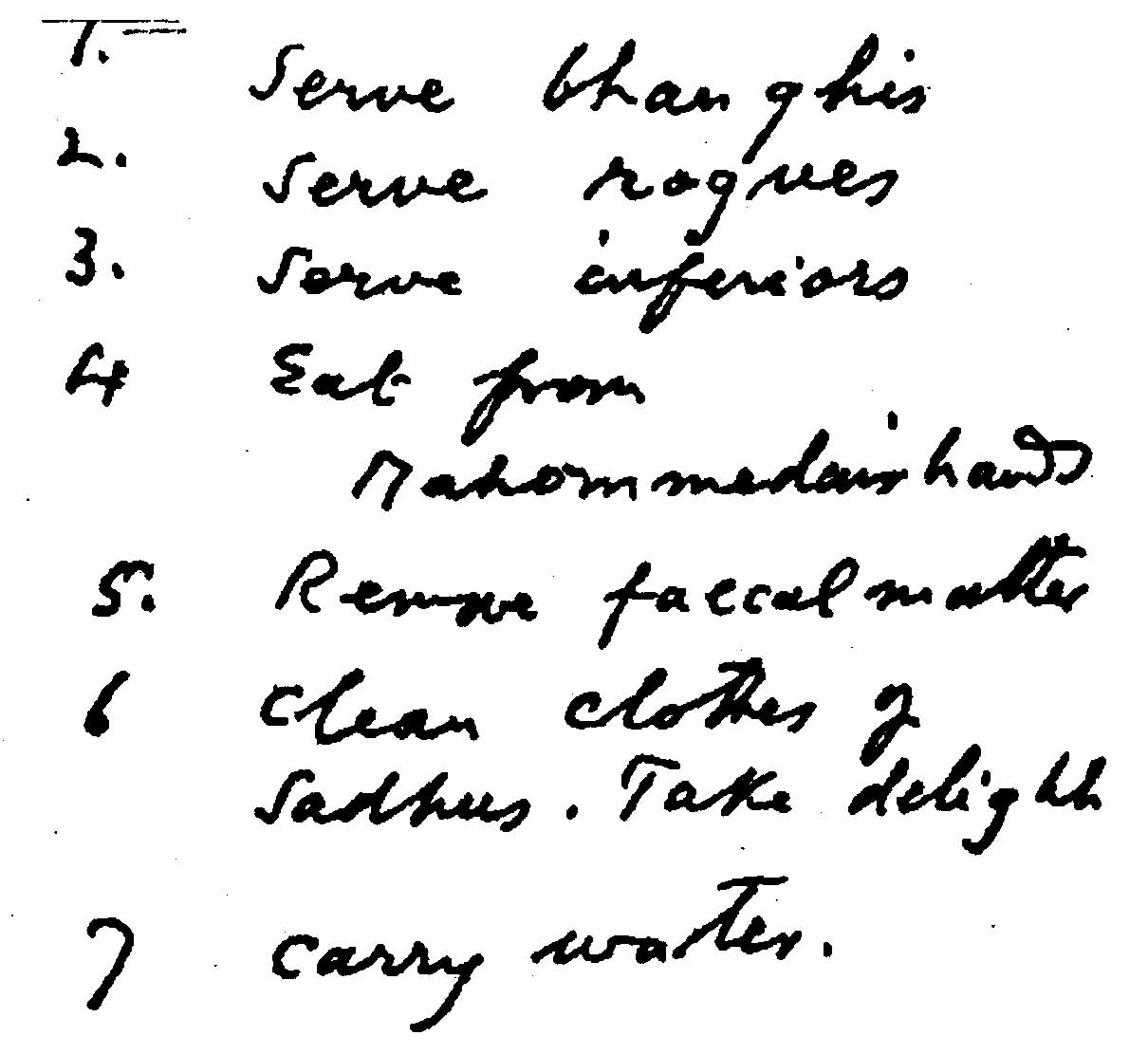
I saw how right from the start the acquisition of humility and simplicity constituted one of the prominent Sadhanas of Swamiji. Service, service is the constant note that shows the means he employed to grow into this virtue. How far this proved a success can be readily seen by a glance at his life which is pervaded by a beautiful humility and simplicity. Another leaf bears the legend:
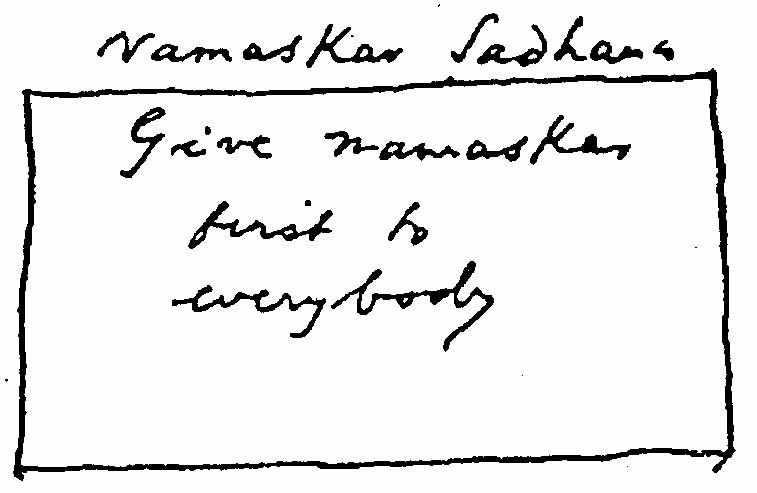
A third page bears on one side a couple of brief catchwords within a simple oblong border, standing out with all the boldness and vivid relief of news headlines splashed upon a poster in Fleet Street:

and on the other side–
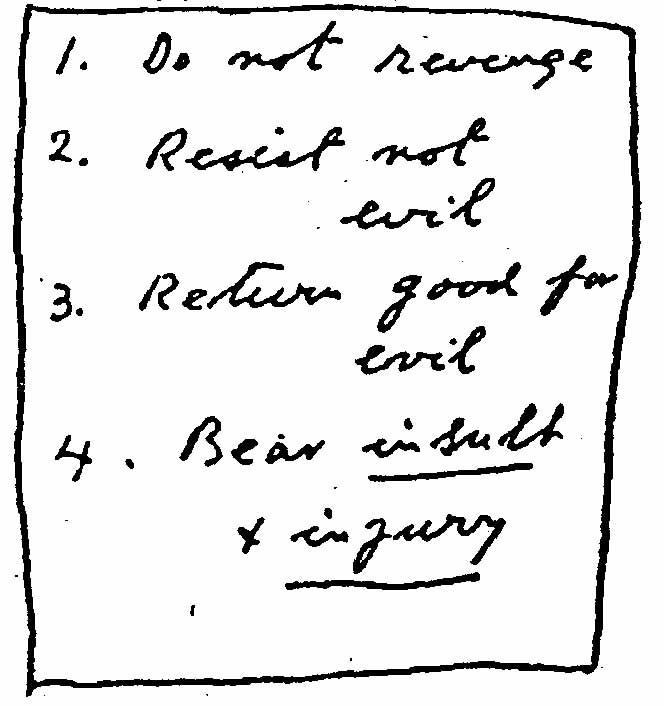
while in another personal notebook is recorded the pursuit of a parallel Sadhana with the hints for self-discipline running as follows: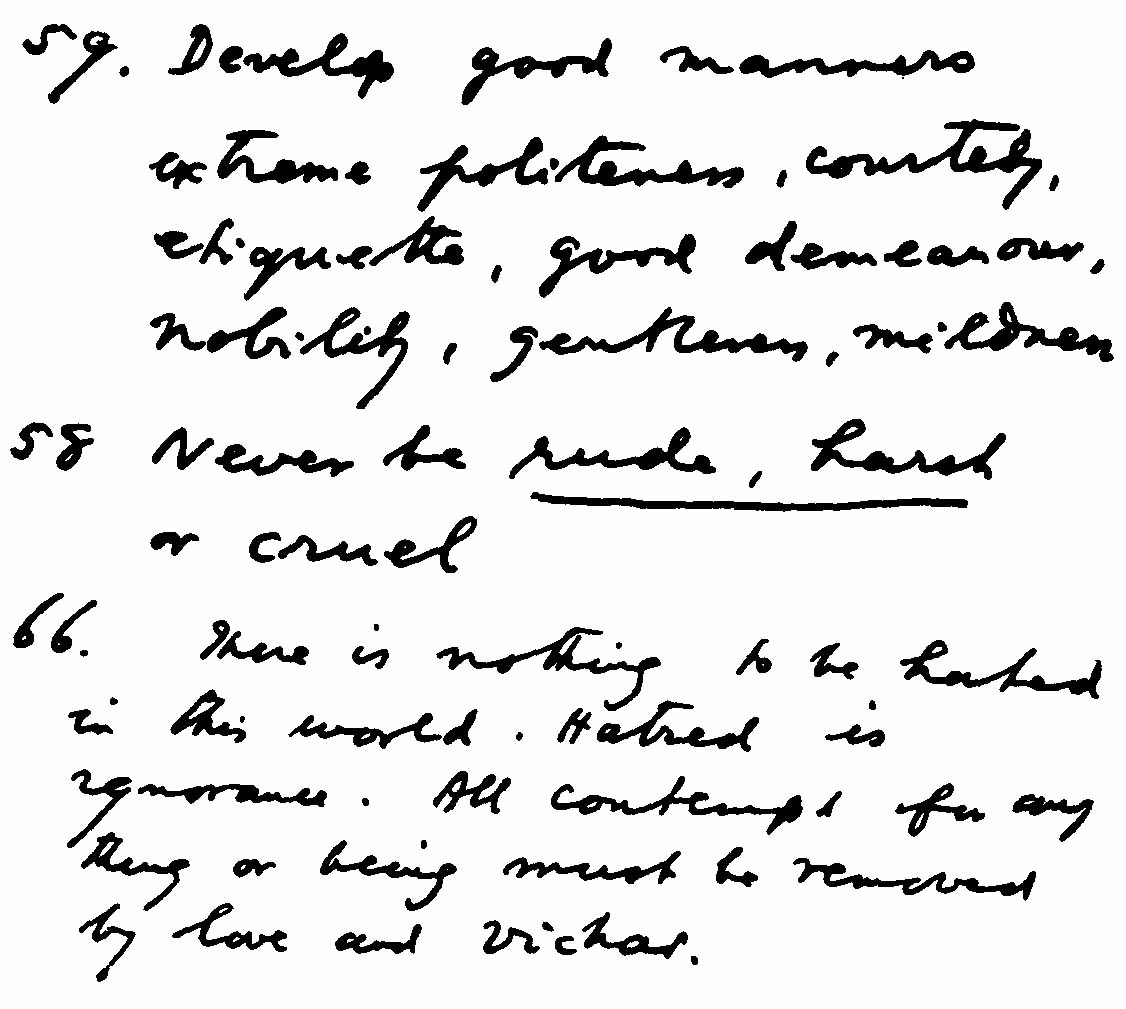
Two other neat little pages on which my eyes lighted bore in his familiar tidy hand:
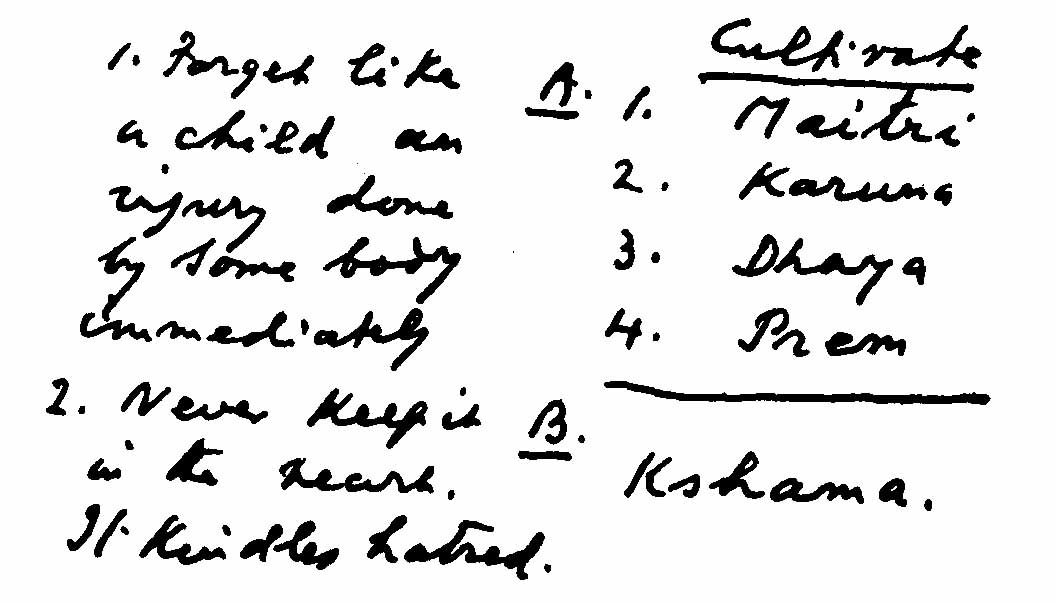
Now, side by side with this great love for all, this great solicitude and affection to those about him and his spontaneous forgiveness and forgetting nature, there is also that air of absolute unconcern, the complete detachment with which Swamiji goes about his work. “What if these things, these books and buildings and activities stay or go away?” he would at times say, “Should you care? If need be, we must distribute all these books free to people, if they find it difficult to buy them. This is our mission and duty. We, as Sadhus, have our alms at the Kshettar any day. Else, stretch out open palms before four houses and we get our Bhiksha. That should suffice for a monk.”
That he has sought to build up the genuine article–the stern spirit of true Sadhuism can be glimpsed here and there in these ‘diaries.’ One portion reveals how, when detected that attachment might creep in by his visiting the same alms house daily for his Bhiksha, he forthwith made it a rule of going to two or three different Kshettars in turn and getting a couple of Rottis at each place. It further shows that he avoided taking his meal within the premises of the Kshettar but used to go out into the open.
One significant para runs: “Sadhuism is a new birth. If big Kshettars abuse you, bear that. Do not think of the past life and birth.”
Then another, “Walk without shoes as far as possible. Hardy life till death is necessary for Sadhu.”
Again, “For a month or 15 days leave Swargashram without informing anybody. Take 2 clothes and 1 blanket. Roam about along the banks of the Ganges canal from Hardwar to Meerut. Live on Madhukari. Do not talk with the villagers. Observe Mouna on these days.”
Now, it is seen that, as a rule, when one leaves home and the relatives by a formal renunciation, he imagines that he has given up all attachment and Moha, but it is nothing of the sort. He has merely given up the object he was attached to, whereas the principle of attachment he has brought with him–it is inside him all the while. So, after renunciation during Sadhana, it comes to the surface and shows its face in various ways. Swamiji hunted it out tirelessly in all corners of the mind, analysing all his actions–searching thoughts–and managed to root out the very trace of it from inside by these various means.
True expansion of heart is very very rare. And the quick and ready impulse to give does not easily come to anyone. The astonishing generosity and large-hearted liberality Swamiji now manifests, he assiduously perfected while at Swargashram. For a long time, whenever visiting pilgrims made him offerings of cash, fruits, eatables or other articles, he deliberately denied himself, took everything and gave it to the other Mahatmas in the neighbourhood. So much did he stick to this practice, that we hear of how the neighbouring Sadhus took to directing all new pilgrims to Swamiji, knowing that all offerings to him would later indirectly flow into their hands without fail.
When Swamiji used to get a little money for his expense every month, during a certain period he purposely practised giving away all of it in charity and for several months lived purely on Kshettar Bhiksha alone.
The advanced practice of intense meditation seems to me the real power that has blossomed into the unruffled equanimity and the strange dignity and self-confidence that radiates from him now. Little hints here and there show that a great deal of intense meditation had been gone through as is indicated by several passages like:
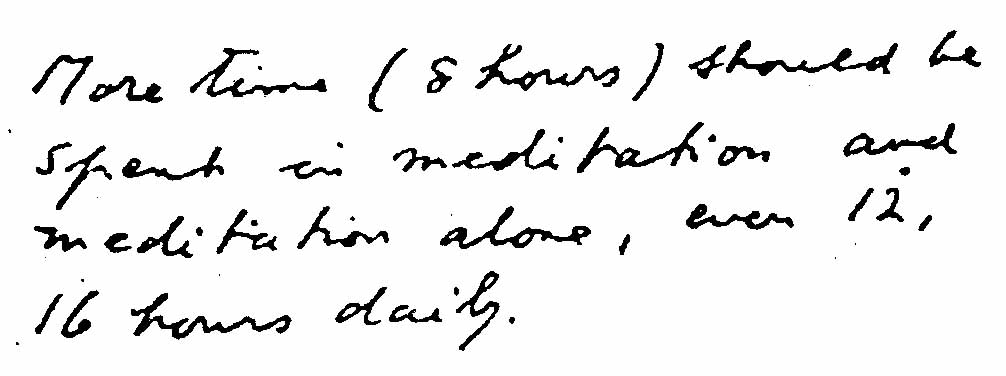
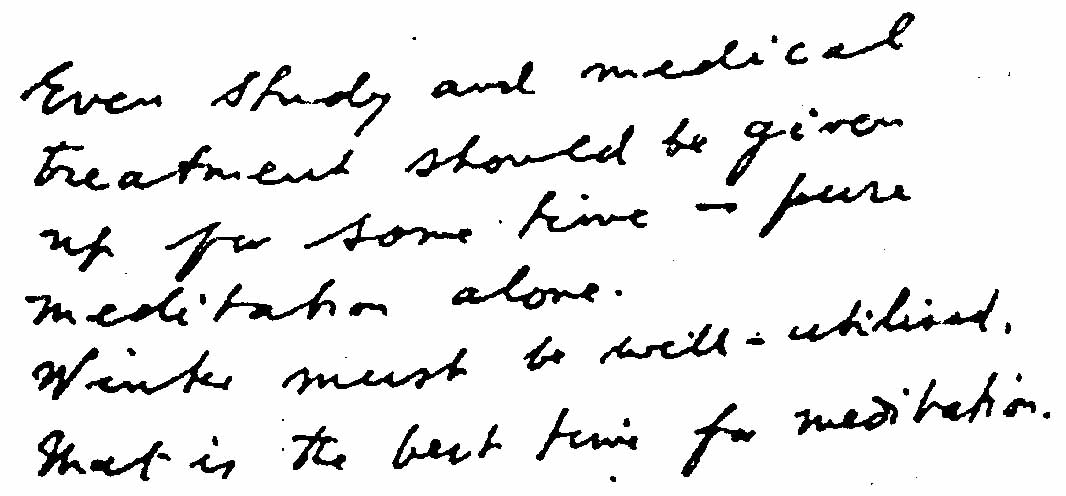
His quiet strength coupled with the force of his utterance and glance that make themselves felt immediately, are doubtless the direct outcome of his inner Sadhana and Tapas. Giving up salt, living on Rottis alone, going without umbrella, shoes, etc., subsisting for sometime on boiled potatoes only, all these and other Tapascharyas get mentioned again and again in several places in these interesting notebooks. His austerity with regard to the mastery over palate has been of the severest type and there was one entry of the earlier days that took my breath away. I reproduce it:
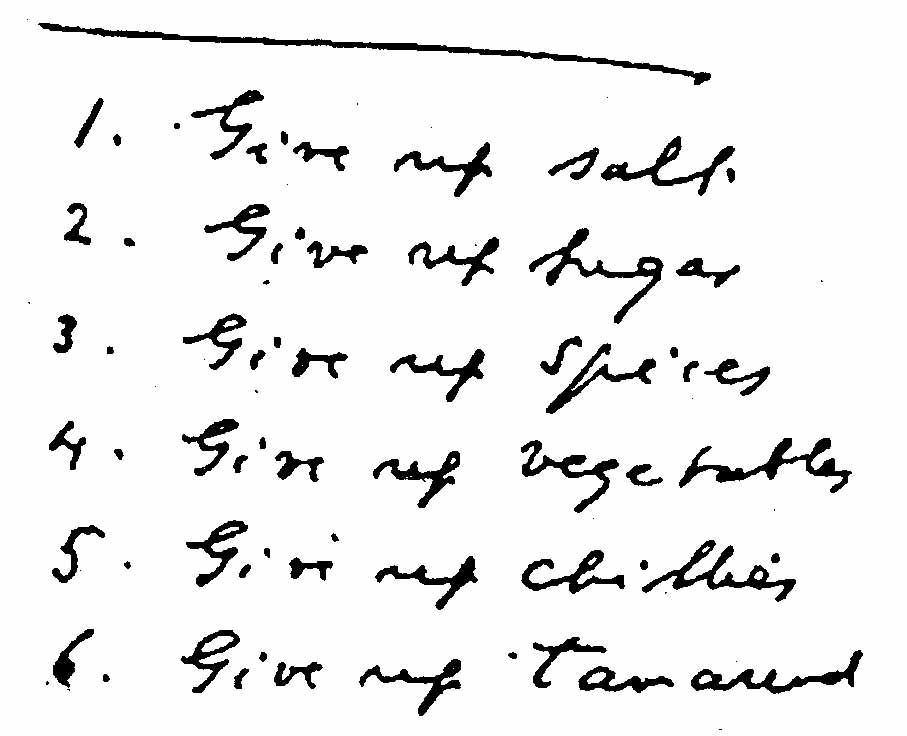
Confronted with this, I was in a quandary as to whether to draw inspiration and courage from it or to despair of myself of ever approaching Sadhus. Personally, I felt a sinking sensation at the pit of my stomach and turned a trifling pale. And when another para adds elsewhere:

I only bowed my head in silent awe and wonderment.
This jewel had gone through the most merciless melting, smelting, and moulding, drilling, chiselling and filing.
This is Swamiji.
CHAPTER NINETEEN
This I Bequeath
In all spheres of human activity–in arts, sciences, morality and religion–the great minds that scaled supernormal heights, inaccessible to the generality of men, have always left their special impress upon the tablets of Time. By their lives and their teachings, they give out some special message, bestow some particular ideal or leave some sublime handiwork of theirs as a sort of heritage bequeathed to humanity of their time as well as to the future.
Christ gave his message for all eternity in the immortal address to the multitude on the Mount and will ever live in the hearts of men for the sublime utterance of his on the Cross. “Father, forgive them for they know not what they do” thereby summing up in one short sentence the essence of the highest sainthood, nay, of the highest divinity.
Socrates lived and died to leave to posterity the ideal of an unbending moral rectitude in private and public life. By his manner of death, he has shown to the world what moral courage and heroism are and how to be steadfast to one’s principles to the very last.
The labours of a Mozart and a Beethoven have given to entranced ears, symphonies and sonatas, overtures and oratorios, almost celestial in their melody. Likewise have Jenner and Wright, Pasteur and Perrie Curie enriched science by Vaccinotherapy and Radium, while the sufficient justification of Wren’s great life is embodied in the grandeur and the majesty that is St. Paul’s. Coming home, the genius of our own motherland, the great Buddha, Sakya Muni bequeathed to the nation the noble Eightfold Path, while Asoka lived to be an example of what the perfect administrator ought to be like. The love-mad Gaur Chaitanya gave the gift of Nama-sankirtan and Prem, while Sri Ramakrishna has left the legacy of unity of all religions and the renunciation of Kamini, Kanchana (lust and greed). And it seems like yesterday, so fresh is it in living memory that, that flashing fragment of delirious divinity, the ever-ecstatic Ram Thirtha, whose whole latter life was like one long peal of a child’s silvery laughter, presented Vedanta in the theory of spiritual daring, “a balanced recklessness” as he termed it. He advocated the cultivation of an infinite self-reliance and an infinite cheerfulness.
In like manner what has this noble and self-sacrificing sage of the Ganges’ bank and Himalayan hills, his life wholly dedicated in the service of humanity, bestowed upon you and me, and the rest of our brethren? I have endeavoured to put down in some detail certain distinctive features in his noble mission as they have appeared to my understanding.
In these years of disinterested work–these two decades of pure selfless service in the interest of mankind–there emerge some prominent features that are in the nature of special gifts Swamiji has bestowed upon the present generation. Some hitherto unknown methods of Sadhana and discipline, certain unique ideas and points of view towards spiritual life, etc. To meet the special needs of the time and the situation, he has deliberately given prominence to some ideas by laying stress upon and treating elaborately of them.
The very practical features that he has given a great impetus to are, in main, the following: the maintenance of the spiritual diary–a unique method of profitably utilising every moment of the day by a scrupulous observance of about 27 items of vital Sadhana amidst the activities of Samsara, with provision for self-analysis, self-correction and self-punishment.
Secondly, the neglected practice of Likhita Japa he has resurrected. So great has been his success in establishing this practice in all people that, now everyday the mail brings books and bundles of paper filled with the written ‘Name’ from the various disciples of Swamiji all over India.
The third is, the practice Swamiji has introduced in bringing out printed forms of resolves and making the Sadhaks fill up the same and submit them to him as a promise to act up to them. This has as its aim the building up of character by getting them to give up some of the most commonly prevalent of weaknesses of modern man–habits such as cinema-going, smoking, novel-reading, etc.
The fourth practice is, the keeping of written mottoes and assertions constantly before you, either on the walls of the house or written in bold letters on slips of paper and carried in the pocket, to be looked at frequently in the course of the day. He has put this in practice at the Headquarters of the D.L. Society where the visitor will find himself confronted by such mottoes in Hindi, Sanskrit and in English, the moment he steps into the Society’s prayer-hall on the hill-side.
His device to get all the Sadhaks to adhere to a daily routine of activities, is yet another method of practical Sadhana he has adopted to spiritualise the life and activity of the ordinary man. His Dinacharya charts are arranged in four or five grades to suit the student, the Grihasthi, retired people, whole-timed Sadhak, etc.
Now what particular ideas has he successfully striven to implant in the minds of the present generation? There are a number of them, several that receive a great emphasis at his hands. One factor that stands out distinctly prominent over and above others in his entire teachings, is the stress Swamiji has laid at every turn on the vital importance of selfless service, Nishkama Karma Yoga.
Selfless and motiveless service of all creatures, he insists, is the greatest purifying force on earth. It is through such disinterested loving service that, that preparatory purification is wrought, so vitally and indispensably essential for the experience of a wider consciousness and a higher life. All endeavour to attain perfection and obtain bliss is bound to be futile and abortive, if it is not based on the sound foundation of ethical development and moral stability. These latter are to be acquired mainly through a period of earnest and whole-hearted service in some form or other. This forms the smelting process to the base ore of the egoistic ‘self’ in man. It is a process absolutely necessary for the emergence of the pure gold of progress, peace and joy in life. To fancy oneself fit for meditation and seclusion from the very start is to put the cart before the horse.
Swamiji is never tired of reiterating the paramount importance of such altruistic and philanthropic activities. Done in the spirit of worship, this alone will suffice to take one to the goal of life. That it is a means as well as an end in itself is his belief. So much so that, many a time, one is led to conclude that Swamiji’s special mission seems to be to expound in detail and glorify selfless service as the surest way to Self-realisation. Some of those in his intimate circle even opine that, to establish the doctrine of Nishkama Seva as the highest worship of this age, is the main purpose of his life.
However one views it, this much is patent even to a casual glance at Swamiji’s everyday life. His greatest joy and inspiration is in getting immersed in service of others–students, guests, strangers, chance visitors and the general public. The subject of selfless service is dearest to his heart and he loves to live it, talk about it, and write on it.
The spirit of today is everywhere characterised by a thirst to be of service. All urge for social service is found to be uppermost in the minds of the people of all countries. Man feels himself to be a citizen of the world because science has made null and void the effect of distance. As Swamiji says, it is foolish to think yourself as separate from the world. That conception is long dead and is replaced by a spirit that knits the globe into a single brotherhood, despite the hatred and vengeance that has seized a section of power-mad humanity for the time being. The spirit of the modern era is the spirit of sharing, serving and sacrificing. Cast your eyes where you will, the reader will find service idealised and glorified by all thinkers, philosophers and saints.
But it is common experience that, though there are very many people who have great desire to be useful and helpful to others, who want to serve all but do not know exactly where to begin, how to proceed, which field to act in. They do not know exactly what to do about it. This perplexes them. It is here that Swamiji has done unforgettable yeoman service. Stepping in to usher in this new era, he has done un-repayable help by painstakingly elaborating the details of practical service. With his detailed work on Karma Yoga, he removes the greatest barrier by showing innumerable ways and means of converting this service urge into actual work. Methods are shown how every individual, be he the humblest and the least, can, in the manner suited to his capacity and position, be of help to others. No being need any longer feel at a loss as to how to actively manifest his desire to serve and to be helpful.
Hitherto the modern individual had hardly any clear conceptions of the real import of ‘Karma Yoga,’ whereas the terms ‘Bhakti Yoga,’ ‘Raja Yoga,’ ‘Jnana Marga,’ etc., conjured up clearly the details and items of practice contained in them. Apart from merely knowing that Karma Marga meant the performance of action without attachment, none had any idea how this had its expression in effect, how exactly it was to be practised, what one did in following this path. It was all vague and unsatisfactory. The work of Swamiji in having cleared this vagueness and thrown definite light upon the various forms that selfless service takes, how Karma Yoga manifests itself on the plane of expressed action, and how, in a hundred different ways, every moment of your life, each individual can be doing selfless service, has conferred the most valuable gift to human society.
The next in importance perhaps is the great service he has done in giving fresh life to the neglected ideal of Brahmacharya, of celibacy and moral purity. He has spared himself no pains in hammering this grand idea into the youth as well as the man of the nation. This is the crying need of the nation, nay, of the whole present-day world. To stem the rot of juvenile moral degeneracy and open a new world of idealism, with the triple purity of thought, speech and act, Swamiji has done priceless service. There is no book of his but makes some reference, directly or indirectly, about the paramount importance of Brahmacharya in all stages of life, both to man and to woman. A rational interpretation of Brahmacharya as not being merely a physical control, but comprising a threefold purity of the physical being, the modes of thought and ideas, we owe to him. Also that Brahmacharya is not for bachelors and monks alone, but for married men and women too in its broader aspects of moderation, purity of motive and outlook and restraint. And, as such, it does not get restricted to a particular period of life but is more a guiding rule of conduct for the whole life.
That it is the firmest and finest foundation of life, both of the individual as well of the nation and constitutes the indispensable condition of all progress and achievement, we now realise, thanks to Swamiji. To develop a great character (which Swamiji holds to be far superior to knowledge), continence and restraint are the basic requisites, equally to the householder and to the married woman as to the student. Thus the subject of celibacy and moral purity has come to be regarded in a new light in this aspect as a wonderful treasure worth acquiring by all and not as any irksome restraint to unwillingly submit oneself to in student life.
At the back of this ideal he has advocated, he himself stands a shining example of what a marvel self-restraint and purity can make of a man. By his clear and plain-spoken treatment of the subject, Swamiji has successfully swept aside all queer notions that existed in this connection. It is no longer regarded by thinking men and women as a sort of violation of nature, a perversion of life, an out-of-date monkish ideal, that is abnormal or impossible.
A third blessing, a blessing we should firmly cling to is having made everyone Japa-conscious. Upto this time, in the entire range of literature, no one had ever written any work dealing purely and wholly with the subject of Japa alone. The nation and the whole world has reason to be grateful to him for having revived Japa Sadhana as an independent self-sufficient method of God-realisation.
He has presented it boldly as a complete Yoga in itself not merely an item in the Sadhana of the Tantrika. The real significance of this teaching and a proper estimate of the benefits wrought thereby may not be apparent just now but time is surely going to show the revolution it is working amongst people. It has in effect made thousands of people take to the Mala and the regular repetition of the ‘Name’. People who had hitherto kept away from active religion, regarding it to be beyond their humble capacity as entailing the necessity of several supranormal practices, have now felt a new life open up before them in Swamiji’s convincing attitude and treatment of Japa. As a Yoga that demanded no extraordinary physique and unusual mental capacity or energy, which at the same time was capable of bestowing the highest realisation, ever increasing numbers are now taking to the practice of Japa. So a new wave of Japa Sadhana has been started which is gaining ground so rapidly that it seems to me as likely to have far-reaching effects in the future.
Swamiji has made a new approach to the science of pure Hatha Yoga. He has banished the bogey of mystery and strange occultism that has characterised our attitude to Asanas, Pranayamas, Mudras, etc. By his very frank and purely utilitarian explanations of the theory and practice of Hatha Yoga, we have now come to know it as a simple, very rational, and extremely practical system for the acquiring and maintaining of a high standard of health and efficiency–physical as well as mental. From being regarded as something dark and dangerous, Swamiji’s efforts have resulted in Asanas and Pranayamas being accepted and adopted by considerable numbers as regular items of their everyday routine activities. Thanks to his works, the pall of obscurity and secrecy that shrouded this very useful science is now removed and the nation has it in a very practical form, advocated not so much for its occult value as for its immediate worth as a health-builder and life-giver. He has not concerned himself with any deep research work in this line to explain it in terms of modern physiology and therapeutics, but has been content to present facts from his own study and practice of Yoga. The result has been a nation wide renewal of interest in this branch of Asanas and Pranayamas.
Here I would touch upon a point which should be of profit to most readers. Criticism has been voiced against such a popularisation of a system which, in experience, proves to be a double-edged sword because, it is argued, enthusiastic readers are at times misled by the apparent simplicity of the subject as presented in the book. Taking to its practice hastily, results in various unexpected troubles. A proportionate harm is done with whatsoever benefits that follow such popularisation of Hatha Yoga. So it is argued.
Without endeavouring to deny facts, I however seek to prove, in a few words, how patently unjust it is to attribute this sort of trouble either to the system itself or to its reviver. As to the former, it is a perfect science and not one bit harmful, provided all laws are scrupulously observed by the practitioners. Transgress them and you land into trouble.
As to Swamiji’s efforts at restoring to it the attention and the interest that it deserves, there is not the least room for complaint whatsoever. What trouble practitioners might have found themselves in, was not only not unexpected but actually foreseen clearly. Because you will find that in every book of his on Hatha Yoga and allied subjects, Swamiji’s approach is invariably characterised by the utmost caution and common-sense. He never fails to enumerate in detail the important qualification an aspirant should possess, if he desires to practise Yoga. Certain indispensable conditions are laid down that are to be fulfilled before one can take up to these practices. But what does one actually see? Practitioners are so enamoured at the glowing descriptions that are given of the state of one advanced in Yoga. They are impatient to get all that but are not willing to abide by the conditions prerequisite to it. The slow processes of preparation and purification are ignored or negligently skipped over and consequently they come to grief. Here they seek to lay the blame at the wrong door. The special instructions that Swamiji usually includes contain all the necessary safeguards to take the Sadhaks safely through the practice. Where it is not heeded, trouble is naturally met with. The instructions regarding Yogic disciplines, dietetic restrictions, moderation, purity and self-restraint, are all actually meant to be followed to the very letter. How many do it? Now-a-days persons will readily follow the instructions pasted on a bottle of medicine or a pot of toilet cream, with holy reverence they will obey the traffic signals. But when it comes to observing the seriously meant precautionary measures in Hatha Yoga, none shows the patience for them. They wish to have the results of the ideal Hatha Yoga without subjecting themselves to the disciplines laid down. No doubt undesirable consequences follow. Practised strictly according to Swamiji’s instructions, there can be no doubt the practitioner will acquire unqualified success. So the harm or otherwise done is patently the reaction of the individual’s negligence or care respectively.
How far Hatha Yoga has been revived can be known from the correspondence that pours in, day in and day out, from every part of India. That reveals more authoritatively and with greater authenticity than any other source, the pleasant surprise of how hundreds of persons have acquired proficiency in Asanas, Kriyas, Mudras, Bandhas, Pranayamas, etc., purely through a careful perusal of Swamiji’s books on the subject. Many of his readers happening to visit the Ashram at Rishikesh have surprised Swamiji himself by demonstrating various Kriyas and Pranayama exercises perfectly, attributing all their knowledge and efficiency to a perusal of his books.
Certain precious ideas that he has given to this generation are to be cherished as rare treasures.
Firstly, he has removed the conception that spiritual Sadhana is some practice meant for a particular set of people during a particular period of life and an ideal that is distinct from normal everyday life. On the other hand, Sadhana is a way of life and way to life in itself. Every activity of the being, mental and physical, inward and external, voluntary and involuntary, is to be done in the light of Sadhana. This Bhava is to be diligently sown and nurtured. For Sadhana is not and cannot be divorced from the individual’s routine activity.
The idea that Sadhana is the only purpose of life, human birth and body are meant only for that, and all other things and aspects of life are at best only incidental and therefore secondary, Swamiji has firmly planted into the minds of the vast number of his readers and correspondents. We have been awakened to the truth that Sadhana is a central fact of life. It is that which gives meaning to our existence.
It has also been his chance to be the interpreter of religion and spiritual life, in consonance with the genius of the present times, the spirit of the times and the particular needs of the century.
An honest adherence to the three disciplines of non-injury, truthfulness and purity, is the means suited to this age. For those alone would serve as aggressive counter-blasts to the three most patently manifest evils that have invaded the life of the civilised individual, society and nation of today. All international and interracial relations have been, since 1914 or even earlier, marked by unmitigated cruelty, hatred and violence. Lying and deceit have become everywhere evident in all societies which have come to be commercial and money-made. Gain, profit and accumulation have come to be the dominant passion that sways modern society. And in individual and family life, incontinence and immorality are on the wax. Therefore the great need of the period becomes a systematic attack directed against these three expressions of undivine forces. And as effective counter to this, the triple observance of Ahimsa, Satyam and Brahmacharya, Swamiji has striven and sought to inculcate and establish through his utterances, his written works and the activities of the D.L. Society.
Further, the presentation of the eminently practical side of spiritual life in its most universal form, so as to allow of the widest application here and now, is another salient feature of his work. Shedding all sectarianism, divesting of all dogma, plucking out the kernel of fact from the mass of irrelevant, non-essentials and superfluities, he puts before the world a scheme of self-culture for Self-realisation, the key-note of which is the living of a divine life in and through the world.
The living of one’s life with the constant consciousness of the presence of the UNDYING UNDERLYING REALITY and the doing of all actions as an offering to IT, he has sought to put before the world. And for this he has taken only the broadest non-sectarian essentials of spirituality.
Finally, the greatest, the most catching and most solid blessing that we have received from this life is the unforgettable idea that religion means “To Do.” All the things you might believe in, revere, accept, talk, read or discuss about, or study, and do research, not one of these nor all together, comprise the religion in you. It is only the one or two little acts that you actually do, what little you practise, live, that constitute religion and spirituality. To rise early and take the name of the Lord for ten minutes is what real Dharma is than to know the Gita and Dharma Sastras, while you do nothing about it. So this urgent idea, this fiery idea that to act, to live, to do, is the only thing that counts in spiritual life, he has stamped into the hearts and minds of the people.
If there is to be spiritual life, first see what outward expression it finds in the life of man, then manifest that yourself. He has given predominance to the mode of active, positive practice, making that the essential note and throwing overboard all conventional satisfactions in beliefs and acceptances and intellectual recreation in the religious field.
No more is man taught everything about religion (except how to ‘live it’) and left to ask in the end, “Well, and now what am I to do about it?” Since Swamiji’s advent, it has become “begin by doing, then know things as you proceed; everything will then come into your knowledge by itself in good time”. He has made it all a vigorous positive “Do.”
Wake up at 4 a.m.; sit on Padmasana for half an hour. Do Japa of a Mantra with a Mala at least 108 times; perform a few Asanas; do a couple of rounds of Pranayama; observe Mouna for an hour; discipline palate; give up chillies and tamarind; keep limited possessions; study scriptures daily; give charity regularly; keep up celibacy; speak kindly; avoid harsh nature; write Mantra at least a page a day; remember God on waking up and retiring to bed. Thus is religion presented by Swamiji to the world.
Do something. Practise. Actually live. Don’t merely believe but Be and Live.
CHAPTER TWENTY
Pointers On The Pathway
During brief spells of leisure that you get in your busy life, just open the book and run your eyes through this section. Here you will find in a nutshell an epitome of Swamiji’s view on all the broad questions of life and its purpose. I have gathered together his various utterances on different occasions, at times in informal company, at others to a select few aspirants in reply to their queries and give them here under convenient heads that you might obtain the essence of his precepts at a glance.
The Real life: There is a sublime, a grand meaning behind life. It is something more than the mere round of eating, drinking and sleeping. The real life is the eternal life in Atman or Spirit, a life of perfect freedom, fearlessness and bliss. It is a state of Immortality and Supreme Peace. It is a state of Nitya Tushti, or perpetual satiety, beyond all desire and restlessness, beyond all decay and death.
The Universe: This earth of ours is less than a pin-point, a mere dot within the vast universe.
All creation with its countless Solar, lunar and stellar systems, is but of momentary duration in timeless Eternity.
The Ultimate Reality beyond all is Eternal, undivided Existence-Knowledge-Bliss.
The entire visible universe is but a conglomeration of atoms. The mighty ocean is only a compound of two gases.
The Goal: To realise the supreme bliss state of Sat-Chit-Ananda is the goal of life on earth. To conquer the lower self, rise above all limitations and regain the lost divinity is the aim of existence.
The Barrier: In the whirlpool of fleeting sensual pleasures, man has forgotten the purpose and goal of life. He does not know what he is exactly doing. He thinks, ‘I know everything,’ but he is sunk in ignorance. This is delusion due to Avidya or Maya. This mysterious power veils your real nature and acts as a barrier to the achievement of Bliss and Immortality. It deludes man in the form of strong egoism, restless nature of mind and a ceaseless craving for sensual pleasures. Infatuated by attachment to one’s own body, to woman and to wealth, man has gone completely blind.
Worldly Life: Life in this world is chaotic, fragmentary and full of unrest. The cause of suffering is the desire to enjoy the sensual objects of this world. This desire for enjoyment is due to the ignorant belief that happiness is outside you. All desires, clinging to life, all disappointment and suffering will cease for ever when you realise that all happiness is within. Within you is the ocean of bliss. Outside is the blazing fire of sex and ego. All living creatures are roasted in it. There is no time to introspect, to purify and to meditate.
The Only Way: But there is no other possible course. It is within a human body alone that one can attempt to cross the ocean of Samsaric existence. Human birth is the greatest and the most precious blessing in all the three worlds. Don’t waste this life in heedlessness and sensuality but utilise every second profitably. If this rare opportunity is lost, you may not get another. Time is fleeting and the mind and senses tempt and cheat you at every step. Obstacles and hostile forces are everywhere. Yet this is the right time and place for salvation. It is foolish to think ‘I will take a bath when all the waves of the sea subside.’ Do not postpone.
The Requisite: O Man! Understand clearly that you have got to exert right from this moment. Life is uncertain whereas death is certain. Understand that temporary connections and transitory pleasures are unreal. God is the only reality. Learn to discriminate between the true and the false. Develop a keen desire to know the Truth and free yourself from the allurement of the false. Learn to remain unperturbed by trials and tribulations and keep your senses and emotions under check. Be content and cheerful in all circumstances. Have faith in yourself and trust in God. Put into practice what you know to be right.
Where to Seek: Knowledge and Bliss are not the exclusive possession of Sannyasins and forest recluses. Heart is the golden Temple of God. God is in you as well as in the heart of every creature. This world is a manifestation of God. Purify your heart and mind, then you will behold Him inside you as well as everywhere about you.
Guiding Notes: Constantly remember the perfections and the pains of Samsara. Remember saints who had attained God-vision and thus draw inspiration. Have a definite Ideal, a proper programme of life and an elevating background of thought. Act with faith and determination. Without self-restraint and moderation, no virtue can grow. Therefore develop a perfect character. Character is greater and more powerful than all wealth and all knowledge. Purity, truthfulness, upright character, firm resolve, will lead to speedy realisation of the Ideal.
The Four Paths: To suit different temperaments, four broad paths are outlined. Jnana Marga for those of a rational intellectual type, Bhakti Marga for devotional or emotional people, Karma Marga for the active man and Raja Yoga for the mystic temperament with leaning towards the occult.
A persistent inquiry into the nature of Self, the source of the elusive ego, the three states of waking, dreaming and deep sleep, and a systematic negation of the non-eternal, will lead to the dawn of Knowledge and free the soul from the shackles of delusion.
The cultivation of intense attachment for the Lord, setting up an intimate and loving relationship with Him and a whole-hearted and ungrudging self-surrender, results in the attainment of Divine Vision and God-Consciousness.
Selfless service of humanity, of parents, elders, teachers, Sadhus, Sannyasins and Mahatmas, the sick and the poor all constitute worship of the Lord. Such service without expectation of reward, purifies the mind and prepares it for the descent of divine light and Ananda.
The practice of Yama and Niyama, steadying of posture, control of breath, withdrawal of the mind from external objects, makes the mind one-pointed and results in deep meditation and Samadhi or super-consciousness.
The Sadhanas or Practices: Karma: Return good for evil. Serve those that harm you. Consider others’ needs before your own. Share whatever you have with others. Give charity to the needy, education to the illiterate and nurse the sick. Relieve the troubles of others to the best of your ability. Sacrifice your comfort in the interest of service. Convert all your daily activities into divine worship by giving your hands to work and mind to God.
But beware of name and fame. Pride will creep in. Seva Abhimana is very dangerous. Remove it by daily self-analysis and introspection. Scrutinise all your motives. Cultivate true humility.
Bhakti: Company of devotees and Sadhus, early rising and Kirtan of the Lord’s sweet ‘Name,’ Japa, prayer, worship of a personal God, study of scriptures, charity, observance of vows like periodical fasts, vigils, etc., are all Sadhanas to develop and progress in the path of divine love. Sing His Name with feeling. Look upon all creatures as manifestations of the Lord. Offer your heart, mind and soul at His Lotus Feet. Pray fervently like Prahlada. Weep with sincere longing for His Vision like Radha, Mira and Ramakrishna. Repeat with Bhava “I am Thine; All is Thine; Thy Will be done, O Lord.”
Laziness, mere emotionalism, weak sentimentality, vanity, hypocrisy, selfishness, are some of the treacherous enemies to the growth of devotion. Be very vigilant and have a fixed daily routine and adhere strictly to every item. Thus conquer laziness. Cultivate moral courage and stick to Truth. Draw inspiration from the bold and heroic actions of former Bhaktas. Overcome vanity and hypocrisy by prostrating before all and constant prayer and appeal to the Lord for His compassion.
Jnana: Approach a Jnani Guru. Hear the Srutis from him. Reflect over and over again on what you hear. Then constantly meditate on the truths of the Vedanta. Develop strong will-power and a clear and bold understanding. Consider this world phenomenon as a mere shadowy dream and all the wealth of the three worlds as chaff. Reflect upon the transitory nature of sense-pleasures and the perishable nature of this body. Destroy the age-long false identification with the physical frame. Inquire “Who am I?” Discriminate between the real and the unreal. Generate an intense desire to know the Truth and attain freedom.
Attachment to the body, ideas of ‘I’ and ‘mine’ keep the mind bound down to ignorance. That little ego constantly asserts itself. Old Vasanas and Sankalpas, fear, unsteadiness of the mind, wrong thinking and Moha, all hamper Atmic inquiry and meditation.
Cultivate a strong positive current of Brahma-Bhava or the feeling that you are pure Spirit, formless and limitless. When you see objects, deny, or reject the names and forms and perceive the hidden Antar-atman only. Remain as silent witness (Sakshi) of all the external changes without being affected by them. Negate all sense-experience. Constantly chant ‘Om’ and thus steady the mind and destroy the idea of world and body.
Raja: A serious practice of Raja Yoga can be thought of only after you purify your character and obtain an extent of control over your senses and appetites. This is an exact occult science. Be truthful, harmless, continent, and observe the canons like purity, contentment, austerity, study and worship. Acquire a healthy and sound body by the practice of Asanas and purify the inner sheaths through Pranayama. Thus when the mind is rendered fine, withdraw it from all sense-perceptions. This is Pratyahara. It checks the outgoing tendency of the mind very effectively, calms its agitations and makes it one-pointed. The concentration (Dharana) that ensues, when continued without break, deepens into meditation (Dhyana). Meditation culminates in Samadhi. Samadhi liberates the soul from birth and death.
Impure motive, lack of Brahmacharya, over-eating, indolence, oversleeping, false fears, castle-building and the lure of minor supernatural powers like clairaudience, clairvoyance, etc., are all obstacles and pitfalls in this path. A wise control of the palate, Trataka and Pranayama are aids to meditation. Combine boldness with caution and use your commonsense at every stage. Shun Siddhis by developing burning dispassion and desire for the highest realisation of Immortality and Supreme Bliss.
The Common Ground: The basis of all methods, the fundamental prerequisites in all successful human endeavour, are the same everywhere. They are ethical culture and the maintenance of a normal physical and mental health. Without morality there can be no progress. Without health no effort and exertion is possible. A man may have everything in this world but if he does not possess good health, he becomes useless to himself and to the world. Likewise, one may own the whole world, have unlimited power and talent, yet without morality his life is in vain. He will ultimately suffer a terrible downfall. Therefore observe the rules of health and hygiene, conform to wise Nature’s laws. Lead a simple life of moderation and regularity. Keep the body light and pure by daily exercise, deep-breathing, Asanas, light diet and clean thoughts. Mould your character by actively exercising and practising virtues. Do good acts, give up all crookedness and deception. Eradicate jealousy and hatred. Adhere to Truth and look upon all women as manifestations of divinity. Thus lay the first foundation of success and achievement in life. You will be assured of rapid progress and realisation.
The Glory: However difficult things might seem, for a sincere man nothing is impossible. What one man has done another can do. When you sweat eight hours in an office to earn a hand-to-mouth salary of Rs. 25/-, is it not worthwhile a little effort to obtain the most blessed state of Immortality and Kaivalya? The glory of the state is indescribable. You will experience ineffable bliss, absolute freedom and eternal peace. You are indeed the Emperor of emperors. Changeless, Fearless and Deathless is that Supreme State.
The Call: O Nectar’s Sons! Enough of this half-awake, imperfect, unsatisfactory life. Lead a rich life of fullness, perfection and all-round development. Become an illumined being and create a heaven on earth, this moment, right where you are. Wake up from the slumber of ignorance and prepare to lead a divine life. Exert. Shake off lethargy and faint-heartedness. Be lion-hearted. You will get success in every attempt. You will prosper gloriously in the physical and the spiritual planes. You will reach the Goal quickly. I assure you.
For the Knap-sack: (Know this and be bold):
1. You have no enemies to fear outside. The real enemies are egoism, pride, lust, anger, avarice, infatuation and selfishness.
2. The more you spend your energy in elevating others, the more divine energy will flow into you.
3. In the beginning, all self-restraint, all self-denial and efforts at concentration will seem extremely dry and disgusting. But if you persist in it calmly, you will later experience strength, peace, new vigour and bliss.
4. If you are sincere and earnest, if you use your common-sense always, if you are patient and persevering, you will reach the Goal quickly.
5. You are bound to succeed because you are born for it. Only you have forgotten your heritage. Claim your birthright now.
This is the message, Reader! And this the rousing call. It is left to you, yes, to you, to ask, to seek, to knock. All that you want is right here, if only you will have it. Ceasing all talk for a while to come, may you be inspired to Act!
CHAPTER TWENTY-ONE
Light-Fountain
“Neither do men light a candle and put it under a bushel, but on a candlestick, and it giveth light unto all…” Message of Jesus Christ.
Time is maintaining, from epoch to epoch, a delightful encyclopaedia of great personalities who leave deep footprints in her heart in rhythmic succession. This record of events originated from time immemorial which history or science could not trace.
It is always her desire to collect pearl-drops, dropped from the celestial plane, and paint out of them portraits with utmost care using her exquisite talent of muses. The picture gallery of cosmos is rich with her unique paintings which never fade but ever attract wakeful eyes. Unfailingly she accepts portraits and caricatures of personalities of momentary success in sovereignty, materialism, inventions and innovations; but, how can she exhibit them side by side with lives victorious and lives triumphant! Naturally she has to discard them.
Moses has declared, “No crown surpasseth humility, no monument a good name, no gain the performance of duty. The good man leadeth others in the right path, loveth his neighbour, giveth his charity in secret, doeth right from pure motives and for the sake of God.” In his heart dwells the Lord of Life. He is to be adored. He is to be worshipped. He has to be conveyed in the head and heart, while awake, while in slumber, while in deep sleep. He exercises undauntedly his command over the whole universe. He erects the epitome of patience through his magnanimity, generosity, benignity and gentleness. He is the pillar of endurance with self-will, dynamic energy, unswerving character and pure originality. Self-respect abodes in him not by inducing him to beat his own drum, nor by tempting him with perishable luxuries of life, nor through the Ariel’s action of carrying him to the peak and hurling him down the next moment. It is the illumination of the innermost heart with intelligence, insight, understanding and introspection. It is the synchronisation of the head and heart. Behold him there, fully enlivened. He is not dead. The sun dies not while setting. He may cast his physical body to have a slight repose. That is all. He lived, he lives and he will live.
Now watch with keen eyes, with forceful insight, the portraits of every messenger of God one by one. Jesus, the daffodil of the West, Mohammed, the oasis of the Middle East and what about the Far East, our motherland? Time, as if disgusted with the satan-swollen heterodoxy of the West, it seems, appealed with a deep sigh of disapproval to God Almighty to sprinkle a few weeds in the ancient lea of Greece and Rome from which sprang swords of heated Hedonism, Eudemonism, materialism, rationalism, daggered by a few philosophers to bring about their own ruin without leaving any substantial mission of their lives. How pitiable are they who have rendered themselves incapable of climbing the palm tree, the saying of Jesus, without a branch to cling to, nor an offshoot to rest assured of cherished growth! How pitilessly were his twelve branches massacred by the heathens!
Deeply interested in the Far East, our motherland, Time is devoting her whole time in calmly, patiently, interestingly and curiously drawing portraits of God-sent messengers, who land in this soil. She has realised the fertility of the base, the sweet aroma of the atmosphere and the sanguineness of the geniuses.
India is a far-spreading banyan tree, deeply rooted in religion, with extensive branches of Yogic philosophy and adventitious roots of philosophers. She is not tired of producing philosopher after philosopher to preach to the world the ideals of life, the mission of life, and the goal of life. And whom has she placed before us today? He is Swami Sivananda!
Men never like to keep their progeny by giving birth to lucifers, tapers and wick-lamps. And what to speak of those who are themselves orient luminosity. Such a family kindled a pillar of fire well seasoned in the womb. This was on the 8th of September, 1887, when a child was born in the extreme South of India, the secret of which not even the parents might have known. It is highly probable and it can well be asserted that He had intuited in him–the child, the self-knowledge. His birth-place, a nest of singing birds, as they call it, with an indelible stamp of Appayya Dikshitar, ever green in remembrance, encircled by a beautiful cascade than a rivulet, panoramic views of green fields and meadows all-round, sky-scraping deep blue Western ghats anon and yonder, perhaps represented a living embodiment of Madhurya Bhav and whose inhabitants, with or without conscience, merge and lie absorbed in the Lord.
Beaming forth with intelligence and knowledge and teaming with full spirit, vigour, enthusiasm and inspiration, Swamiji outwitted every one of his playmates and school-mates. He had a wonderful physique and won various prizes in school and college sports and games. Probably he might have thought that physiology should precede psychology and hence took to the profession of a doctor in 1910, and sailed to Singapore. The art of equality is hereditarily handed over to equators of justice, to bring about unity among men and material. But most of them have failed to apply it properly due to their un-understandability and want of discrimination. Doctors have in their turn picked them up and applied them skilfully in synchronising and tuning the derangements of the physical body. But Swamiji did not use this injecture intraveinous or intra-social but intra-spiritual. Having relieved thousands of patients from bodily ailments, he wanted to rescue and liberate souls struggling hard and suppressed by the pangs and horrors of present-day life.
How far can his motherland bear the infliction of his separation? Yet was she ready to accept him with conferred titles and honours which are but a jugglery of permutation and combination of the 26 letters of the English alphabets meant merely to be displayed in a visiting card or a broad letter-head? Never. Never. Is she not aware of the non-utility and the inertness of such langoolams? Further has she forgotten the genuine purpose for which she bore him?
Ideas of renunciation flashed in his mind. He felt his residence ablaze. Movables and immovables were devoured by rolling spiritual flames. Forfeiting his position and possession, mates and comrades, the all-consuming and highly passionate spiritual longing volleyed him with intense impulse and handed him the Flaming Brand.
Holding this torch and with a strong will and stern determination to scorch evils of thought and evils of conduct which hover over humanity with a word and a blow, this freshly charged luminary returned to India in 1923. On 4th January, 1924, he was initiated by a radiant sage in the order of Paramahamsas. From this moment onwards he became to be known as “Sivananda Saraswati.” Let free from the cage of Samsara, he travelled from place to place on foot, imparting valuable instructions to the inhabitants, igniting aspirants ready for consecration, and adding sumptuous fuel to the already ablazed. After a heart-contented travel, he retired to the holy summits of the Himalayas. Rigorous Tapas with severe austerities, selfless service to Sannyasins and pilgrims, untiring devotion to study, noble seriousness and regularity in his activities, all-embracing, gracious and sympathetic outlook on mankind irrespective of caste, creed or community, has made him a full-blown Yogi. The remnant sensual agitations, inert griping desires which might have stuck to some nook or corner, all took to their heels as wasps flee from the furnace. Pleasant calmness, and deep abiding peace reigning over him, solemnly he transmits his sweet, fragrant, spiritual vibrations which everyone is perforced to take a deep breath of in whatever corner of the universe he may be situated. He knows the import of all the systems of knowledge. He is endowed with good memory. His speech makes everybody spell-bound. He is an adept in duties and acts. He views everybody equally and looks always in the same pleasing manner. He is quite simple, easily accessible and looks upon every man as his own soul. Are we to lose this opportunity of obtaining his grace? Are we to forego gifts of heaven brought at our doors in the form of books penned by such a superman, books that spoon-fed us with its lucidity of style? Are we to reject the divine offer of a support to free ourselves from a steep precipice?
Just close your eyes for a few seconds. Load your mind with all your sins and propel it to Swami Sivananda. Sacrifice all your evils at this altar. Advocate Santi, Santi and Santi to all your organs. Merge in bliss for a while.
O Man! Withdraw your mind. You have not completely renounced the world yet. Switch on your ear to hear what Swamiji announces as his birthday message. Closely follow. May there be Peace, plenty and prosperity!
Epilogue
“How long you want to remain a
Slave of passion,
Try to seek peace within
By dispassion and practice.
Arise! Awake! Stop not till the Goal is reached.”
–Swami Sivananda.
The eagle that soars high in the sky is not worried how to cross streams and rivers; similarly, loftiness of life is not affected by the multifarious questions with which our elemental lives are troubled and the minds often perturbed. Quite often we swerve from the right path due to lack of disciplined life, self-culture and selfless service. We brood over triflings aimlessly. We let loose our thoughts uncontrolled and wander in lands of high hopes and vain dreams. We do not realise that we can never hope to come to our best by selfishness. We have not understood that, by selfless service alone, we attain greatness. We rush headlong with pittance activities and a vain pomp of carrying the whole world on our shoulders. Then how can we hope to lead a happy life and rest in bliss? Our destiny is not to perish unwept, unhonoured and unsung. After innumerable wanderings, pains and miseries, we are to attain wisdom and bliss. We are to stand face to face with Truth. Our ultimate fate is not to be abjectly subject to the wands of inward foes but a stamping successful triumph over them all. This, every layman, every savant and every saint, has to accept nem con. Is this mere theory and postulation? Hypothesis without proof! Look back to every epoch from time immemorial. How voluminous is the list of realised souls, no matter to whatever school of thought they belonged! It is true that some blossomed quite early. It can be admitted that many flowered late. But it is never that any was nipped in the bud. Every human being has a distinctive virtue innate in him, which he never cares to dive deep into, explore, unearth, refine, manifest and make the best use of.
Quite often we come across men pronouncing with despair, “Had I never been born I would have been better off.” Why? What is the root-cause of such a despair? You have not realised that some teeth of the cog-wheel of your life are defective and are not functioning properly. What is the cog-wheel of life and which are its setting teeth? The robust manhood, facing undauntedly the world at large, is a cohesive mould of courage, self-reliance, sincerity, generosity and kindness. Faith is its axle. Right understanding is the clutch to regulate the cogs. Self-control is the belt to drive. Knowledge and victory emanate as power. Now you enjoy your life and rest in perfection.
Do not be discouraged by various undulations in life. Men are like rivers. Learn lessons from them. What is shallow today is deep tomorrow. What babbles now is calm in a few moments. The ripples of the dawn may be surging waves at dusk. Have steadfast faith in the Cosmic Order. Develop belief in the Eternal and Universal Justice. It is the prelude to success in life. Sufferings are only experiences and lessons for self-correction. Dawn is the forecast of the day. Faith foretells the shaping of the character and life. Never succumb to evil and thence blame that your surroundings are bad. Your own mind is the cause for your success and failure. Forbearance and self-surrender are your true guides. The law of the divine is cosmos and not chaos. ‘Good’ busies itself more elaborately than ‘evil’. Joy and misery are their respective gauges. But men, out of their sheer ignorance, fall victims to evil, cursing their lot at one stage of their lives or other. The odds are in favour of success in life. Plant faith deep in your hearts; synchronise your head and heart. If you worry about irritability, anxiety, hopelessness and lamentation over the untoward things of life, know that, in spite of your religious belief or philosophy, you still lack in faith. Light up your own taper of faith in your heart; plod through darkness of your ignorance guided by its illuminating rays; it is true that this light is feeble unlike effulgent knowledge. But even a foot-step, gained through this, will lead and set you in motion in the right direction and this you are sure never to retrace.
Sincerity is equally a good guide to oppress your sufferings. To quote Confucious “It is sincerity which places a crown upon our lives; without it our best actions would be valueless; the seeming virtuous, mere hypocrites; and the shining light, which dazzles us with its splendour, but a poor passing gleam ready to be extinguished by the slightest breath of passion.” Always be sincere in your thought, word and deed.
Build up your manliness. By manliness, it is not meant here, the animalistic passions. Be strong, free and self-reliant. Waste not your energy. Energy is quantitative. Its loss in one direction cannot be recouped in another unless it is constantly being generated. Past cannot be recalled; energy is the power-house of your virtues and ideals. A quiet, modest, unostentatious and self-conscious nobility is the hall-mark of a well-disciplined, well-developed, ripe and perfect manhood. Divine humility is intertwined with self-consciousness and self-reliance.
Many are there who have earnestly launched on their thirst for knowledge and quest for God. But most of them hold that there is none to guide them properly. “Nor an ignis fatuus arose” they mourn “to lead us in our goal of life.” But let them think for a moment. Has any era or epoch passed without being illumined by messengers of God enlightened souls? Never. There is a continuous stream from days of yore. They never cease to exist. It is only through your reluctance, you are unable to find your Guru. Are you not ashamed when, bewildered by your senses, you roam and roam about to satisfy them with their trivial wants? Flock together at the foot of the Himalayas, the Holiest of the holies overshadowing Mother Ganges whose sanctity is beyond expression.
Here lies the abode of realised souls, the blissful Ananda Kutir. Fix your eyes at the fountain, wherefrom rays of enlightened knowledge beam forth. Here is your Guru, your Master, the Messenger and the Citizen of the world. He proclaims from the beacon, “I live to serve you all. I live to make you all happy. I live to help you all in destroying the ignorance and in attaining the Goal of life–Kaivalya, the final beatitude.”
Om Santih! Santih! Santih!